
Use the calendar and forecast to stay ahead of cash-flow dips
The question is not only whether the month adds up. It is whether enough cash is there on the day each payment needs it.
By Keel · Cash flow ·
Free 7-day trial. No card required. Subscribe for $4.99/month to continue; no charge unless you subscribe.
Start with a date-based picture
A monthly budget compares totals; a cash-flow plan puts those amounts in time order. The CFPB’s cash-flow worksheet and bill-calendar tools use this distinction to help match income with expenses. List confirmed bill dates, amounts and payment status. Record expected income separately, with realistic dates and uncertainty. Check when an automatic payment is initiated and when the provider expects funds, rather than assuming every payment waits until midnight on the printed due date.[1] [2]
Find the lowest point, not only the final balance
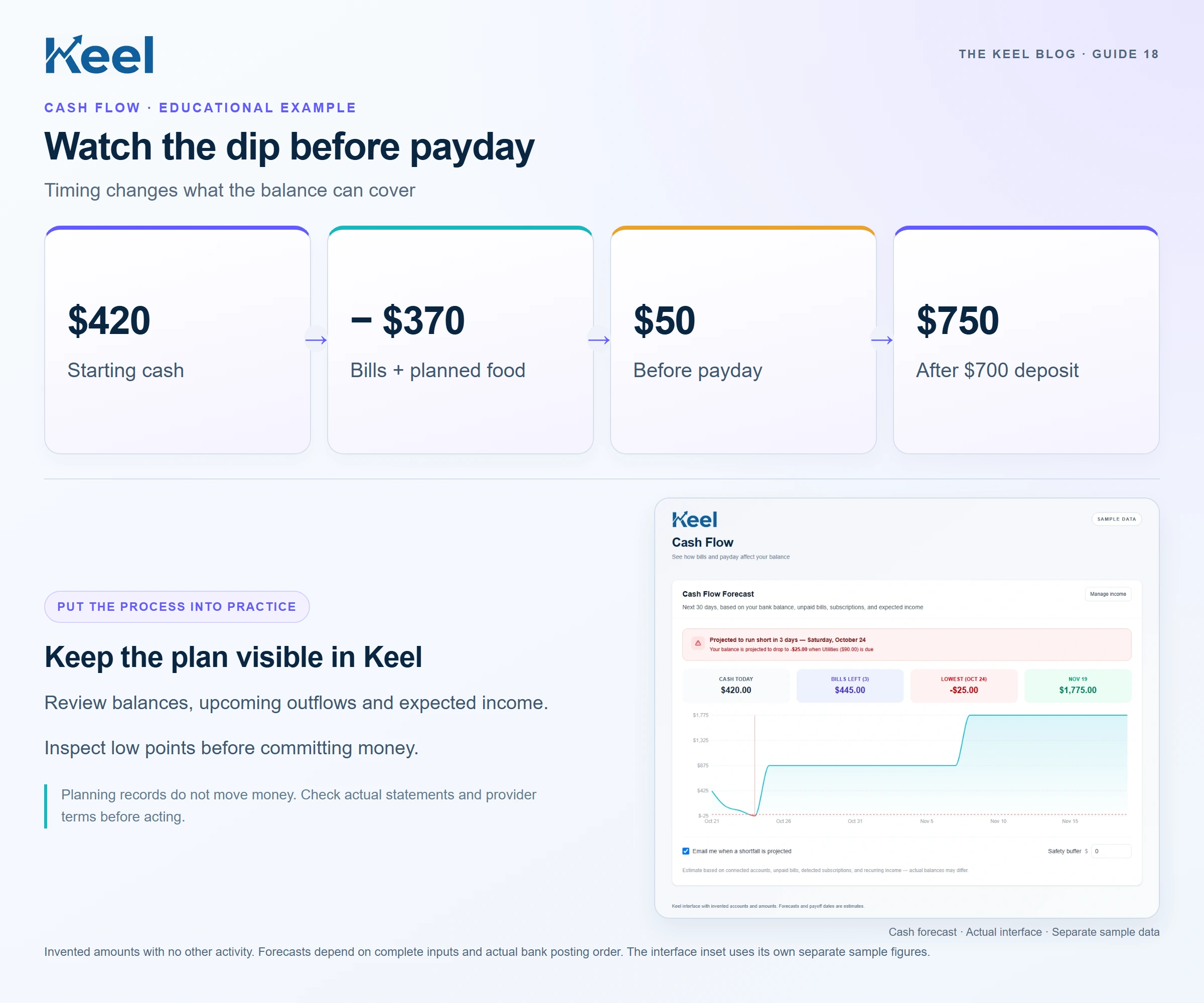
Suppose an invented account starts with $420. Before payday it needs $200 for a bill, $90 for utilities and $80 for planned food. That leaves $50. A later $700 deposit brings it to $750, assuming no other activity. The final amount looks comfortable, but it does not help if an additional earlier charge exceeds the $50 low point. A forecast should draw your attention to that gap between payment timing and income timing.
| Event | Change | Balance |
|---|---|---|
| Starting cash | $420 | |
| Bill | −$200 | $220 |
| Utilities | −$90 | $130 |
| Planned food | −$80 | $50 |
| Later deposit | +$700 | $750 |
Add costs that do not arrive as bills
A calendar can look complete while omitting groceries, transport, variable utilities or a subscription not yet identified. Include realistic allowances and verify that each obligation is represented once. A detected recurring charge, a manual bill and an installment entry can refer to the same future payment. Also consider pending transactions and provider balance definitions. A displayed available balance may already reflect some holds; avoid subtracting the same hold again without checking how the account reports it.
Use Keel’s two views together
In Bills, Keel’s calendar shows due dates and payment status. The cash forecast combines current cash, upcoming outflows and expected income to estimate future balances. The calendar itself does not plot a bank-balance line or turn expected income into received cash. Review the projected low point and the obligations around it before committing extra debt payments. Check the assumptions if the result looks surprising; an estimate is only as useful as the account, bill and income information feeding it.
Change timing only when the change is real
Possible actions include reducing a flexible expense, holding back an optional payment or asking a provider whether a due date can move. Ask when the change takes effect and whether fees or a different first billing period apply. Keep the current due date in your plan until approval is confirmed. Update Keel afterward and review the new low point. Moving dates may reduce a temporary dip, but it does not fix a recurring situation where expenses exceed income.
Recheck before payday and after important changes
Review the calendar and forecast weekly, after a large unexpected charge and when an expected deposit changes. Leave a realistic buffer for uncertainty rather than treating a projected balance of exactly zero as comfortable. Same-day posting order and bank availability can differ from your assumptions. Keel cannot guarantee overdraft prevention or change the bank’s rules. The practical habit is to notice a likely dip early enough to investigate an affordable, confirmed response.[3]
Footnotes and sources
U.S. consumer education. Sources checked . General education, not an individual financial or legal recommendation.