
Debt snowball vs. avalanche: choose a repayment order
Both methods organize extra payments. Their difference is which debt gets that extra money first.
By Keel · Debt planning ·
Free 7-day trial. No card required. Subscribe for $4.99/month to continue; no charge unless you subscribe.
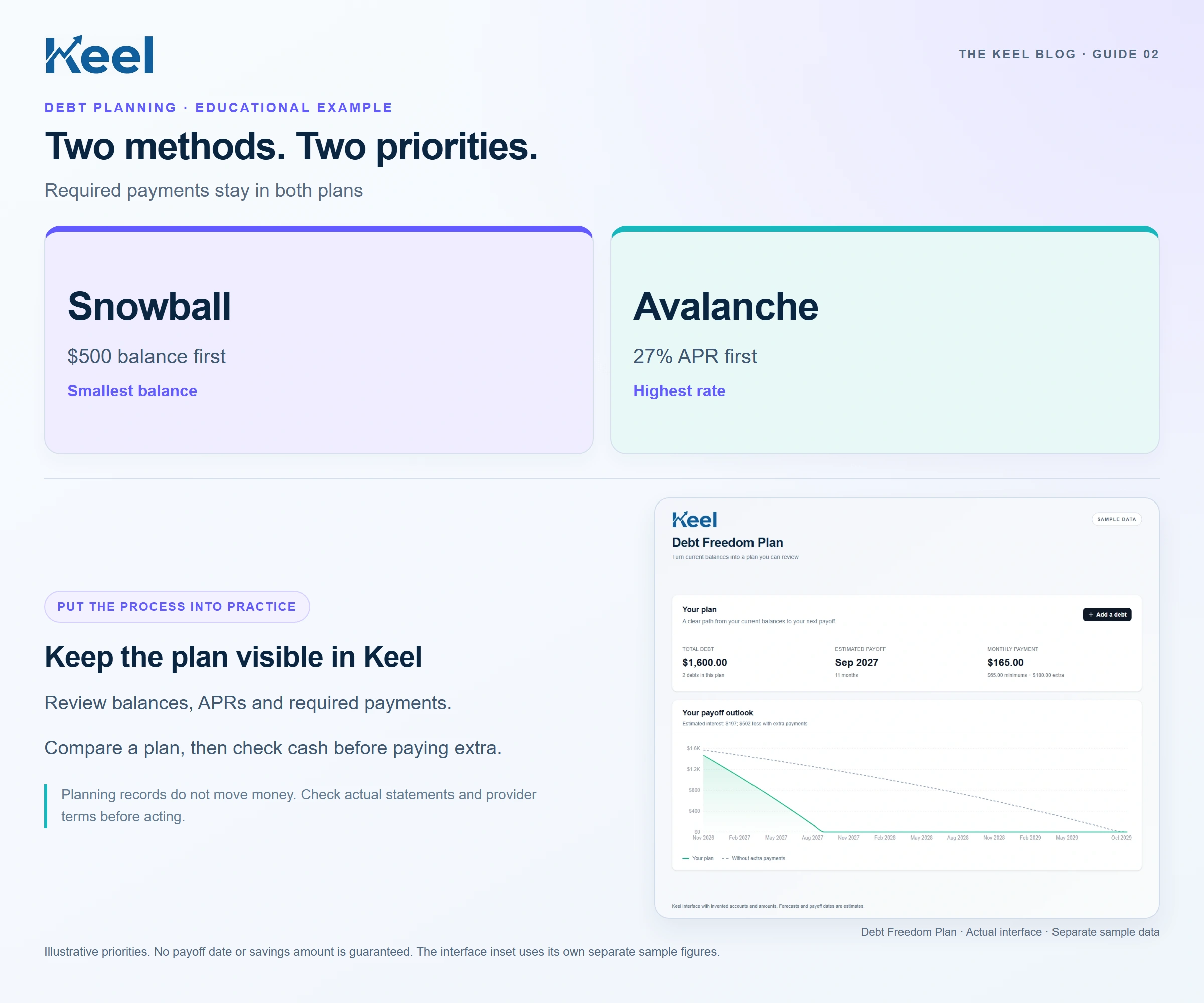
What the snowball method does
Make required payments on each account, then put the available extra amount toward the smallest balance in your chosen debt group. When that debt is cleared, direct its freed payment toward the next balance. The purpose is visible progress: one fewer account may make the next month easier to organize. The CFPB describes this approach alongside the highest-interest method. A small balance is not necessarily the cheapest debt, so the order can involve an interest trade-off. Do not mistake paying a monthly bill for clearing the full balance.[1]
What the avalanche method does
Keep required payments on the other accounts and direct extra money to the debt with the highest APR. When it is cleared, move to the next-highest rate. With the same payment budget, fixed rates and otherwise comparable assumptions, attacking higher-rate debt generally reduces interest. Real accounts add complications: promotional terms, fees, new borrowing and different payment timing can change the comparison. A debt that threatens housing or essential transport is also not just another APR ranking. Stabilize urgent obligations before optimizing a mathematical ordering.[2]
Compare the same invented debts
Imagine Card A has a $500 balance at 18% APR and a $25 minimum. Card B has a $2,000 balance at 27% APR and a $60 minimum. An extra $100 means a total planned payment budget of $185. Snowball initially directs $125 to A and $60 to B. Avalanche initially directs $25 to A and $160 to B. The example shows allocation only; it does not simulate changing minimums or quote total interest.
| Method | Card A | Card B |
|---|---|---|
| Required payments only | $25 | $60 |
| Snowball with $100 extra | $125 | $60 |
| Avalanche with $100 extra | $25 | $160 |
Use a decision rule you can sustain
Write down the extra amount you can fund without disrupting bills and a reserve you have chosen to keep. Then ask which ordering you are likely to maintain, what the estimated interest difference is, and whether either account has special terms. A hybrid decision can be reasonable, but describe it honestly instead of claiming it always beats both methods. If you clear a small balance first for simplicity, decide what happens to that freed payment before it disappears into unrelated spending. Revisit the order when rates, income or required payments change.
Compare both methods in Keel
Open Debt and confirm each balance, APR and minimum from current lender information. Review any rate that Keel marks as estimated or needing attention. Preview the repayment strategy and extra amount, compare the resulting outlook and apply the plan you choose. Read the cash forecast alongside the debt preview so an extra payment does not create an upcoming dip. The projection is a model, not a lender payoff quote. Keel records your plan; payments still happen through your lender or payment provider.
Check the assumptions every month
After payments post, update from the actual lender balance rather than subtracting the payment yourself. Interest and purchases may have changed the result. Keep the debt inventory complete and avoid listing a manual account again after connecting its bank. A strategy is working when it guides repeatable payments and helps you understand the result, not when a chart stays identical forever. If required payments are unaffordable, seek a hardship arrangement or reputable counseling; changing the ordering of extra payments does not solve a missing minimum-payment budget.
Footnotes and sources
U.S. consumer education. Sources checked . General education, not an individual financial or legal recommendation.