
Use the 50/30/20 rule as a starting point
A percentage rule can start a useful conversation. Your actual obligations decide whether the first draft works.
By Keel · Budgeting ·
Free 7-day trial. No card required. Subscribe for $4.99/month to continue; no charge unless you subscribe.
Start with the money you can actually allocate
The familiar rule divides take-home income into needs, wants, and saving or debt reduction. The CFPB presents this kind of spending rule as a guideline people can adapt to their circumstances. Start with income after payroll deductions rather than gross salary. If pay varies, use a realistic baseline and inspect the timing of individual deposits. A percentage of an optimistic future income figure can produce a neat-looking budget that cannot pay the next bill.[1]
Define each bucket before sorting purchases
Needs generally include essential housing, food, utilities and transportation. Wants are discretionary choices. Saving and debt reduction support future financial stability. Real expenses can contain both essential and optional elements: a basic transport need and a premium upgrade are different decisions. Pick a consistent treatment for required debt payments and additional principal, document it, and count each dollar once. The point is to understand tradeoffs, not to make the labels look favorable by moving the same payment between buckets.
Try an example before changing your budget
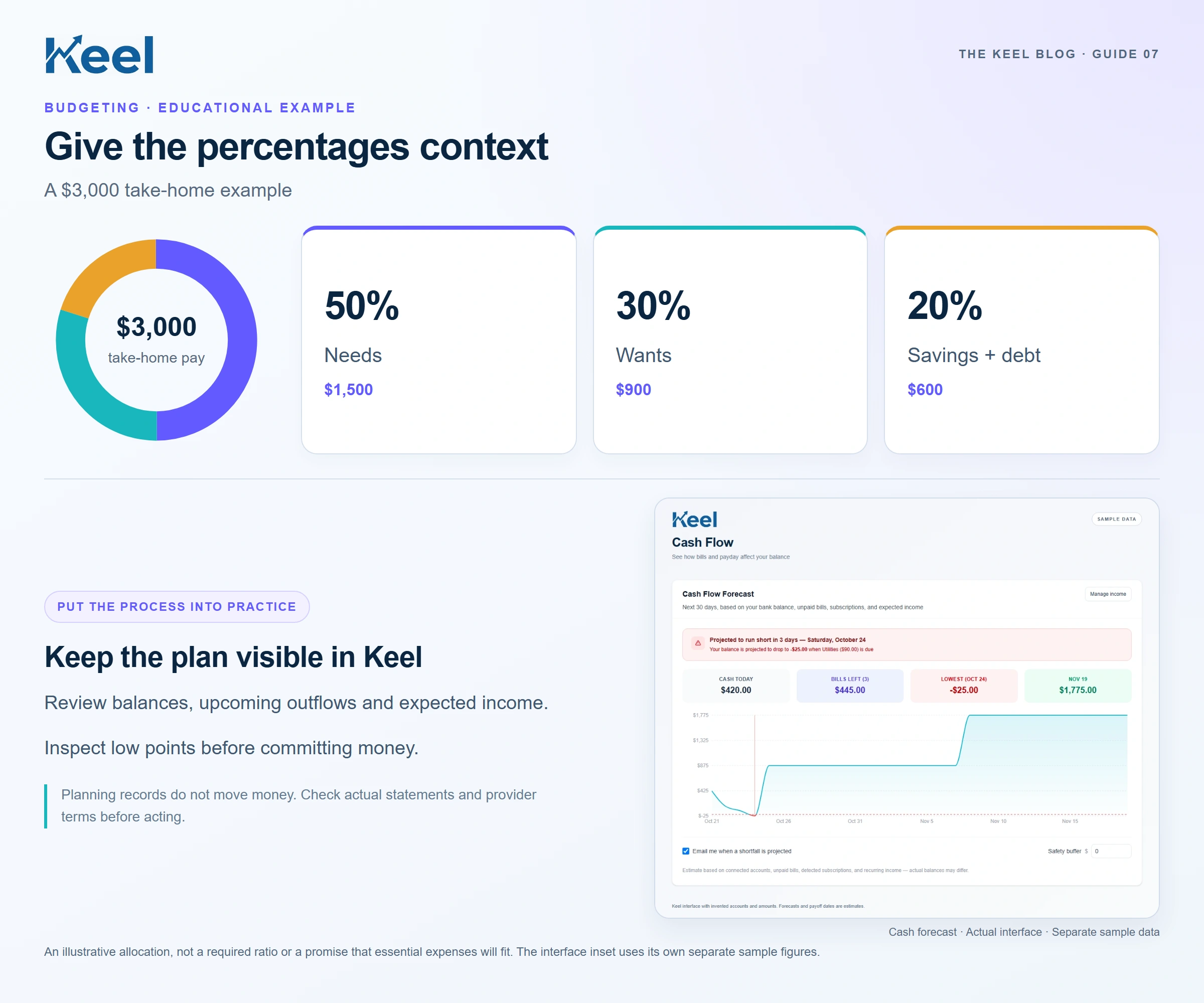
With invented monthly take-home pay of $3,000, 50% is $1,500, 30% is $900 and 20% is $600. Together the allocations use the full $3,000. The $600 bucket is shared across its purposes; it does not mean $600 for saving plus another $600 for extra debt. If essential costs already total $1,950, the needs share is 65%. That is information about a constraint, not proof that you failed a financial rule.
| Purpose | Share | Amount |
|---|---|---|
| Needs | 50% | $1,500 |
| Wants | 30% | $900 |
| Savings and debt reduction | 20% | $600 |
| Total | 100% | $3,000 |
Adapt the rule to real constraints
Write an achievable version using actual housing costs, dependents, medical needs and required payments. A high essential-cost share may require a smaller discretionary allowance or longer-term changes; renaming essential spending does not create cash. If basic obligations exceed income, move to a bill-priority and hardship process rather than forcing percentages. Revisit the allocation when income or obligations change. A useful rule should guide an affordable action this month, even if the result looks different from a popular template.[2]
Review category budgets in Keel
Use Keel to review transaction categories and set category budgets that reflect your chosen plan. Check unclear classifications before interpreting the totals. Keel does not automatically determine which expenses are needs or apply a universal 50/30/20 allocation for you. Keep bank cash outflows and separate card activity in their proper context so a purchase and its later card payment are not treated as two versions of the same budget decision.
Check whether the plan survives the calendar
A monthly allocation still needs a date-by-date check. Review Bills for upcoming obligations and use the cash forecast with current balances and expected income to look for low points. Leave room for ordinary spending that has not yet become a bill or transaction. At the end of the month, compare the plan with actual activity and choose one adjustment. Judge the rule by whether it helps you cover obligations and make progress, rather than by perfect percentages.
Footnotes and sources
U.S. consumer education. Sources checked . General education, not an individual financial or legal recommendation.