
Audit Your Debt Statements Before Making a Plan
Build one reliable debt list from current statements, separate balances from payments and resolve unclear accounts before choosing a payoff order.
By Keel · Debt planning ·
Free 7-day trial. No card required. Subscribe for $4.99/month to continue; no charge unless you subscribe.
Gather documents for the same review date
Collect statements or lender account pages for cards, loans and installment plans. A debt inventory needs the balance, rate, payment and date; the CFPB debt-action worksheet provides a useful starting structure. Mark the date of each balance. A figure from six weeks ago and one from today should not be compared as though they describe the same moment.[1]
Resolve similar names before adding totals
Two cards from one institution may be separate debts. A manual record and a newly connected account may describe one obligation. Compare account endings and provider records, then investigate uncertainty. Never delete a legitimate account merely because its amount matches another. For disputed collection claims, verify the claim through the appropriate process before treating an app record as proof.[2]
Separate the stock from the monthly flow
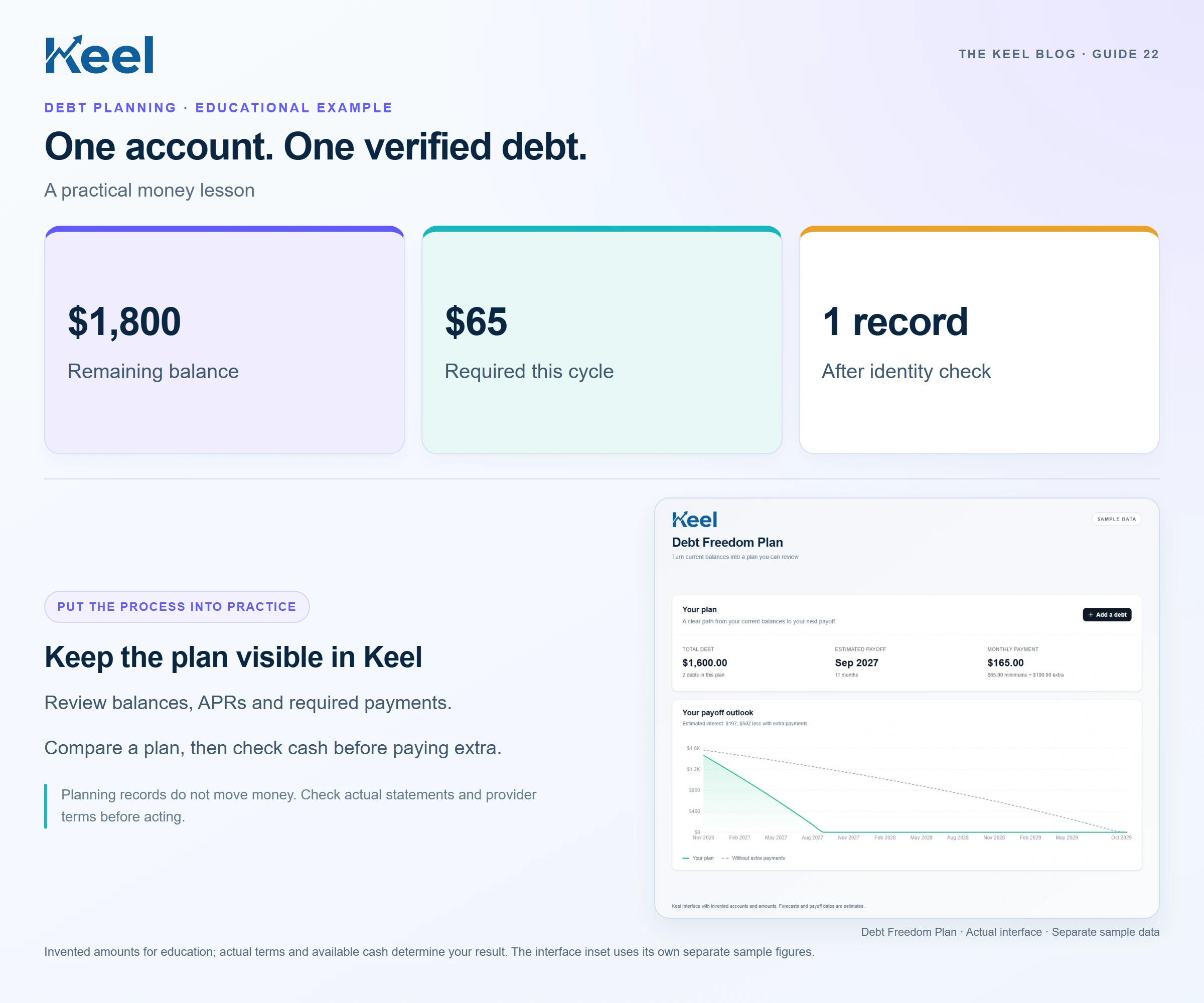
An invented card balance of $1,800 with $65 due this cycle represents $1,800 of remaining debt and a $65 payment requirement. Adding them together would overstate the debt as $1,865. The payment may include interest and fees, so subtracting it from the old balance is also not a substitute for reading the next statement.
| Figure | Meaning |
|---|---|
| $1,800 | Remaining debt balance |
| $65 | Required payment this cycle |
Review the inventory in Keel
Open Debt and compare each entry with lender information. Correct the balance, APR and required payment where needed. Review Accounts when identifying connected cards, and compare manual entries carefully. Keel can organize the list and estimate a repayment path from its inputs. It cannot certify a creditor’s legal claim or turn a stale balance into an official payoff quote.
Set a reconciliation checkpoint
Keep a short list of unresolved questions and obtain the missing statement or provider explanation. Recheck after payments post, a rate changes or an account is transferred. Only then compare strategies using the same debt list. This audit is useful even without extra cash: it stops a planning decision from being based on a duplicated account or an estimated rate treated as confirmed.
Footnotes and sources
U.S. consumer education. Sources checked . General education, not an individual financial or legal recommendation.