
Automate Savings Without Ignoring Cash Timing
Choose a safe transfer amount and schedule with your bank, check what happens around payday and use Keel to record the savings that actually arrive.
By Keel · Savings ·
Free 7-day trial. No card required. Subscribe for $4.99/month to continue; no charge unless you subscribe.
Use automation to support a decision
A scheduled transfer can make a chosen habit easier to repeat, but the amount should come from a realistic plan. FDIC savings guidance describes setting aside affordable amounts consistently. Automation does not make a contribution affordable by itself, and a fixed debit may be a poor fit when income dates or amounts are uncertain.[1]
Check the provider’s mechanics
Find out whether the bank supports recurring transfers or your employer supports split direct deposit. Check timing, fees, availability and how to stop or change instructions. A deposit date is not always the moment every dollar becomes withdrawable. Keep sufficient money for other debits; automatic financial activity can create fees if the account is short.[2] [3]
Test a modest first amount
An invented $30 transfer every payday across twenty-six paydays contributes $780 over that schedule, before interest or withdrawals. Twice-monthly pay would produce twenty-four transfers, or $720. Count your actual calendar rather than using the wrong frequency. Start at an amount that can survive a normal pay period, not only an unusually cheap week.
| Schedule | Contributions |
|---|---|
| 26 × $30 | $780 |
| 24 × $30 | $720 |
Use Keel for the planning check
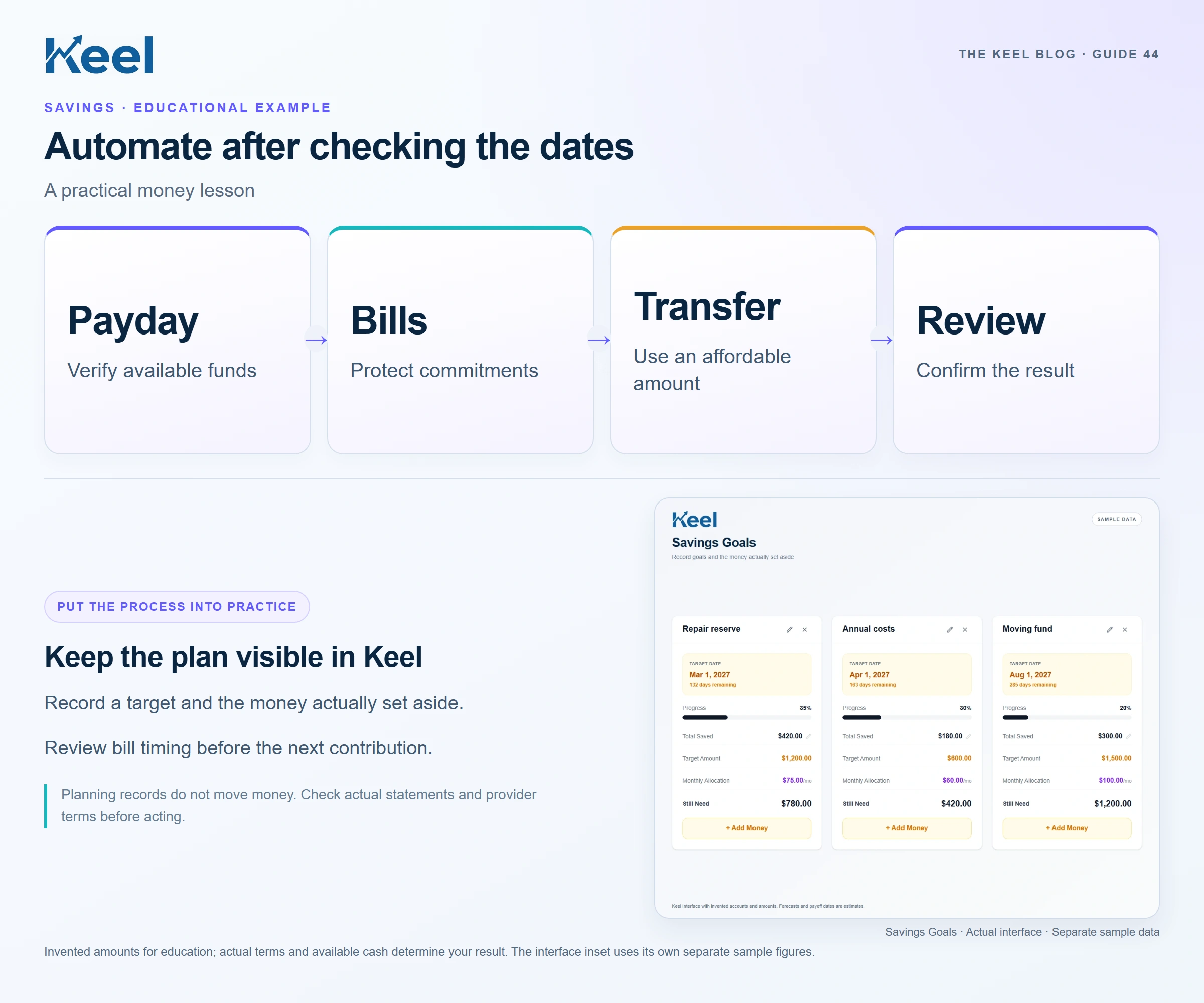
Review Bills and the cash forecast before choosing a bank transfer schedule. Record funded progress in Savings after the provider completes the transfer. Keel’s savings allocation and Add Money record do not initiate a bank transfer. If the cash is already in the balance, do not also add it as a new future deposit to make the forecast appear stronger.
Review after a changed paycheck
Check the first transfers, then revisit the amount after a pay cut, new bill or account change. Confirm the cancellation of obsolete instructions through the provider. Keep a realistic buffer instead of relying on the transfer landing in a particular order on a busy banking day. A useful automation remains adjustable when the underlying cash plan changes.
Footnotes and sources
U.S. consumer education. Sources checked . General education, not an individual financial or legal recommendation.