
Check the full cost before moving a card balance
A lower promotional rate can help, but fees, the deadline and your actual payment capacity decide whether the plan fits.
By Keel · Debt planning ·
Free 7-day trial. No card required. Subscribe for $4.99/month to continue; no charge unless you subscribe.
Read the offer as a set of conditions
A balance transfer moves an existing balance to another credit account. Look beyond the headline rate: check the transfer fee, eligibility, credit limit, deadline to complete the transfer, promotional end date, later APR and consequences of missed payments. The CFPB notes that consolidation and promotional offers can include costs or terms that change the apparent benefit. Approval, a sufficient limit and the ability to transfer a specific balance are not guaranteed.[1]
Calculate a fee-inclusive payoff target
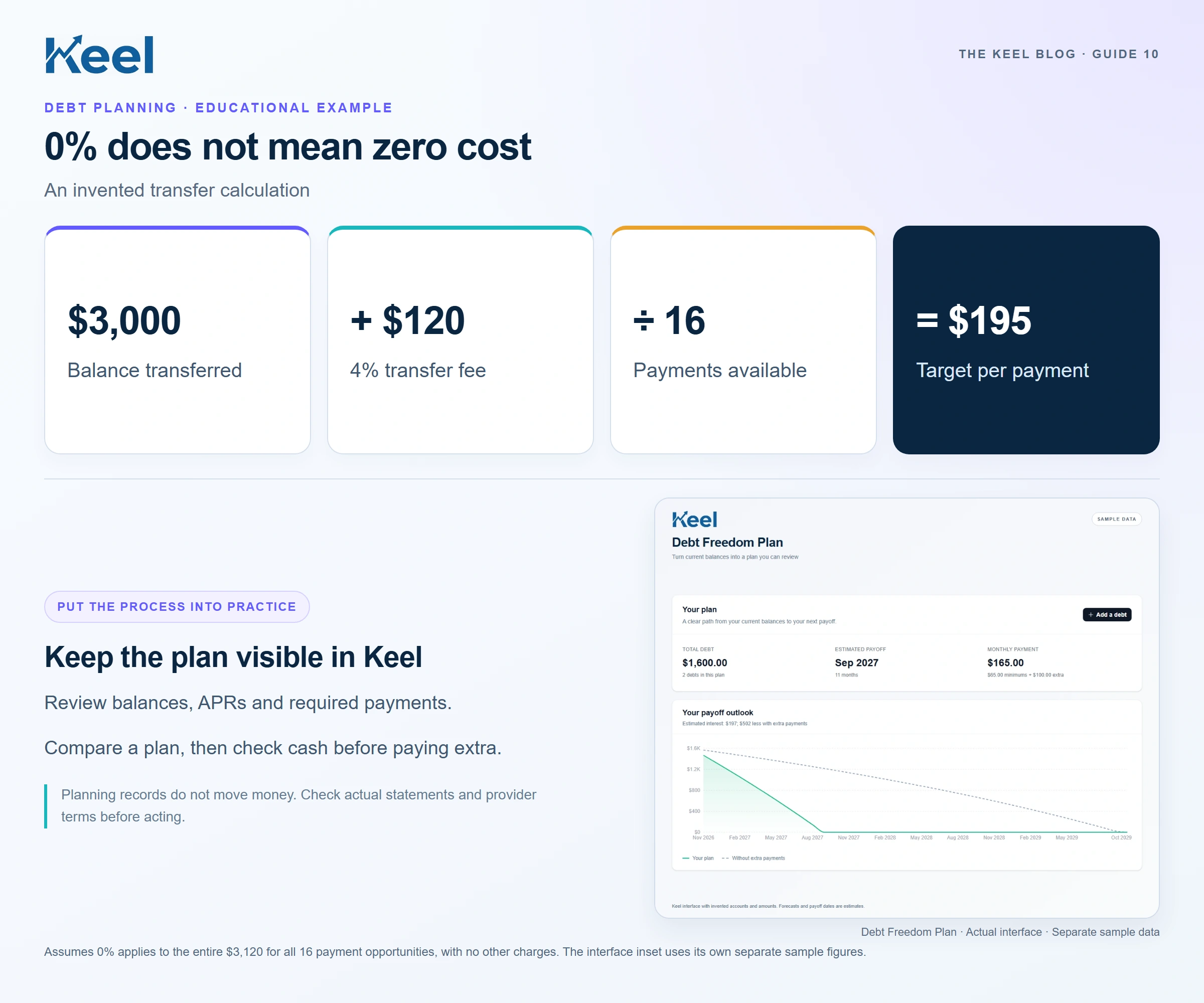
In an invented offer, transferring $3,000 at a 4% fee adds $120. If the full $3,120 receives 0% for sixteen payment opportunities, paying $195 each time would clear it within that period. This assumes no new charges, no other fees and every payment being received as planned. Count actual payment opportunities before the promotion ends; sixteen months on an advertisement does not necessarily mean sixteen full payments remain after a late transfer.
| Step | Amount |
|---|---|
| Transferred balance | $3,000 |
| Fee: $3,000 × 4% | $120 |
| Balance including fee | $3,120 |
| Sixteen equal payments | $195 each |
Check purchases and the end of the promotion
A promotional transfer rate may not apply to new purchases. The CFPB warns that carrying a transferred balance can affect the grace period on purchases, so new purchases may accrue interest even while the transferred balance has a low rate. Also distinguish a 0% APR offer from deferred-interest financing; the terms and consequences differ. Read the actual agreement rather than assuming all promotions behave alike or that a transfer makes every charge interest-free.[2]
Test affordability before comparing savings
Compare the fee-inclusive payment target with essentials, required payments on other debts and a cash reserve. A transfer that requires $195 each period is fragile if only $100 is reliably available. Model what happens to the remaining balance at the post-promotion APR and whether a different payment plan is needed. A minimum payment can be lower than the amount needed to finish before expiry. Keep paying the original issuer until you confirm the transfer and remaining amount due.
Record the real terms in Keel
After a confirmed transfer, review both account balances and update the debt plan using actual terms. Record the promotion end date and later rate in your own notes and review reminders, and place required bill dates in Bills. Compare snowball and avalanche previews with accurate inputs. Keel’s general payoff estimate does not reproduce every issuer promotion, fee or payment-allocation rule, so keep a separate check of the offer-specific deadline and target.
Verify the transfer instead of counting it twice
A transfer changes where a debt sits; it does not itself erase principal. Verify the old account’s remaining balance, any residual interest and the new account’s fee. Review subsequent statements and keep required payment arrangements current. Check the cash forecast before adding extra payments. If the plan relies on another future promotional offer to work, recognize that approval and terms may change rather than treating repeated transfers as a guaranteed exit.
Footnotes and sources
U.S. consumer education. Sources checked . General education, not an individual financial or legal recommendation.