
The Math Behind Biweekly Loan Payments
Understand why twenty-six half-payments differ from two payments per month, and check the lender’s rules before adopting a biweekly plan.
By Keel · Debt planning ·
Free 7-day trial. No card required. Subscribe for $4.99/month to continue; no charge unless you subscribe.
Count payments rather than relying on a label
A biweekly payment happens every two weeks. Twice monthly commonly means twenty-four payments each year; biweekly commonly means twenty-six. A marketing claim about faster payoff may rely on those additional dollars. Compare both the total payment amount and when principal is credited before attributing the result to frequency alone.
Ask how your servicer handles the arrangement
Confirm whether half-payments satisfy the contract, whether funds are held until a full payment arrives and whether there are program fees. Check prepayment terms too. CFPB guidance directs borrowers to verify how payments reach principal. Paying a third party to split payments is not automatically better than a lender-supported method.[1] [2]
Work through the annual difference
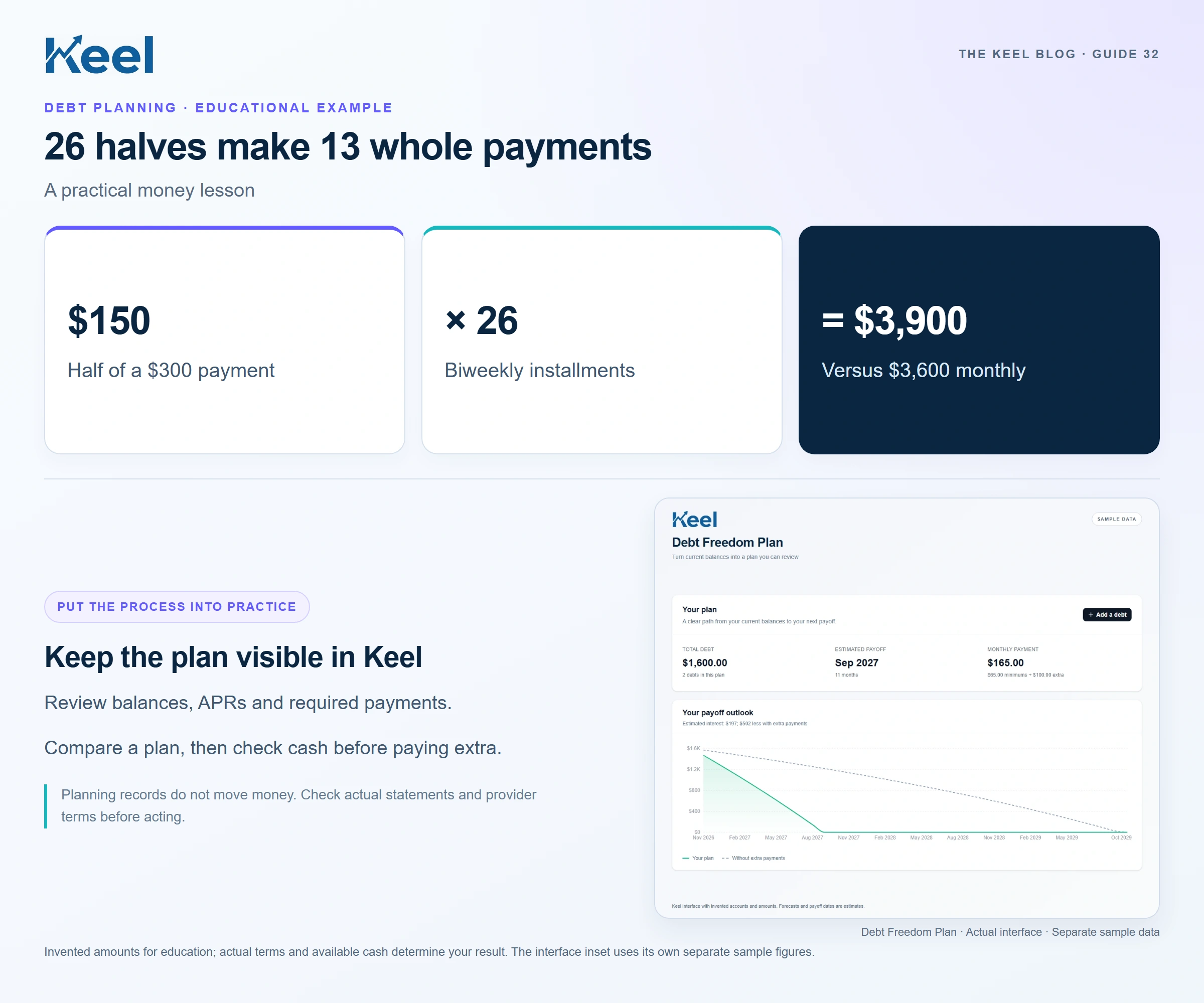
For an invented $300 monthly obligation, twelve payments total $3,600. Twenty-six half-payments of $150 total $3,900, equivalent to thirteen full $300 payments. The additional contribution is $300 per year. This calculation excludes interest and servicing costs; it does not establish a guaranteed payoff date.
| Schedule | Total |
|---|---|
| 12 × $300 | $3,600 |
| 24 × $150 | $3,600 |
| 26 × $150 | $3,900 |
| Additional annual dollars | $300 |
Check the added commitment in Keel
Use Budgets to test the extra annual contribution and Bills to keep contractual deadlines visible. Inspect the forecast before the payment dates you actually authorize. Keel’s calendar is not a biweekly payment-processing service. If individual dates need tracking, record them accurately and avoid duplicating an existing obligation.
Verify the first two billing cycles
Check the lender’s payment history and remaining amount due, especially when the new schedule begins midway through a month. Make sure a required payment has not been missed during the transition. Keep enough flexibility for three-debit months. A repayment routine should be understandable and affordable before it is described as an acceleration strategy.
Footnotes and sources
U.S. consumer education. Sources checked . General education, not an individual financial or legal recommendation.