
Give a Pay Raise a Job Before Lifestyle Costs Grow
Use the actual change in take-home pay to revise bills, savings and debt payments without committing the gross raise more than once.
By Keel · Budgeting ·
Free 7-day trial. No card required. Subscribe for $4.99/month to continue; no charge unless you subscribe.
Confirm what changed in take-home pay
A raise in gross salary does not necessarily produce the same percentage increase in the deposit. Taxes, benefits and payroll choices can affect net pay. The CFPB’s paycheck guidance distinguishes earnings from deductions. Use an actual new pay stub before increasing commitments, and confirm whether the first deposit contains one-time adjustments.[1]
Decide which pressure the raise should relieve
Review underfunded essentials, reserves and high-cost debt before adding fixed lifestyle costs. A deliberate increase in enjoyment may also fit, but it competes with other uses. Choose the priorities while the money is still unassigned. A budget is most useful when new income changes a real constraint rather than disappearing into several informal promises.[2]
Allocate a modest example
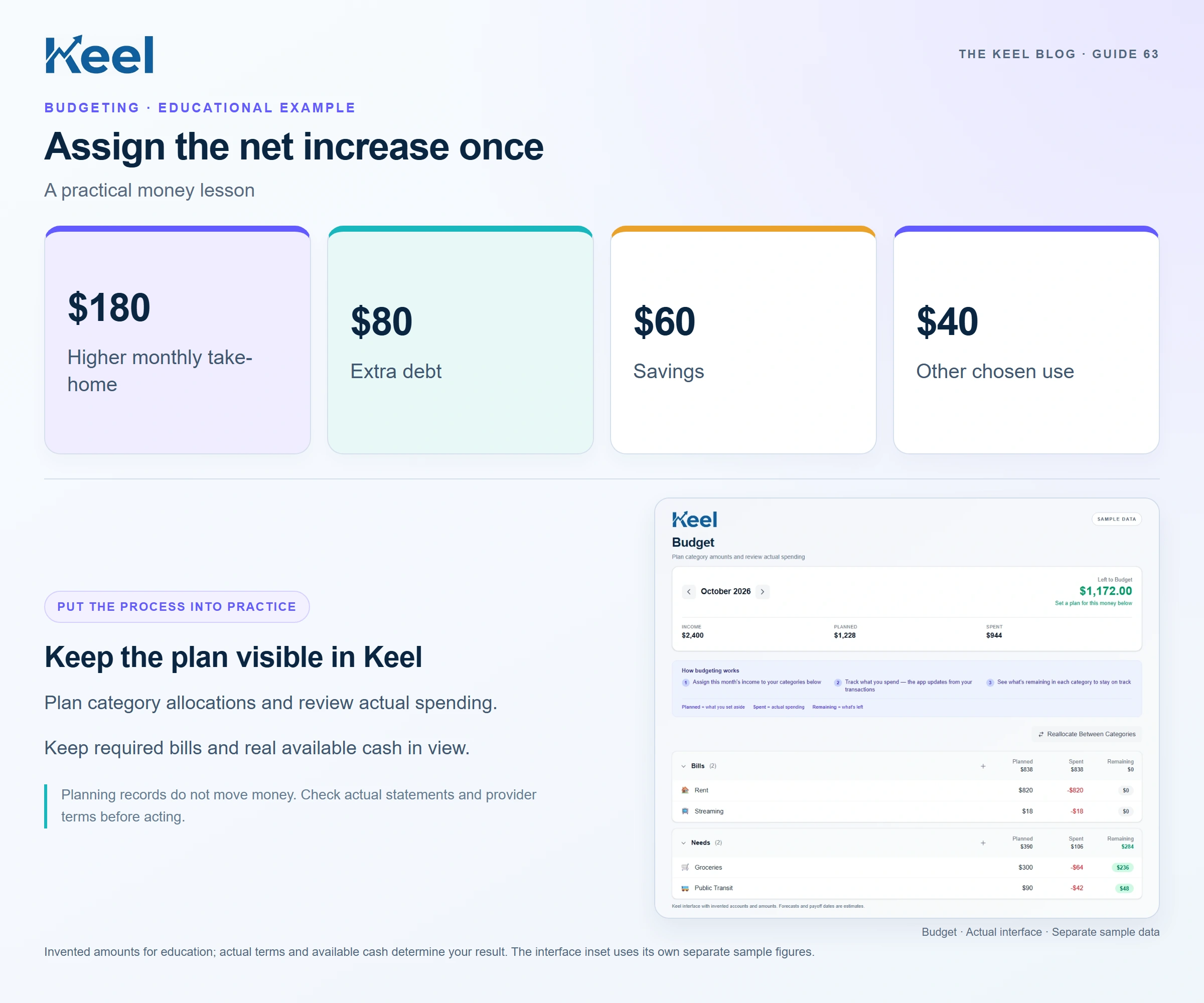
An invented net increase of $180 could be assigned as $80 extra debt, $60 savings and $40 for another purpose. The parts total $180. The example is not a recommended split and does not establish affordability if costs also rose. Avoid telling each goal it can receive the entire increase.
| Purpose | Amount |
|---|---|
| Extra debt payment | $80 |
| Savings | $60 |
| Other use | $40 |
| Total increase assigned | $180 |
Review the new plan in Keel
Adjust category budgets and expected income to match confirmed pay. Preview an affordable extra payment in Debt, record funded Savings contributions and inspect the forecast around bill dates. Keel does not read a pay stub to choose an allocation or automatically move the raise into goals. Verify actual deposits and transfers.
Recheck after two normal cycles
Compare the new plan with actual spending before signing a larger recurring contract. Keep future raises out of today’s affordability calculation. If the increase mainly covers essential inflation or changed benefits, recognize that honestly rather than forcing a progress claim. The useful result is a plan that reflects the new net amount and your chosen priorities.
Footnotes and sources
U.S. consumer education. Sources checked . General education, not an individual financial or legal recommendation.