
Budget around irregular income without spending it early
A good average month does not guarantee enough cash on the day a bill is due.
By Keel · Budgeting ·
Free 7-day trial. No card required. Subscribe for $4.99/month to continue; no charge unless you subscribe.
Build a history before choosing a baseline
List take-home deposits over enough months to see ordinary variation, quieter periods and one-off payments. Consumer.gov suggests using annual income to estimate a monthly average when pay does not arrive monthly. That average is a reference, not a safe spending limit for every week. Separate unusual windfalls from ongoing work and record gross business receipts differently from money actually available for personal spending. If taxes or business expenses apply, the amount you can spend may be lower than a deposit appears; get appropriate tax guidance for your circumstances.[2]
Write an essential-cost baseline
List the minimum realistic cost of housing, food, utilities, transport and required obligations. Include less frequent essentials and avoid calling every expense fixed simply because it recurs. Compare that baseline with both a lower-income month and an average month. If the baseline routinely exceeds lower-month income, identify what must change or what reserve would cover the gap. Treat this as a problem to solve, not a reason to hide expenses from the budget. An optimistic revenue target cannot pay an already scheduled bill.[1]
See the difference between an average and a cash gap
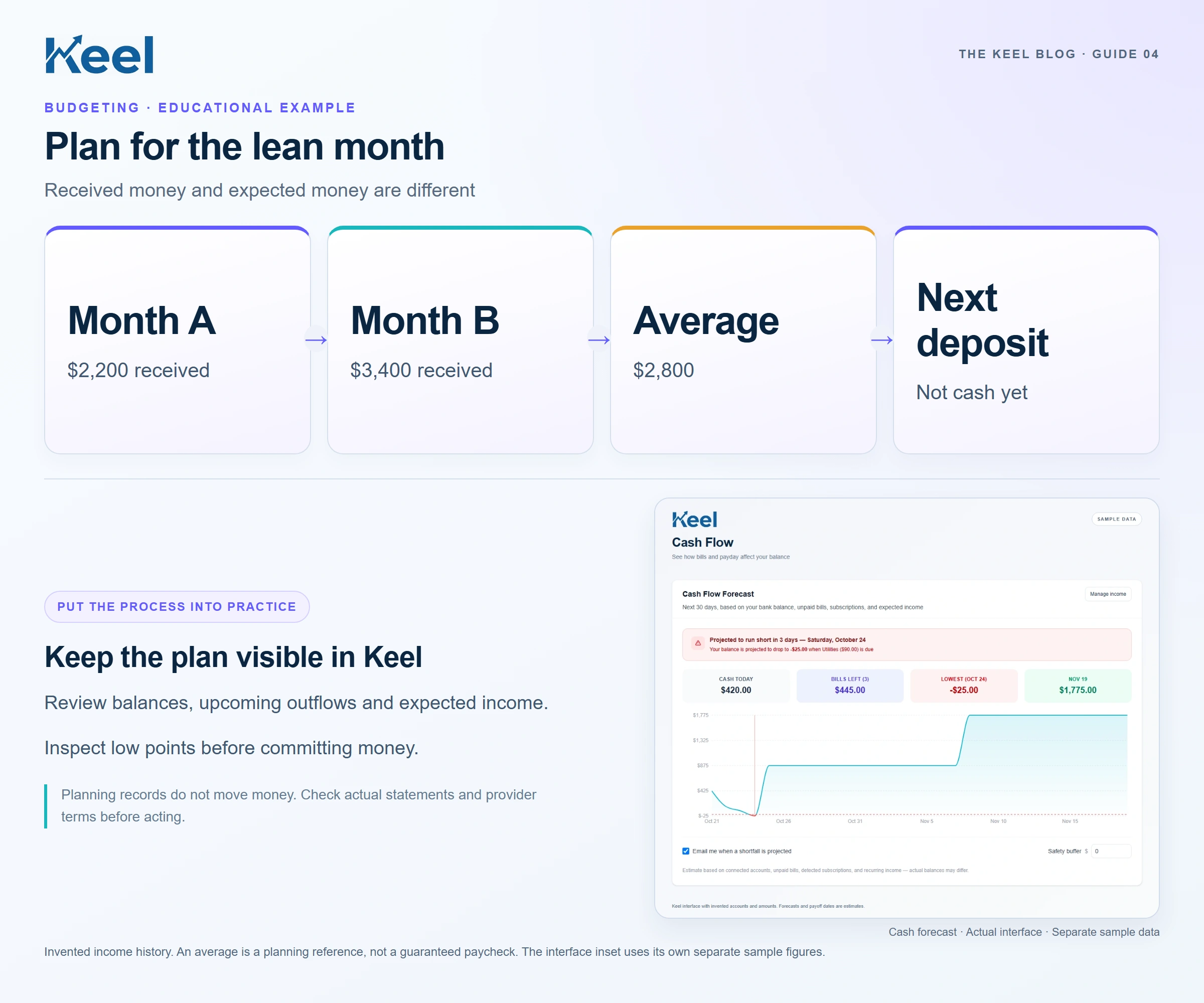
Suppose an invented household receives $2,200 one month and $3,400 the next. The average is $2,800. If the next month resembles the $2,200 month and committed spending is $2,500, the average does not remove the $300 gap. A reserve built in a stronger month could help bridge it, but only if it actually exists and is not already assigned elsewhere.
| Reference | Amount |
|---|---|
| Month A received | $2,200 |
| Month B received | $3,400 |
| Two-month average | $2,800 |
| Example low-month spending plan | $2,500 |
| Gap against Month A | $300 |
Give deposits a funding order
When money arrives, review what is due before the next likely deposit, then fund essential costs, required payments and reserves you have chosen. Add flexible spending only after seeing the remaining amount. This is a planning order, not a universal legal priority list. If a deposit is uncertain, make a lower-income version of the plan instead of using the same optimistic date repeatedly. Keep a written record of which obligations a reserve covers so a healthy account balance does not become an accidental invitation to spend it twice.[3]
Use Keel’s calendar and forecast together
In Bills, review the dates with the largest clusters of obligations. Review expected income separately and update its amount and date when circumstances change. Use the forecast to inspect the low point between those events. Keel’s calendar is a bill calendar; it does not turn an unpaid invoice into cash or guarantee that a deposit will clear. Transactions help you review what actually arrived, while category budgets help you compare the plan with spending. Avoid entering the same income both as a new future deposit and as money already included in the starting balance.
Review after each meaningful change
Use a short check after a deposit arrives, an invoice is delayed or a bill changes. Ask what is now funded through the next review date, what remains uncertain and what action is needed. A useful rule is to expand commitments only after the supporting cash exists. You may still need a longer-term earnings or expense change if repeated low months cannot cover essentials. Keel helps keep the dates and amounts visible; it does not guarantee work, collect invoices or decide an appropriate tax reserve for you.
Footnotes and sources
U.S. consumer education. Sources checked . General education, not an individual financial or legal recommendation.