
Calculate a Savings Rate You Can Explain
Define what counts as saving and which income figure you use, then compare consistent periods without confusing transfers with new wealth.
By Keel · Everyday money ·
Free 7-day trial. No card required. Subscribe for $4.99/month to continue; no charge unless you subscribe.
Choose the question the rate should answer
A personal cash-saving rate might compare money added to reserves with take-home income. A broader wealth-building measure might include retirement contributions or principal reduction, under a clearly stated definition. Those are different measures. CFPB savings and budgeting guidance helps plan contributions, but the label alone does not establish which definition a dashboard uses.[1] [2]
Keep transfers and withdrawals consistent
Moving existing savings between two accounts is not a fresh savings contribution. If measuring net additions to a reserve, subtract withdrawals from new contributions. Avoid including the same money in a goal, transfer and retirement line more than once. Keep the time period and income basis consistent when comparing months.
Calculate a transparent example
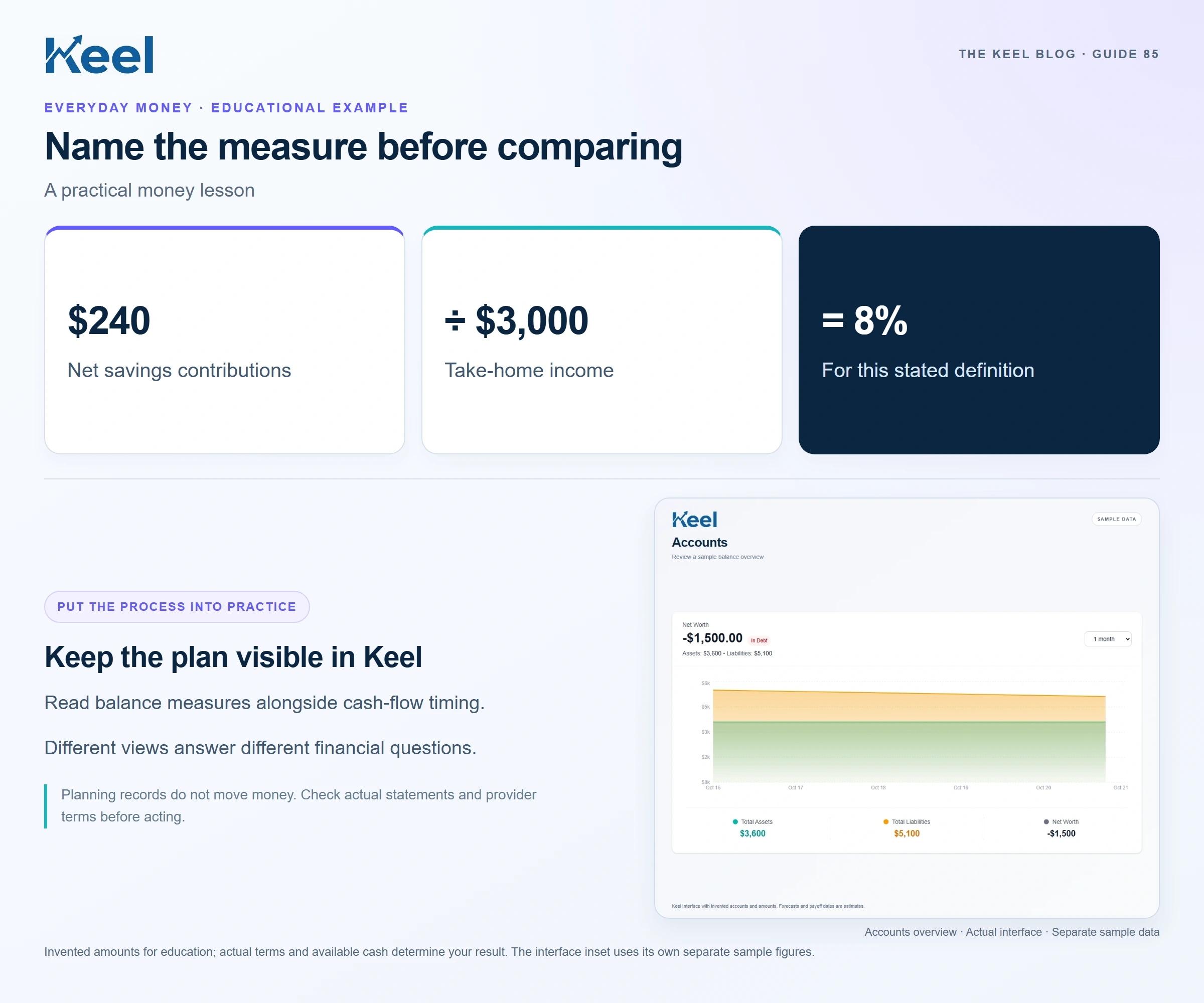
With invented net savings contributions of $240 and take-home income of $3,000, the stated rate is $240 ÷ $3,000 = 8%. If $90 was then withdrawn and the definition uses net additions, the numerator becomes $150 and the rate is 5%. Neither number should be compared with a gross-income retirement rate without explanation.
| Measure | Rate |
|---|---|
| $240 / $3,000 | 8% |
| ($240 − $90) / $3,000 | 5% |
Read Keel’s report labels carefully
Keel’s cash-flow summaries use their defined income and outflow scope; a reported net-savings rate is not automatically the same as the reserve-contribution measure in this example. Use Transactions and Savings records to review the underlying amounts. Keel does not certify a household-wide tax or economic savings rate across assets it does not track.
Use the rate to ask a practical question
Look at why the measure changed: income timing, a necessary withdrawal or a sustained contribution change. A negative period can reflect using money for its planned purpose. Pair the percentage with dollar amounts and reserve access. The useful result is a measure you can explain and a decision it supports, rather than the largest percentage available.
Footnotes and sources
U.S. consumer education. Sources checked . General education, not an individual financial or legal recommendation.