
A Card Purchase and Its Payment Are Different
Separate what you bought from how money moved to repay the card, so spending analysis and bank cash-flow analysis answer the right questions.
By Keel · Everyday money ·
Free 7-day trial. No card required. Subscribe for $4.99/month to continue; no charge unless you subscribe.
Start with the question you are answering
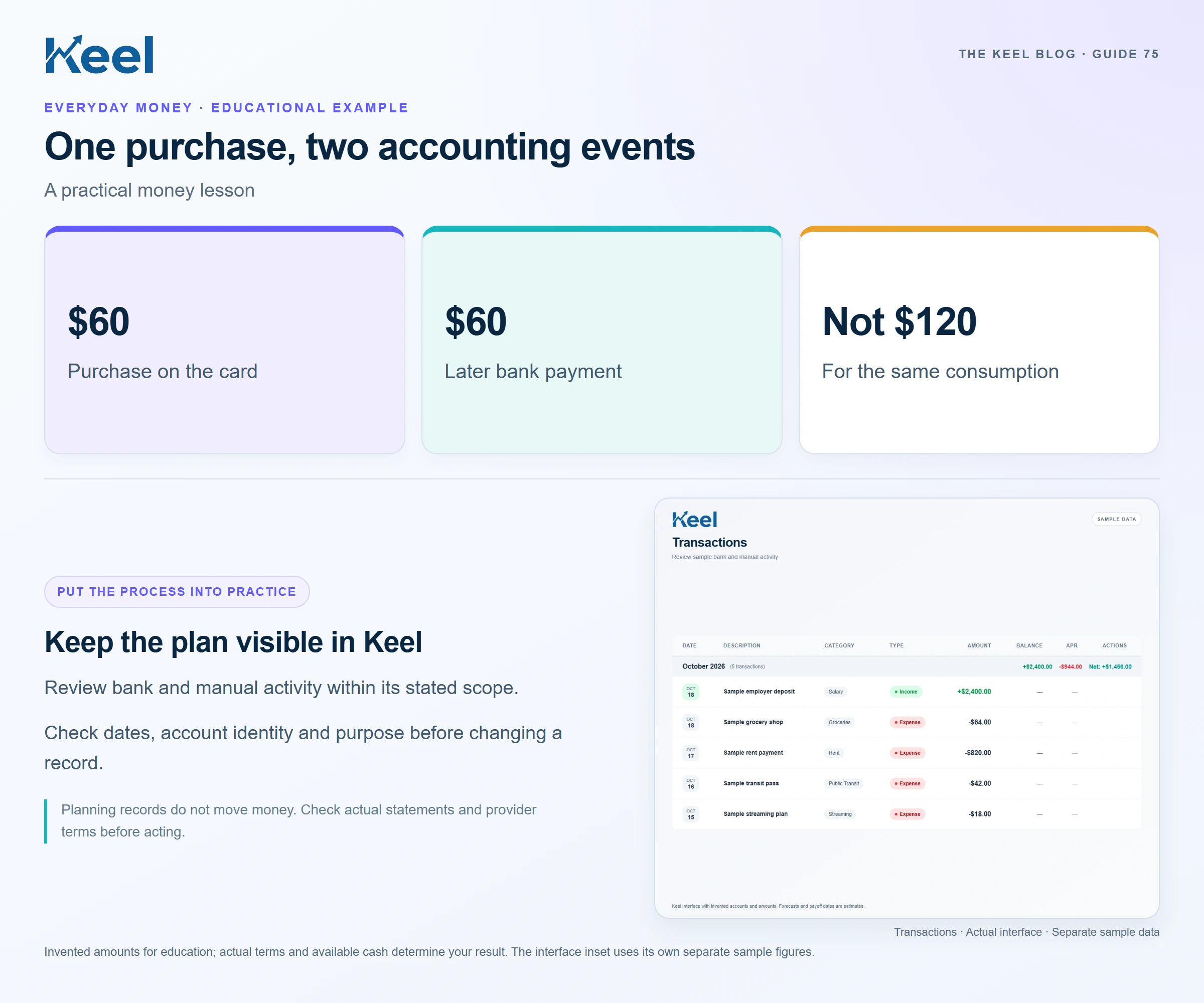
A spending review asks what goods or services were purchased. A bank cash-flow review asks when money entered or left the account. Credit cards separate those dates. The NCUA describes statements as records of charges and required payments. Both views are useful, but adding them without a clear scope can count the same consumption twice.[1]
Follow a simple purchase
An invented $60 card purchase creates $60 of consumption and an amount owed to the card. Paying that $60 from checking later reduces cash and the card obligation, assuming no other interest or fees. It does not create another $60 purchase. A bank outflow total can still correctly include the payment because it measures cash leaving checking.
Keep interest and old balances distinct
A card payment can cover purchases from earlier months, interest or fees. Do not infer this month’s purchases from the full payment amount. Conversely, new card purchases may not leave checking until later. A cash-flow plan needs the required payment date even when your category review is focused on the underlying purchases.[2]
Use Keel’s separate views
Keel shows bank and manual activity in Transactions and supported posted card activity through Accounts. Its bank cash outflows can include card repayments while card purchase activity remains separate from those totals. Read the view’s labels before comparing it with another report. Keel is not claiming that the bank outflow total equals all household consumption across every account.
Review manual entries carefully
If you track a purchase manually and it later imports, identify the same event before adding another entry. Matching dates and amounts alone are insufficient when several purchases look alike. Keep account identity and source records available. The goal is an accurate answer to a defined question, not deleting real activity to make all screens show the same number.
Footnotes and sources
U.S. consumer education. Sources checked . General education, not an individual financial or legal recommendation.