
Track Cash Withdrawals Without Double Counting
Choose a consistent way to track withdrawn cash, distinguish the movement from later purchases and reconcile what remains in your wallet.
By Keel · Everyday money ·
Free 7-day trial. No card required. Subscribe for $4.99/month to continue; no charge unless you subscribe.
Decide what the withdrawal represents
Withdrawing $80 from checking moves money into cash you hold. It does not by itself explain what you bought. For budgeting, you can track the later purchases in detail or use a clearly defined cash allowance. Choose a method consistently. Mixing a fully spent withdrawal category with additional purchase expenses can overstate consumption.
Separate the ATM fee
A provider or ATM operator may charge for the withdrawal even when an account has no monthly fee. CFPB guidance notes that certain fees can remain on a free account. Treat an actual fee as a cost rather than hiding it inside the cash amount. Check provider terms instead of assuming every ATM with a familiar logo is free.[1]
Reconcile the wallet
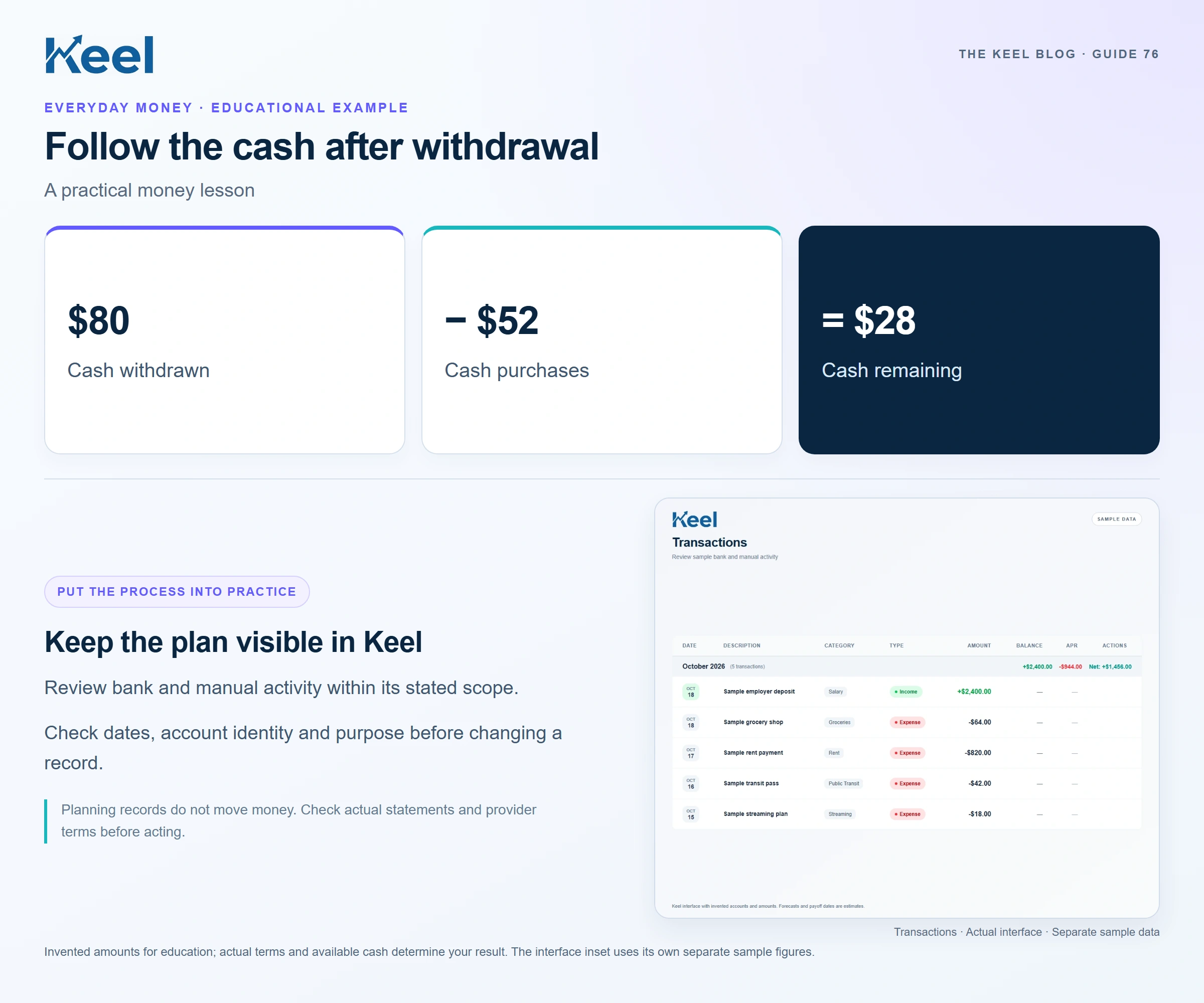
An invented $80 withdrawal followed by $52 of recorded purchases leaves $28 cash. If the wallet contains less, look for a missing purchase or another movement rather than inventing income. A later bank deposit of unused cash is not necessarily earnings. Keep the physical balance and recorded uses consistent.
| Item | Amount |
|---|---|
| Withdrawn | $80 |
| Purchases recorded | −$52 |
| Expected cash left | $28 |
Use Keel without assuming a cash-wallet ledger
Review the bank withdrawal in Transactions and use supported manual transaction entries only under a consistent tracking approach. Do not assume Keel automatically links a withdrawal to later cash purchases or maintains a separate wallet balance. If necessary, keep a small external cash record and use the app’s categories for the resulting budget decisions.[2]
Keep the method manageable
Detailed tracking helps when cash spending is otherwise invisible, but it should be simple enough to maintain. Review weekly and stop recording the same event in two places as spending. The useful result is an honest category total and a known amount of cash remaining, rather than a perfect-looking list that cannot reconcile.
Footnotes and sources
U.S. consumer education. Sources checked . General education, not an individual financial or legal recommendation.