
Compare Card Rewards With the Cost of Borrowing
Keep cashback in perspective by comparing rewards with interest, fees and additional spending instead of treating points as free progress.
By Keel · Everyday money ·
Free 7-day trial. No card required. Subscribe for $4.99/month to continue; no charge unless you subscribe.
Read the whole card arrangement
Rewards can have earning limits, exclusions, redemption conditions and fees. The NCUA’s card guidance recommends comparing features and charges rather than selecting a card on a perk alone. A reward earned on spending you would otherwise avoid is not automatically a financial improvement. Start with whether the purchase itself fits the budget.[1]
Check whether interest is being charged
A purchase grace period can depend on paying the statement balance in full and on the transaction type. Carrying a balance may change the cost of new purchases. The CFPB explains these conditions. Do not assume cashback makes borrowing free or that a transfer promotion gives every new purchase an interest-free period.[2]
Keep a simple comparison in perspective
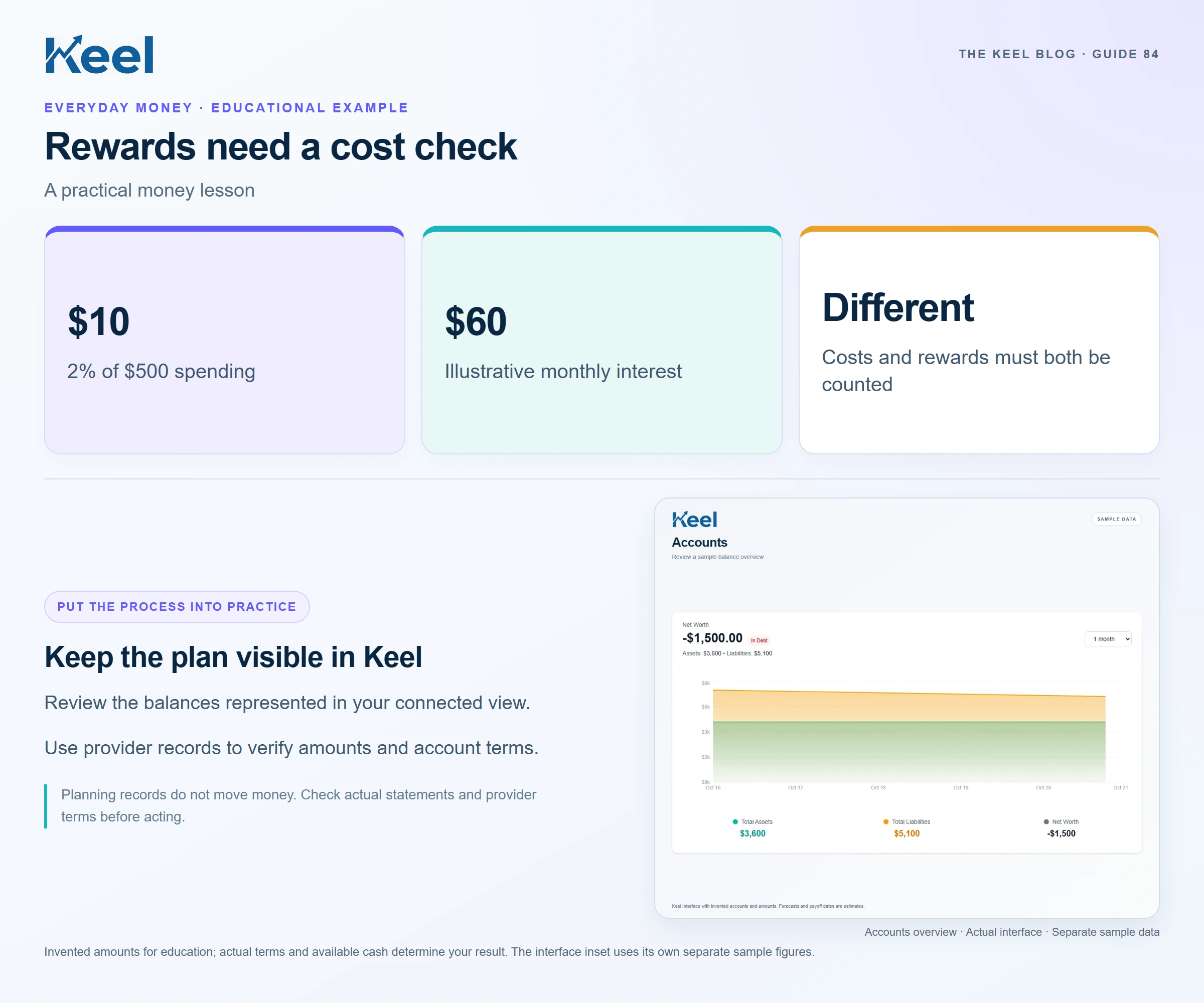
Two percent of an invented $500 of eligible purchases is $10. A separate simplified interest illustration on $3,000 at 24% APR is about $60 for a month using APR divided by twelve. Actual interest commonly uses daily balances. These are separate illustrations, not a complete net-benefit calculation for a particular account.[3]
| Calculation | Amount |
|---|---|
| $500 × 2% reward | $10 |
| $3,000 × 24% ÷ 12 illustration | $60 |
Use Keel for spending and debt decisions
Review card activity in Accounts where supported, bank payment timing in Transactions and required obligations in Debt and Bills. Inspect the forecast before an extra payment. Keel does not optimize reward redemptions, apply for cards or guarantee cashback. Use issuer statements to verify actual reward credits and interest charges.
Choose the simplest workable habit
If rewards encourage overspending or distract from a growing balance, focus on reducing the underlying cost and maintaining required payments. If using a card within an affordable plan, still compare its annual fees and terms. A small reward is valuable only in the context of the complete behavior and account cost that produced it.
Footnotes and sources
U.S. consumer education. Sources checked . General education, not an individual financial or legal recommendation.