
Understand CD Ladders Before Locking Up Cash
Learn what staggered certificate maturities can do, check withdrawal penalties and keep emergency cash separate from money committed to a term.
By Keel · Savings ·
Free 7-day trial. No card required. Subscribe for $4.99/month to continue; no charge unless you subscribe.
Understand the building blocks
A certificate of deposit places money in a deposit product with stated terms and a maturity date. Investor.gov recommends checking early-withdrawal penalties and other conditions. A ladder spreads deposits across different maturities so all the money is not tied to one date. Products vary, especially when purchased through brokers rather than directly from a bank.[1]
Keep urgent cash needs separate
Do not assume a certificate is as accessible as ordinary checking. Early withdrawal may cost interest, and some arrangements can be harder to exit. Review deposit insurance separately and confirm the actual institution and account ownership. A product label or app display does not establish coverage. Emergency funds need an access plan appropriate to their purpose.[2]
Map a modest example
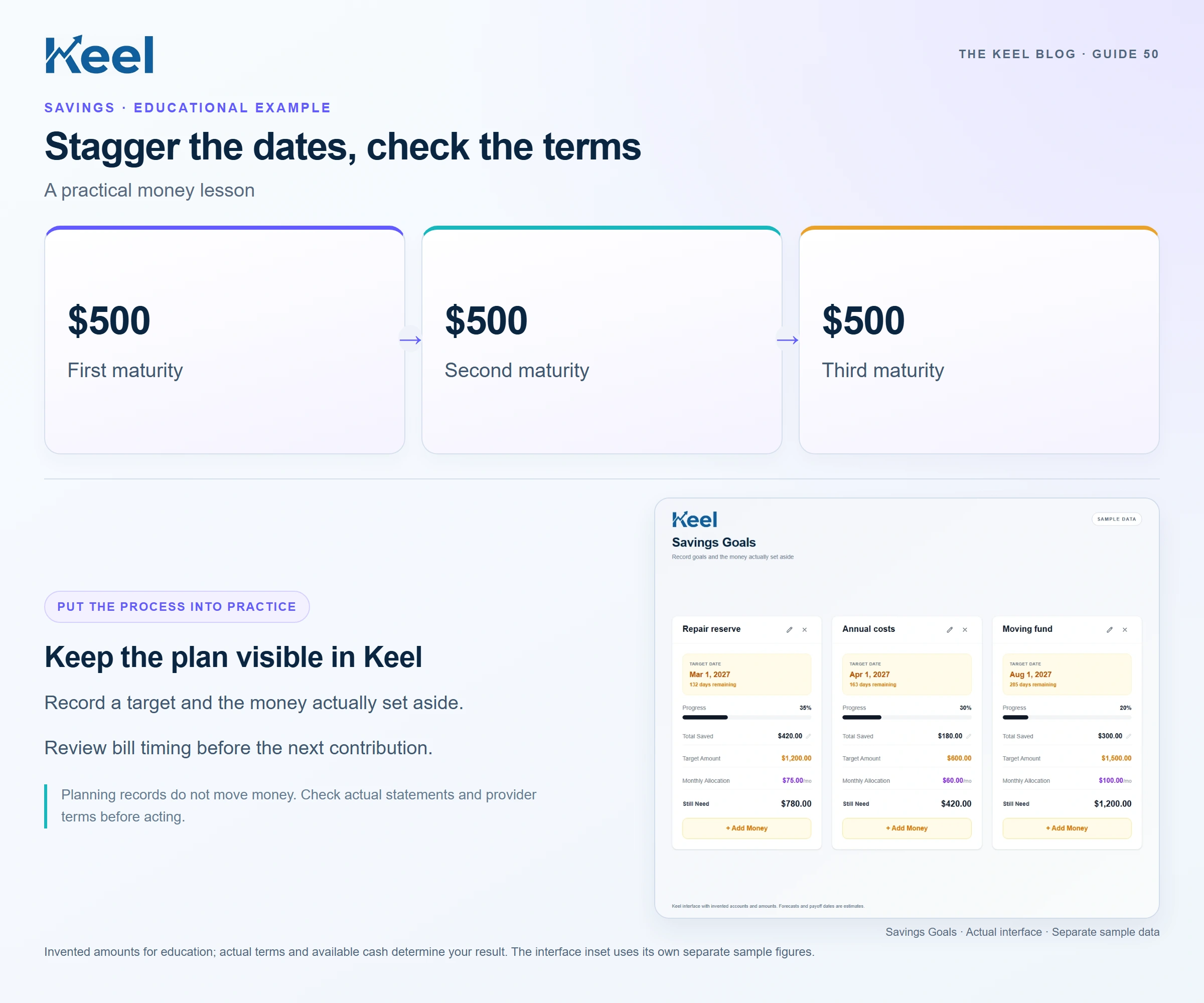
An invented $1,500 could be split into three $500 certificates with different maturities. The example describes allocation only, without recommending terms or rates. When one matures, decide whether the cash is needed or can be committed again. Future renewal rates are unknown; staggered dates do not guarantee a particular yield.
| Maturity group | Principal |
|---|---|
| First | $500 |
| Second | $500 |
| Third | $500 |
| Total | $1,500 |
Use Keel for the surrounding goals
Record funded savings goals and review upcoming bill needs before committing cash to a term. Do not assume every certificate balance or maturity is automatically available in Keel. Keep provider confirmations and a separate maturity review schedule as needed. Keel does not buy CDs, execute a ladder or manage automatic renewal settings.
Review renewal instructions in advance
Read what happens at maturity, including any renewal or grace-period rules. Check the offered rate and future access needs rather than letting an old decision repeat unnoticed. A ladder can organize timing, but it adds records to maintain. Use a simpler arrangement if tracking the terms would make essential cash harder to manage.
Footnotes and sources
U.S. consumer education. Sources checked . General education, not an individual financial or legal recommendation.