
Audit the Fees on Your Checking Account
Find recurring bank fees, compare waiver conditions with your real activity and decide whether the account still fits the way you use it.
By Keel · Everyday money ·
Free 7-day trial. No card required. Subscribe for $4.99/month to continue; no charge unless you subscribe.
Build a list from actual statements
Look for maintenance, ATM, transfer, overdraft and other account charges. Identify which are recurring and which resulted from a specific event. The CFPB notes that even an account described as free can still have certain fees. Do not assume every charge is prohibited or unavoidable without reading the terms that apply.[1]
Check the waiver against your normal behavior
A required balance, direct deposit or other condition may fit some households and create pressure for others. Read how the provider measures compliance and whether different fees remain. CFPB guidance recommends comparing fees and terms with the way you actually bank. A waiver that requires holding scarce cash idle still deserves a full budget check.[2]
Annualize only the repeated cost
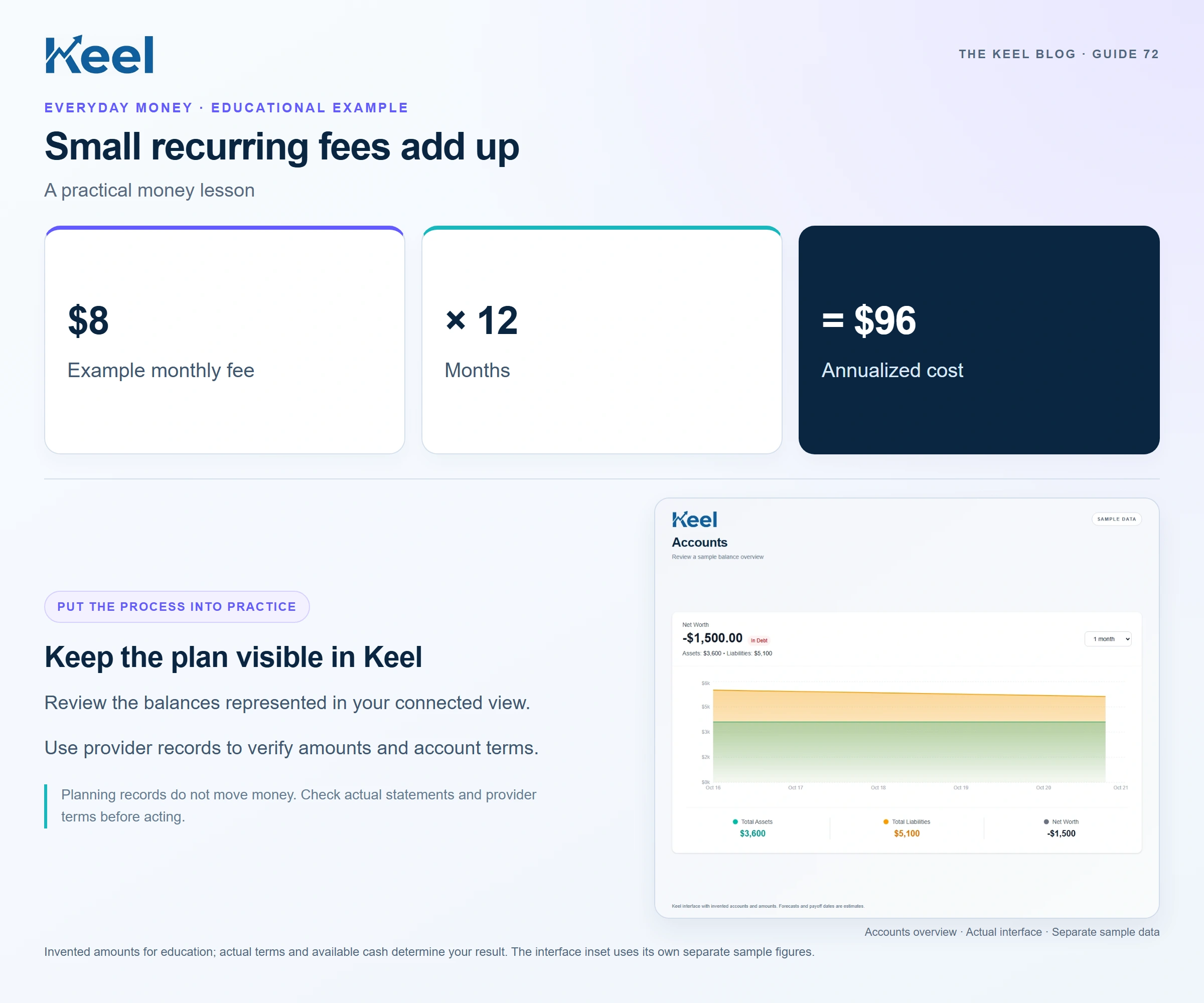
An invented $8 monthly fee totals $96 over twelve unchanged months. A one-time $8 fee is not automatically a $96 annual expense. Compare verified patterns and ask the provider about alternatives or a courtesy reversal when appropriate. Future savings begin when the charge actually stops, not when you decide to ask.
| Calculation | Amount |
|---|---|
| Monthly charge | $8 |
| 12 unchanged charges | $96 |
Use Keel to see the charges
Review Transactions for bank-fee activity and category records for recurring effects. Use Accounts to identify the relevant provider. Keel does not negotiate fees, waive charges or open a replacement account. Confirm the bank’s response and update any recurring bill plan only when the terms actually change.
Move accounts carefully if needed
Before closing anything, check outstanding payments, deposits and linked services. Verify the replacement’s terms and access rather than choosing on one promotional number. Keep the old account funded for obligations still in transit. A lower-fee arrangement helps only if the transition does not create missed payments or duplicate debits.
Footnotes and sources
U.S. consumer education. Sources checked . General education, not an individual financial or legal recommendation.