
Why minimum payments can make debt feel stuck
A payment can satisfy this month’s requirement while reducing the underlying balance much less than you expected.
By Keel · Debt planning ·
Free 7-day trial. No card required. Subscribe for $4.99/month to continue; no charge unless you subscribe.
Separate the minimum, statement balance and current balance
The minimum payment is the amount required for that billing cycle. The statement balance records the balance at a statement closing date. The current balance reflects later activity as well. These amounts answer different questions, so do not use them interchangeably when planning. The NCUA’s credit-card guidance explains the minimum-payment warning and repayment estimate on statements. That warning can show why paying only the minimum may extend repayment. Read the lender’s actual statement for the amount and deadline that apply to you.[3]
Understand APR without turning it into a false monthly quote
APR is an annual rate. The CFPB explains that many card issuers calculate interest using daily balances and that different transaction categories can have different APRs. A cash advance, purchase and transfer may not share one rate or grace period. Dividing an APR by twelve is useful for a rough educational illustration, but it is not a complete statement calculation. Your agreement’s daily method, transaction dates, payment dates and fees determine the actual charge. An app estimate should not override those documents.[1]
Work through a simplified payment
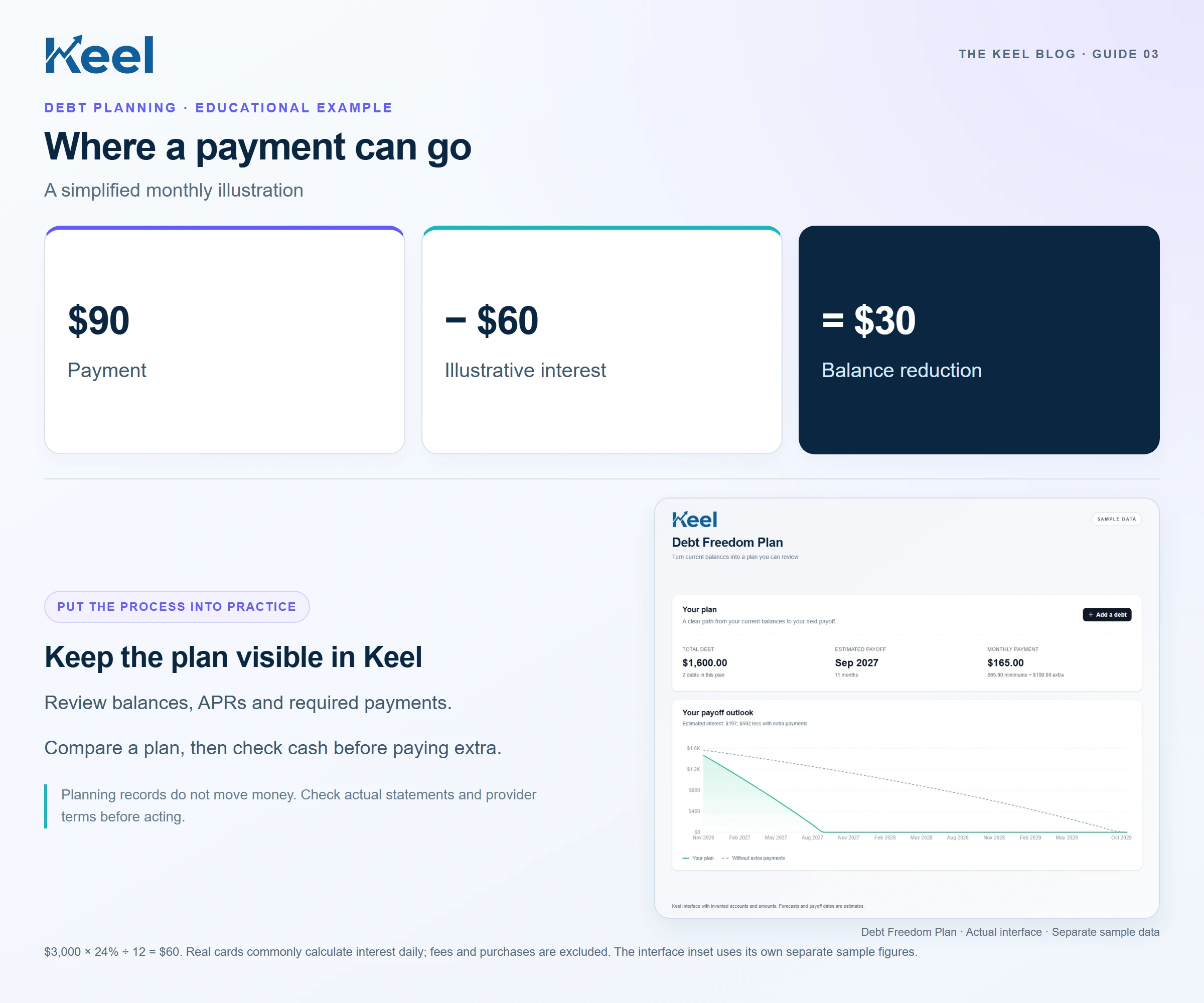
For an invented $3,000 balance at 24% APR, a simple monthly approximation is $3,000 × 0.24 ÷ 12 = $60. If a $90 payment covered exactly that $60 charge and there were no fees or new purchases, only $30 would reduce the balance. The illustration deliberately omits daily timing and other statement details. Its point is to explain why a payment can feel large while progress feels small, not to predict your next bill.
| Item | Amount |
|---|---|
| Starting balance | $3,000 |
| Approximate interest for illustration | $60 |
| Payment | $90 |
| Approximate principal reduction | $30 |
Know what a grace period actually covers
A purchase grace period can allow eligible purchases to avoid interest when the statement balance is paid in full by the due date. Not every transaction has that treatment, and carrying a balance can affect eligibility. Cash advances commonly work differently. Check the agreement and ask the issuer how to restore a lost grace period rather than assuming that one large payment fixes it immediately. Paying interest is not a requirement for demonstrating responsible credit use. Focus on the contractual payment and the cost of carrying the debt.[2]
Use Keel to test a more useful payment amount
In Debt, review the APR and required minimum, then preview an affordable extra amount. Compare the payoff outlook with the same assumptions rather than comparing two plans with different budgets. Review upcoming bill dates and the cash forecast before applying a larger amount. A plan based on an estimated APR needs another check when the actual rate arrives. Keel does not calculate an issuer’s official statement, allocate payments among multiple APR categories on your behalf or issue a guaranteed payoff quote.
Choose a practical rule for the next cycle
After the statement arrives, check the required payment, the interest charged, the rate and whether you added new purchases. If you cannot meet the required amount, contact the issuer instead of treating a smaller app budget as permission to underpay. If you can pay more, choose a repeatable amount after checking essential costs and timing. Save the new balance only after verifying lender activity. The useful measure is whether the debt is moving in the direction you expect under accurate inputs, not whether a simplified formula matches to the cent.
Footnotes and sources
U.S. consumer education. Sources checked . General education, not an individual financial or legal recommendation.