
Credit Reports and Scores Are Different Tools
Understand what a credit report contains, why scores can differ and how to investigate the underlying records instead of chasing one unexplained number.
By Keel · Credit ·
Free 7-day trial. No card required. Subscribe for $4.99/month to continue; no charge unless you subscribe.
Start with the report
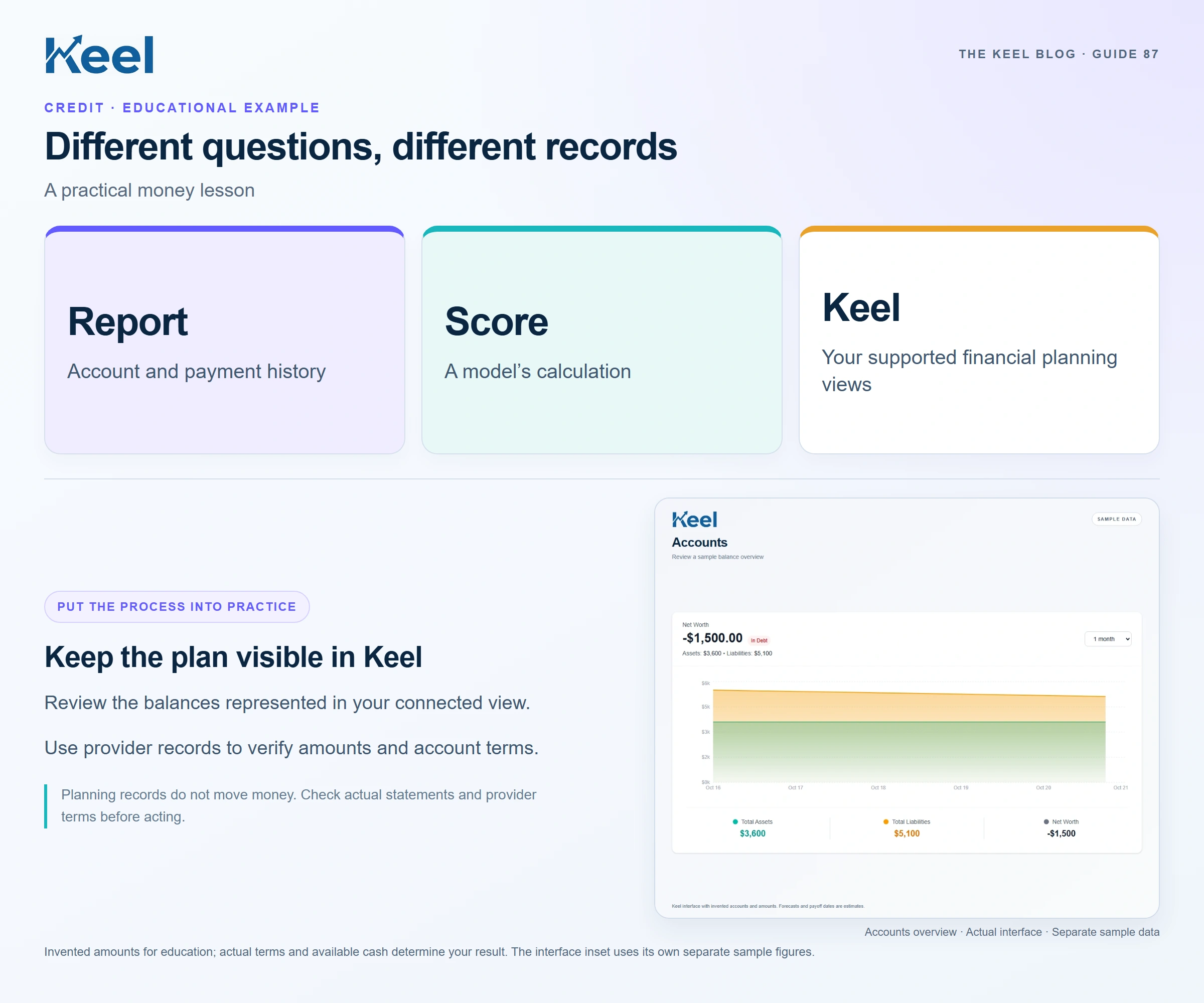
A credit report records credit activity and account information supplied to a reporting company. A score is calculated from report information using a model. The CFPB explains that scores can differ by bureau data, scoring model, product and date. Two different numbers are not automatically proof of an error.[1]
Compare the same type and date
Before interpreting a change, identify the source, model if supplied and date. A card issuer’s score and a mortgage lender’s score may answer different underwriting questions. Check recent balance and account changes rather than assuming a particular purchase caused a precise point movement. Avoid paying for a new product solely to make a number easier to watch.
Review the underlying information
Use official access routes to get reports and check the identity and account details. The CFPB describes free weekly reports through AnnualCreditReport.com. If an item is inaccurate, follow the reporting company and furnisher dispute process with evidence. Accurate negative information and an error require different interpretations.[2] [3]
Use Keel for the financial facts it tracks
Review supported account balances, card activity, bills and your debt plan in Keel. Those records can help you ask a better question, but they are not bureau reports. Keel does not retrieve or guarantee a credit score, diagnose every score change or submit credit disputes. Verify bureau information directly and keep provider statements as supporting evidence.
Choose an action connected to a real issue
Confirm a due date, investigate an incorrect account or review an affordable balance-reduction plan. A score can be useful, but the practical aim is accurate records and sustainable obligations. Do not create interest charges or unnecessary borrowing merely to generate activity. Review the effect over appropriate reporting periods without promising a particular score result.
Footnotes and sources
U.S. consumer education. Sources checked . General education, not an individual financial or legal recommendation.