
Understand credit utilization without chasing a magic number
Your current card balance, the statement balance and the balance reported to a credit bureau can be different.
By Keel · Credit ·
Free 7-day trial. No card required. Subscribe for $4.99/month to continue; no charge unless you subscribe.
Know which balance you are looking at
Utilization compares revolving credit balances with available limits. FICO explains that the balances appearing in credit reports matter for this calculation. An app’s current balance can differ because purchases, payments and issuer reporting happen on different schedules. A statement balance describes the completed billing cycle; a current balance includes later activity. Before comparing numbers, identify the balance date and source. A bank sync is not evidence that a credit bureau received the same balance that day.[1]
Calculate individual cards and the combined total
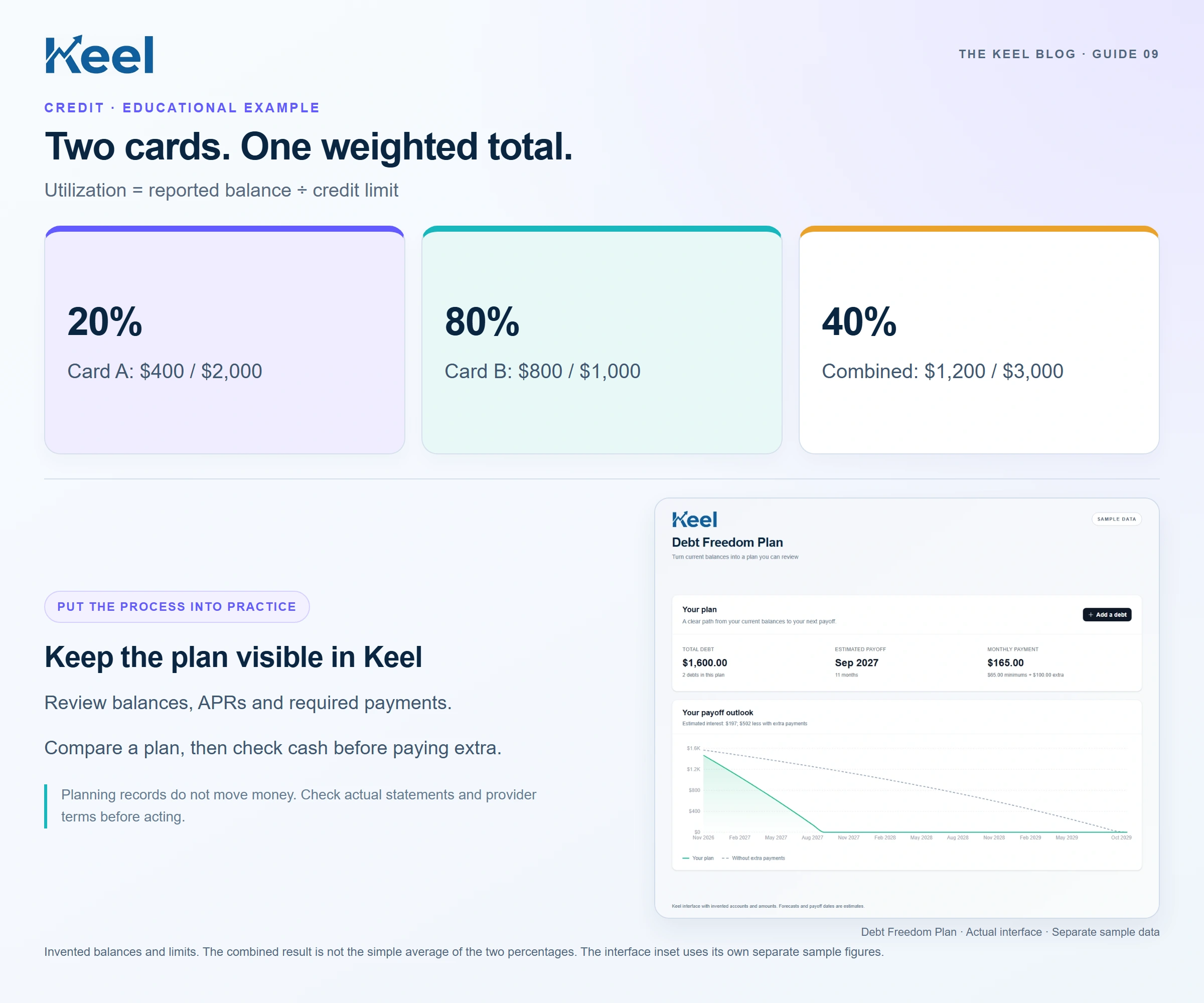
For an invented Card A, a $400 balance against a $2,000 limit is 20%. Card B has $800 against $1,000, or 80%. Combined, the balances are $1,200 and limits are $3,000, so overall utilization is 40%. Averaging 20% and 80% would incorrectly produce 50%. Different credit models can consider utilization in different ways; understanding both individual accounts and the combined picture is more useful than relying on one isolated percentage.
| Account | Balance | Limit | Utilization |
|---|---|---|---|
| Card A | $400 | $2,000 | 20% |
| Card B | $800 | $1,000 | 80% |
| Combined | $1,200 | $3,000 | 40% |
Separate due dates from statement and reporting dates
The due date is the deadline for the required payment. The statement closing date ends a billing cycle. Reporting often follows an issuer’s periodic schedule, commonly around statement timing, but practices can vary. Check with your issuer instead of assuming a universal reporting day. Paying by the due date remains important even if you are also trying to reduce a reported balance. Do not miss a required payment while attempting to optimize the timing of an optional one.
Avoid the interest and threshold myths
FICO says you do not need to carry a balance and pay interest to build a score. Lower reported revolving utilization generally helps compared with higher utilization, but there is no universal promise that crossing one percentage produces a particular score gain. Your full report and the scoring model matter. Avoid borrowing or paying unnecessary interest merely to create activity. A sound payment plan should also protect essential cash needs rather than chase an uncertain score change.[2]
Use Keel for the account and payment view
Review each card’s identity, current balance and available limit where supplied in Accounts. Use Debt to maintain the balances, rates and required payments used in your payoff plan. Put confirmed payment dates in Bills and inspect the forecast before an extra payment. Keel does not provide a credit score or establish the date an issuer reports to bureaus. Verify credit-report balances directly on your reports when evaluating what lenders may see.
Choose a repeatable action
Record the next due date, confirm your payment arrangements through the issuer and review whether an affordable extra payment fits the cash forecast. If utilization remains high because spending regularly exceeds income, work on the underlying budget as well as the balance. Check limits and reported information for accuracy before interpreting changes. A smaller balance can improve flexibility even when the exact credit-score effect is unknown.
Footnotes and sources
U.S. consumer education. Sources checked . General education, not an individual financial or legal recommendation.