
Dave Ramsey’s Baby Steps: A Practical Review
Understand Ramsey’s staged debt-and-savings framework, examine its assumptions and use Keel’s actual tools to organize your own informed plan.
By Keel · Money methods ·
Free 7-day trial. No card required. Subscribe for $4.99/month to continue; no charge unless you subscribe.
What Ramsey’s framework prioritizes
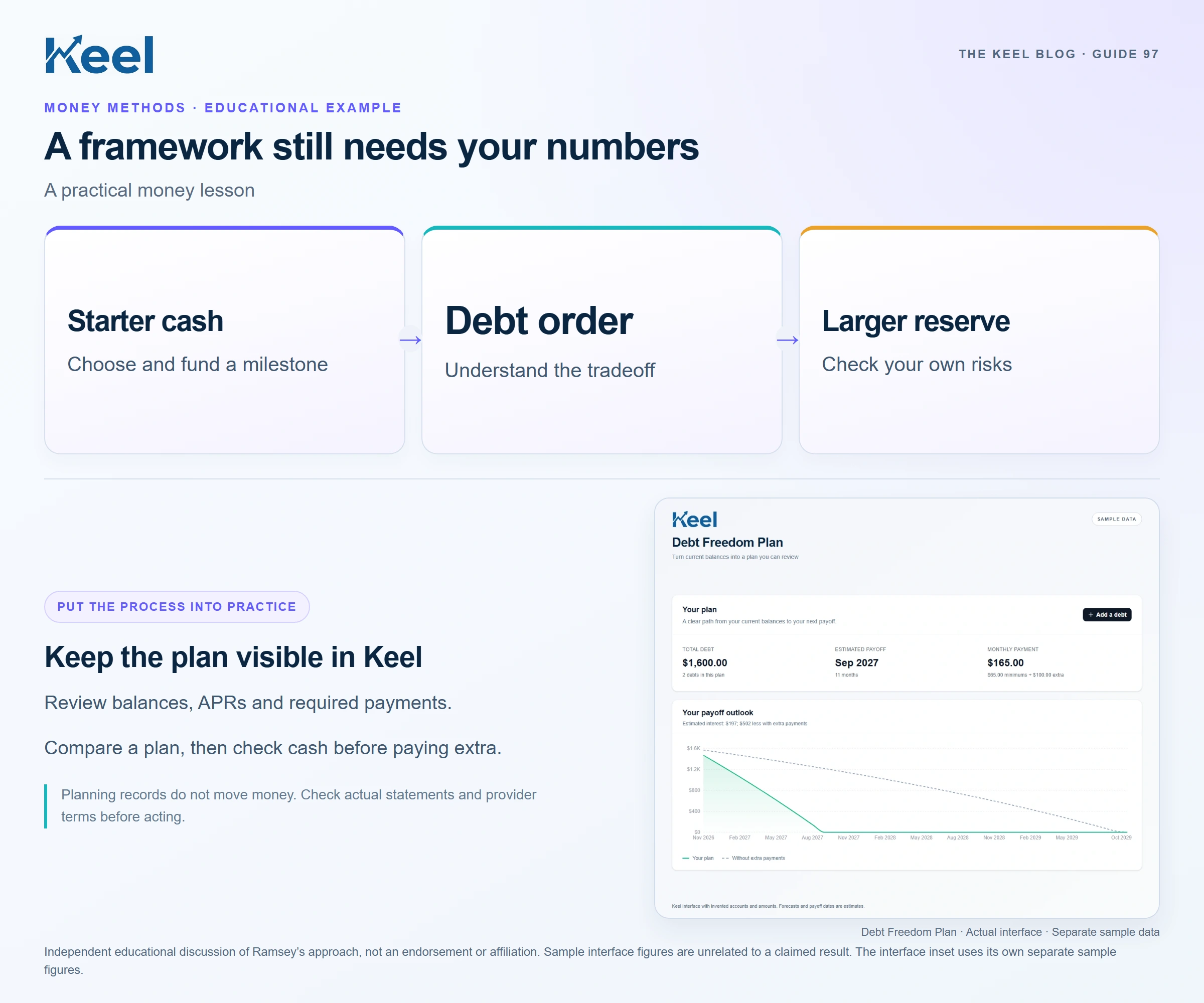
Ramsey Solutions presents seven stages: a $1,000 starter reserve; nonmortgage debt repayment using snowball order; a larger reserve covering three to six months of expenses; retirement contributions targeted at 15% of household income; children’s education saving; early mortgage repayment; and later wealth building and giving. These are Ramsey’s prescriptions, not universal requirements or a Keel-designed program.[1]
Understand the snowball tradeoff
The smallest-balance approach aims for visible account-clearing progress while maintaining other required payments. The CFPB also describes highest-interest ordering, which can reduce interest under comparable payment and rate assumptions. Motivation and modeled cost are different criteria. Ramsey’s preference does not establish that snowball is always mathematically fastest or cheapest for every set of debts.[2]
Test the starter reserve against your actual risks
A round-number first milestone can make starting easier, but it does not prove that your household is sufficiently protected. Consider income stability, essential costs and likely disruptions. The CFPB’s emergency-fund guidance emphasizes circumstances and practical contributions. Choices about retirement benefits, taxes and mortgages can need individual advice; do not infer that following a general sequence settles every tradeoff.[3]
Use the supporting parts of Keel
Record genuinely funded targets in Savings, maintain balances and required payments in Debt, and compare snowball with avalanche previews. Review Bills and forecast low points before directing extra money. Keel does not automatically move you through the Baby Steps, make transfers, choose retirement investments or send lender payments. Its projections use its inputs and modeling assumptions.
Choose a process rather than a promise
Write down which part of the framework helps your next decision, what you will adapt and when you will review it. Verify lender balances and actual savings after action. Keep essential obligations and special loan terms visible. This is Keel’s independent educational discussion; Ramsey Solutions has not endorsed Keel, and the article does not imply an affiliation.
Footnotes and sources
U.S. consumer education. Sources checked . General education, not an individual financial or legal recommendation.