
Check Deposit Insurance Where Your Money Is Held
Understand basic FDIC and NCUA coverage, verify the actual institution and avoid assuming every financial app or investment has deposit insurance.
By Keel · Savings ·
Free 7-day trial. No card required. Subscribe for $4.99/month to continue; no charge unless you subscribe.
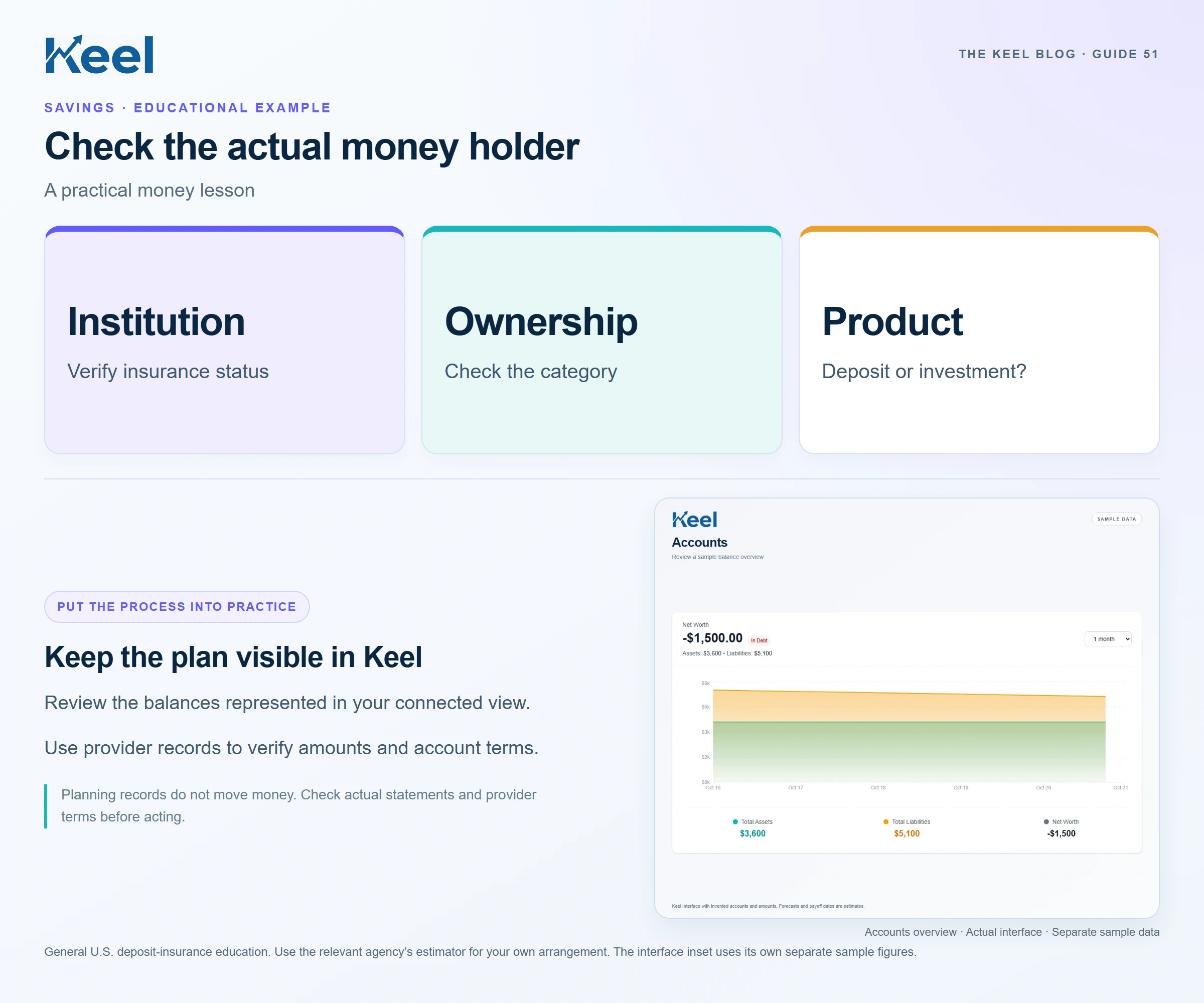
Know the basic FDIC structure
The FDIC describes standard coverage as $250,000 per depositor, per insured bank, for each ownership category. Accounts in the same category at the same bank are combined for that calculation. Opening another savings account or using another branch does not by itself create another independent coverage limit.[1]
Check credit-union coverage separately
At federally insured credit unions, NCUA share insurance has its own coverage rules and ownership categories. The standard share insurance amount is generally $250,000 per share owner, per insured credit union, for each ownership category. Verify the institution and use official guidance for joint, trust or other arrangements rather than applying a simplified example blindly.[2]
Distinguish deposits from other products
A bank can offer products that are not insured deposits, such as investments. A financial app’s name or an advertised relationship with a bank is not enough to determine your coverage. Find who actually holds the money and how it is titled. For complex arrangements, use official estimators or ask the relevant institution and agency.
Use Keel without treating it as the custodian
Keel can display supported connected-account balances and help organize savings goals. It does not hold your deposits, open insured accounts or certify insurance coverage. A $500 goal record is not a $500 deposit. Check the institution’s own account records and terms for the legal arrangement behind the money you are planning around.
Make verification part of an account change
Before moving a reserve, verify the destination institution, product type, ownership and combined balances already there. Keep the relevant disclosures. Repeat the check if ownership or the institution changes. Insurance is one part of a cash decision alongside access and fees; it does not make every advertised product suitable or protect against every type of loss.
Footnotes and sources
U.S. consumer education. Sources checked . General education, not an individual financial or legal recommendation.