
Use Envelope Budgeting Without Losing the Cash View
Apply envelope-style spending limits to selected categories, track reallocations and distinguish a planning label from money held in a separate account.
By Keel · Budgeting ·
Free 7-day trial. No card required. Subscribe for $4.99/month to continue; no charge unless you subscribe.
Choose the categories that need a boundary
Envelope-style budgeting gives a purpose a limited allocation and checks what remains before another purchase. The Budget Mom’s guide uses cash envelopes for variable spending as part of its broader framework. You do not need dozens of categories to begin. Pick a few where a visible remaining amount would change the next decision.[1]
Separate physical money from a planning record
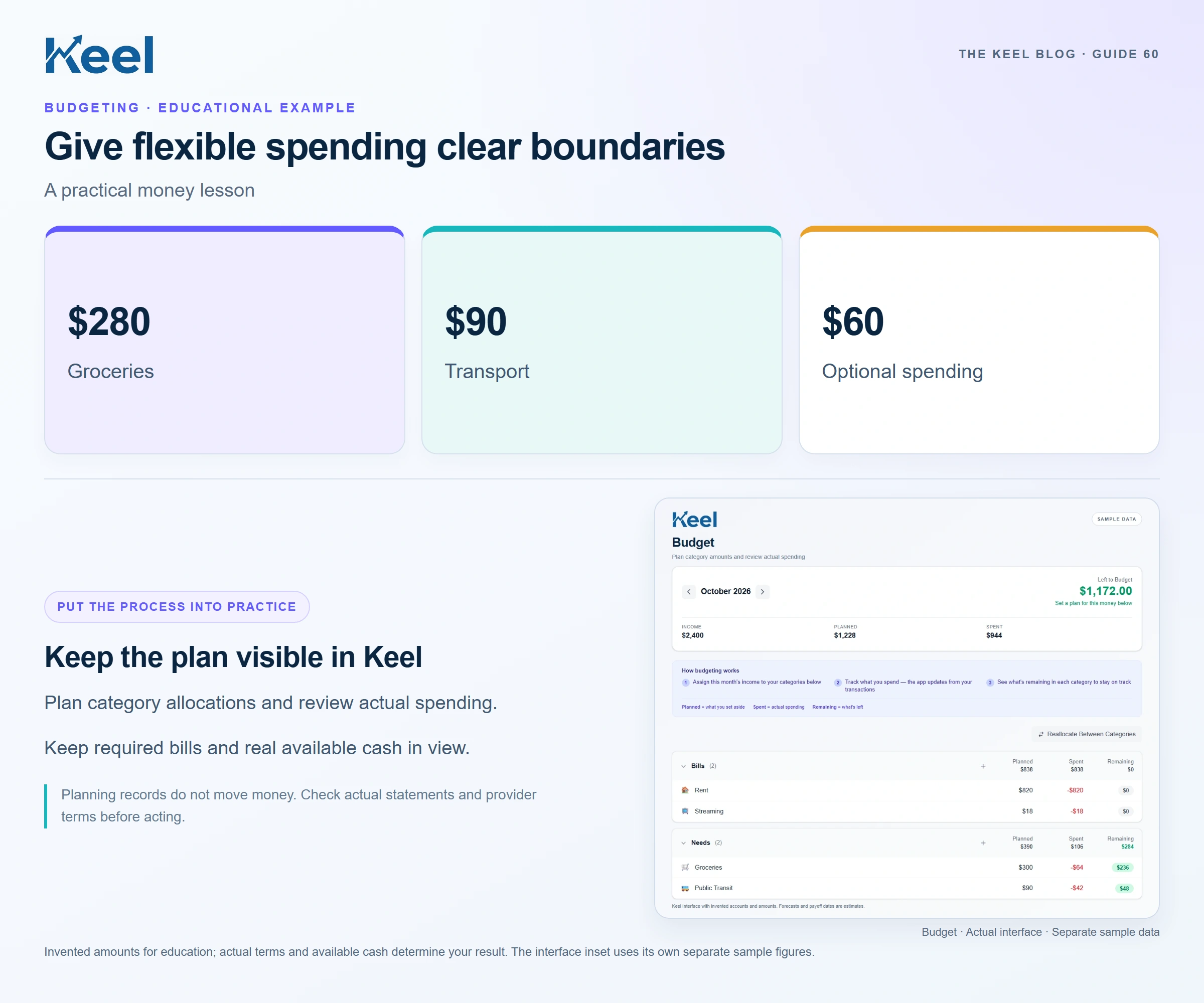
A physical envelope holds cash. A digital category can simply label part of a bank balance. If you assign $280 to groceries, $90 to transport and $60 to optional spending, those allocations total $430; they do not create another $430 in addition to your balance. Confirm that all allocations together are actually funded.
Record a deliberate reallocation
Suppose groceries need $20 more and optional spending can safely fall by $20. Move the plan from $280/$60 to $300/$40. The total remains $340 across those two categories. Taking $20 from an essential bill that is still due does not make the problem disappear. Revise the underlying decision rather than only the labels.[2]
| Category | Before | After |
|---|---|---|
| Groceries | $280 | $300 |
| Optional spending | $60 | $40 |
| Combined | $340 | $340 |
Use Keel’s category tools accurately
Use Budgets to plan category amounts and review spending from Transactions. Where category reallocation controls are available, use them to record the decision. Keel does not hold physical envelopes, lock a debit card to a category or transfer bank funds when a budget allocation changes. Keep Bills and the forecast in view for the overall cash position.
Review the categories that keep running short
A repeated shortfall may reflect unrealistic estimates, unavoidable price changes or a missing expense. Adjust the plan without deleting the spending history. If withdrawing cash, distinguish the movement from the purchases made with it to avoid double counting. Envelope limits are a decision aid; accurate transaction records and an affordable total still matter.
Footnotes and sources
U.S. consumer education. Sources checked . General education, not an individual financial or legal recommendation.