
Build an emergency fund while paying down debt
Sending every spare dollar to debt can leave the next surprise expense with nowhere to go except back onto a card.
By Keel · Savings ·
Free 7-day trial. No card required. Subscribe for $4.99/month to continue; no charge unless you subscribe.
Define the emergency you want the first reserve to handle
Think about realistic disruptions: a necessary repair, an interruption in income or an unplanned essential bill. The CFPB describes emergency savings as money for unexpected expenses and notes that even small amounts can help. A target should reflect your household, available benefits, job stability and other resources. A round number from a video is not a requirement. Start by naming the risk, estimating a useful first milestone and identifying where the money would actually be kept. You can revise that milestone as circumstances improve.[1]
Separate reserves from predictable spending
An annual insurance renewal is not unexpected merely because it arrives less often than rent. Plan predictable expenses with sinking funds or category allocations rather than treating every future bill as an emergency. Otherwise the reserve repeatedly disappears on costs you could have listed in advance. Keep enough access to the money for its intended purpose, and check account terms before choosing where to hold it. Keel is a planning tool, not a bank, custodian or provider of deposit insurance. The actual institution’s terms determine account protections and access.[2]
Test a split with invented numbers
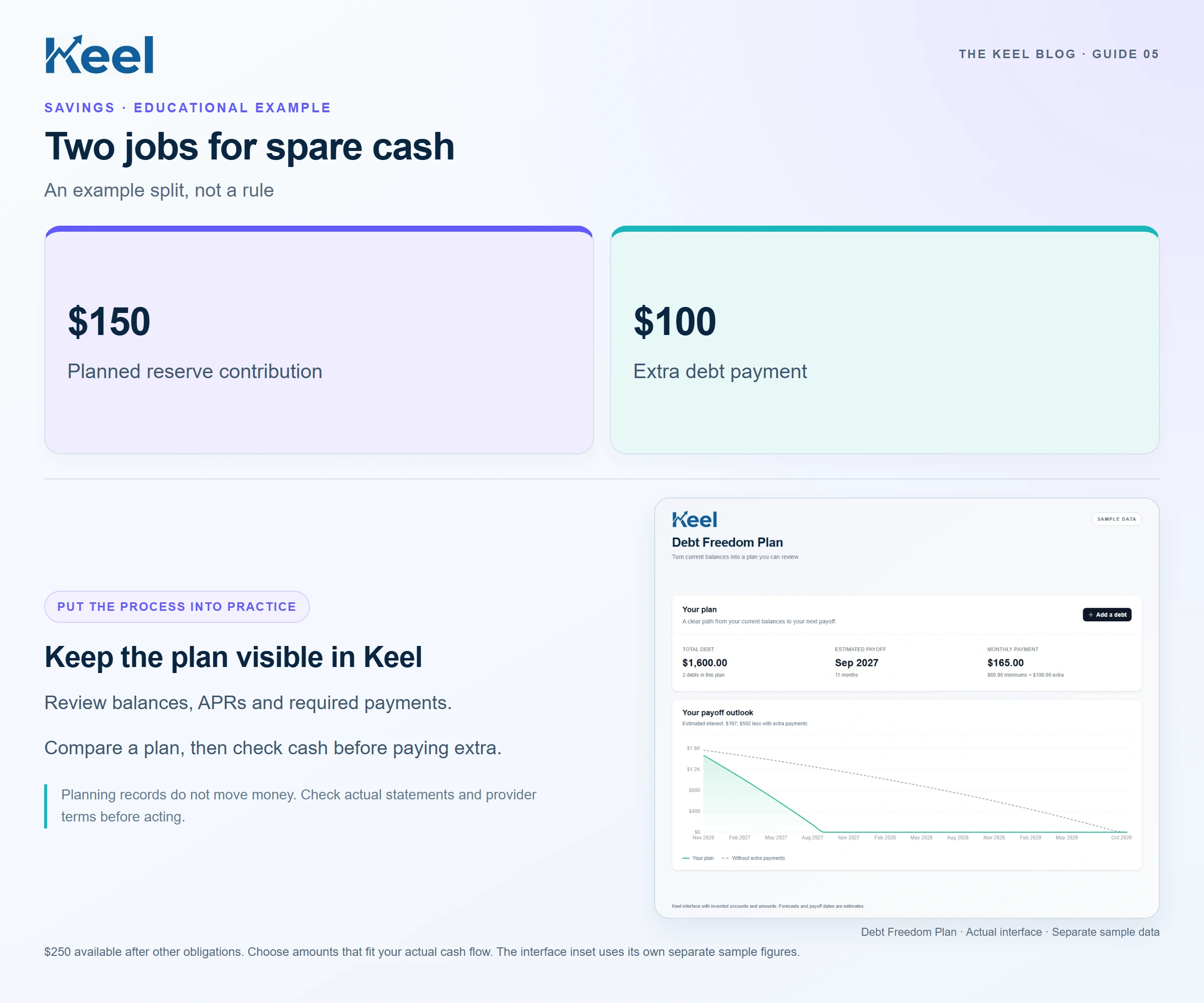
Suppose $250 remains after required payments, essentials and upcoming planned costs. An illustrative decision is $150 toward a reserve and $100 as extra debt payment. Another household might reasonably choose a different split or have no available surplus yet. Saving $150 monthly for four months would add $600 before interest or withdrawals. That calculation describes contributions, not a guaranteed balance. If the next week’s forecast goes negative, the proposed split needs to be revisited.[3]
| Purpose | Monthly amount |
|---|---|
| Reserve contribution | $150 |
| Extra debt payment | $100 |
| Total assigned | $250 |
| Four reserve contributions before changes | $600 |
Make the trade-off explicit
Compare the cost of carrying expensive debt with the risk of having no usable reserve. There is no single split that is right for every interest rate, job situation and family obligation. Keep contractual minimums visible, and seek appropriate advice when arrears or urgent bills change the decision. If income is unstable, your reserve may need a different role from someone with predictable pay. Avoid claiming that either saving or repayment is always the priority; describe why the choice fits the next set of risks you face.
Track the reserve and debt plan in Keel
Create a savings goal with a target that matches your chosen milestone. Update its recorded amount after real money is set aside, and review whether the same cash is being counted toward more than one purpose. In Debt, preview the extra amount you can sustain; in the cash forecast, check the bill dates before payday. Recording a contribution in Savings does not initiate a bank transfer. Carry out the transfer with your actual provider and confirm the result before treating the money as available for the goal.
Write rules for using and rebuilding the reserve
Decide what counts as an eligible unexpected cost, how you will confirm the amount and when you will review the target after using it. A necessary withdrawal is not automatically a failure; the reserve had a job. The follow-up is to update the recorded balance, adjust the next few contribution amounts and check the effect on extra debt payments. Review after major changes in income or essential costs. The purpose is resilience that supports the repayment process, not an attractive goal percentage disconnected from real bank balances.
Footnotes and sources
U.S. consumer education. Sources checked . General education, not an individual financial or legal recommendation.