
Find an Extra Debt Payment You Can Sustain
Calculate a realistic extra debt payment after required bills, everyday needs and reserves, then test its timing with Keel’s cash forecast.
By Keel · Debt planning ·
Free 7-day trial. No card required. Subscribe for $4.99/month to continue; no charge unless you subscribe.
Calculate the margin using real expenses
Start with take-home income and subtract essentials, planned everyday spending and required debt payments. Review several months so insurance renewals and other irregular costs do not disappear. The CFPB recommends looking beyond a typical month when assessing spending. An apparent surplus caused by omitting groceries or annual bills is not dependable money for accelerated repayment.[1]
Protect a deliberate reserve
Choose a cash cushion based on your situation rather than sending every remaining dollar automatically. Emergency-saving guidance recognizes that the target depends on the household. Distinguish a reserve already held from new contributions you still need to fund. If required payments are unaffordable, address that shortfall before optimizing extra payments.[2]
Work through the adjustment
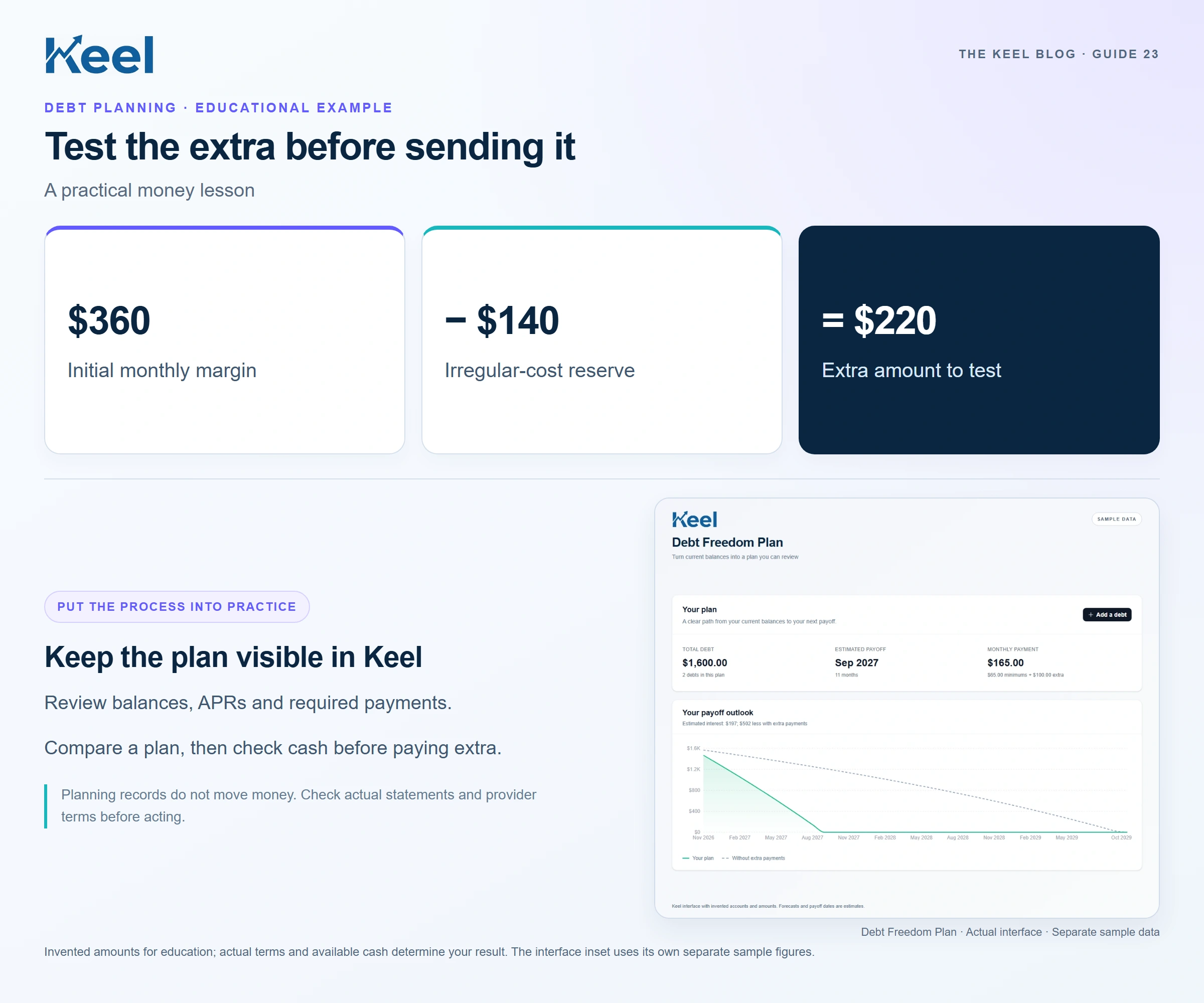
Suppose an invented budget leaves $360 after required costs. Reserving $140 for known irregular expenses leaves $220 to test as extra repayment. This is an allocation example, not a recommendation. If an omitted $90 bill appears, the tested amount falls to $130 unless another real change offsets it.
| Calculation | Amount |
|---|---|
| Initial margin | $360 |
| Reserve allocation | −$140 |
| Proposed extra | $220 |
| After an additional $90 obligation | $130 |
Test both the amount and the date in Keel
In Keel, use Budgets and Transactions to review the spending assumptions, Bills to check due dates, and the forecast to inspect upcoming low points. In Debt, preview an extra payment using current balances and rates. Applying a plan saves the planning choice; it does not send money. A monthly surplus can still be unavailable before payday.
Increase gradually from evidence
Choose a payment you can actually repeat and verify its effect on the lender’s next balance. Review after income changes or a reserve is used. A smaller sustained extra can be more workable than a larger amount that forces new borrowing next week. Keep optional payments adjustable rather than confusing your chosen target with the lender’s contractual minimum.
Footnotes and sources
U.S. consumer education. Sources checked . General education, not an individual financial or legal recommendation.