
Prepare Financial Records for an Emergency
Create a secure inventory of key accounts, bills and documents so an interruption does not leave essential financial tasks dependent on memory.
By Keel · Safety ·
Free 7-day trial. No card required. Subscribe for $4.99/month to continue; no charge unless you subscribe.
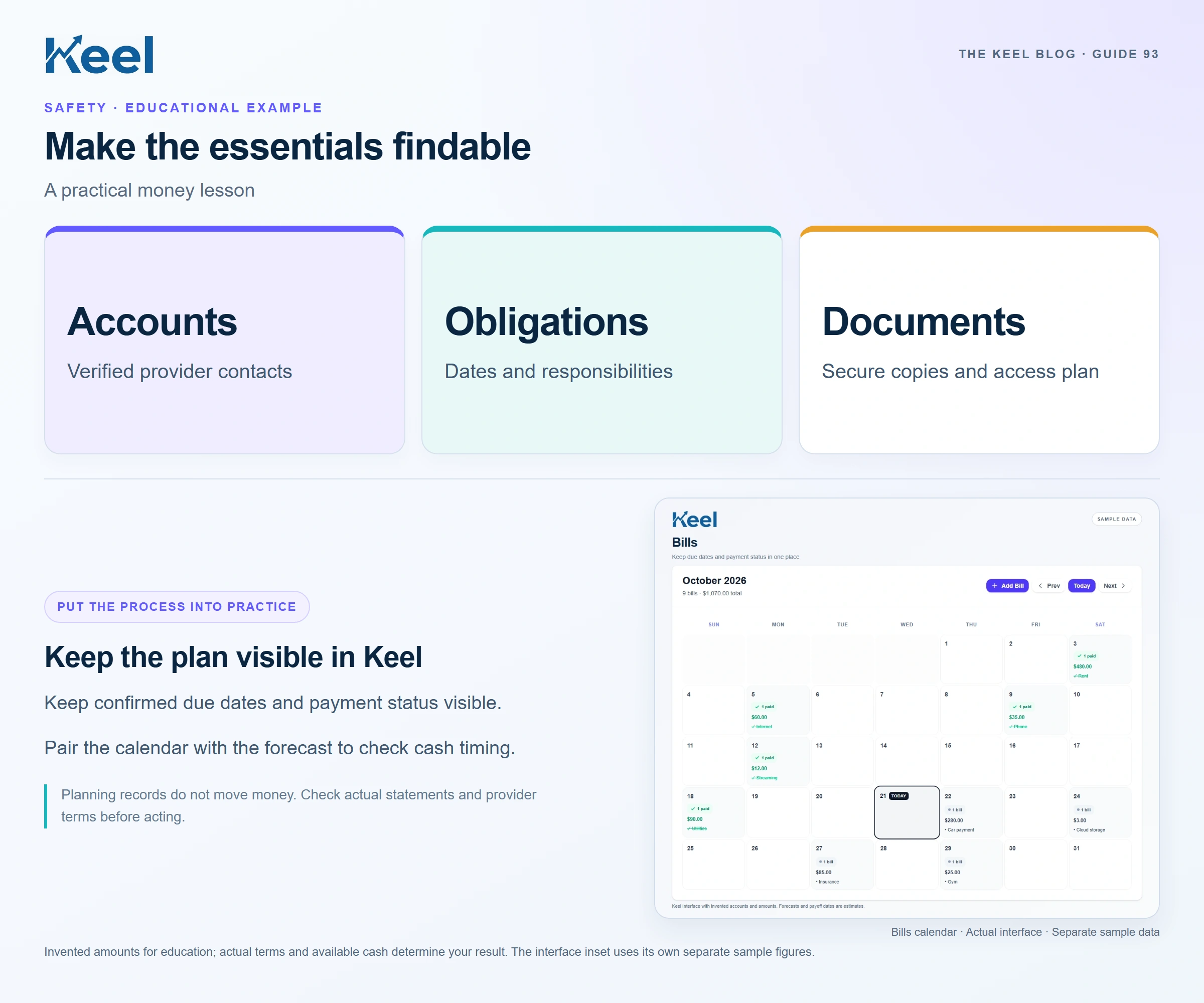
Start with a practical inventory
FEMA and Operation HOPE’s Emergency Financial First Aid Kit organizes financial preparedness around important records and obligations. Identify the documents and contacts needed to keep essential bills and household tasks functioning. The purpose is not to place every secret in one unprotected file. Consider how the information will be used if a device or home is temporarily inaccessible.[1]
Separate reference information from credentials
A list of providers and masked account identifiers may be useful for orientation. Passwords, identity documents and full account details require stronger storage and access decisions. Avoid sending them in ordinary messages or placing them in casual app notes. Verify anyone requesting emergency access; stress and urgency can also be exploited by scammers.[2]
Identify the next essential tasks
List which bills are automatic, which require action, and who is authorized to handle each. A payment reminder and legal authority to act are different matters. Review beneficiary, power-of-attorney or estate questions with appropriate providers and qualified advisers rather than treating a household checklist as a legal document.
Use Keel for the planning portion
Bills can help you review dates and payment status, while Accounts, Debt and Savings can organize supported financial information. Keel does not provide a complete document vault, executor access system, estate plan or legal authorization. Preserve original statements, agreements and sensitive records in suitable secure storage outside routine planning fields.
Review after a major change
Update the inventory after an account change, move, new debt or changed household responsibility. Confirm that the person who may need the information knows the agreed process without sharing credentials unnecessarily. A short current inventory can be more useful than a large archive nobody can safely locate. Keep actual provider instructions and authorizations as the source of truth.
Footnotes and sources
U.S. consumer education. Sources checked . General education, not an individual financial or legal recommendation.