
Your first 30 days getting out of debt
Before making an aggressive extra payment, build a complete picture of what you owe and what your next month actually requires.
By Keel · Debt planning ·
Free 7-day trial. No card required. Subscribe for $4.99/month to continue; no charge unless you subscribe.
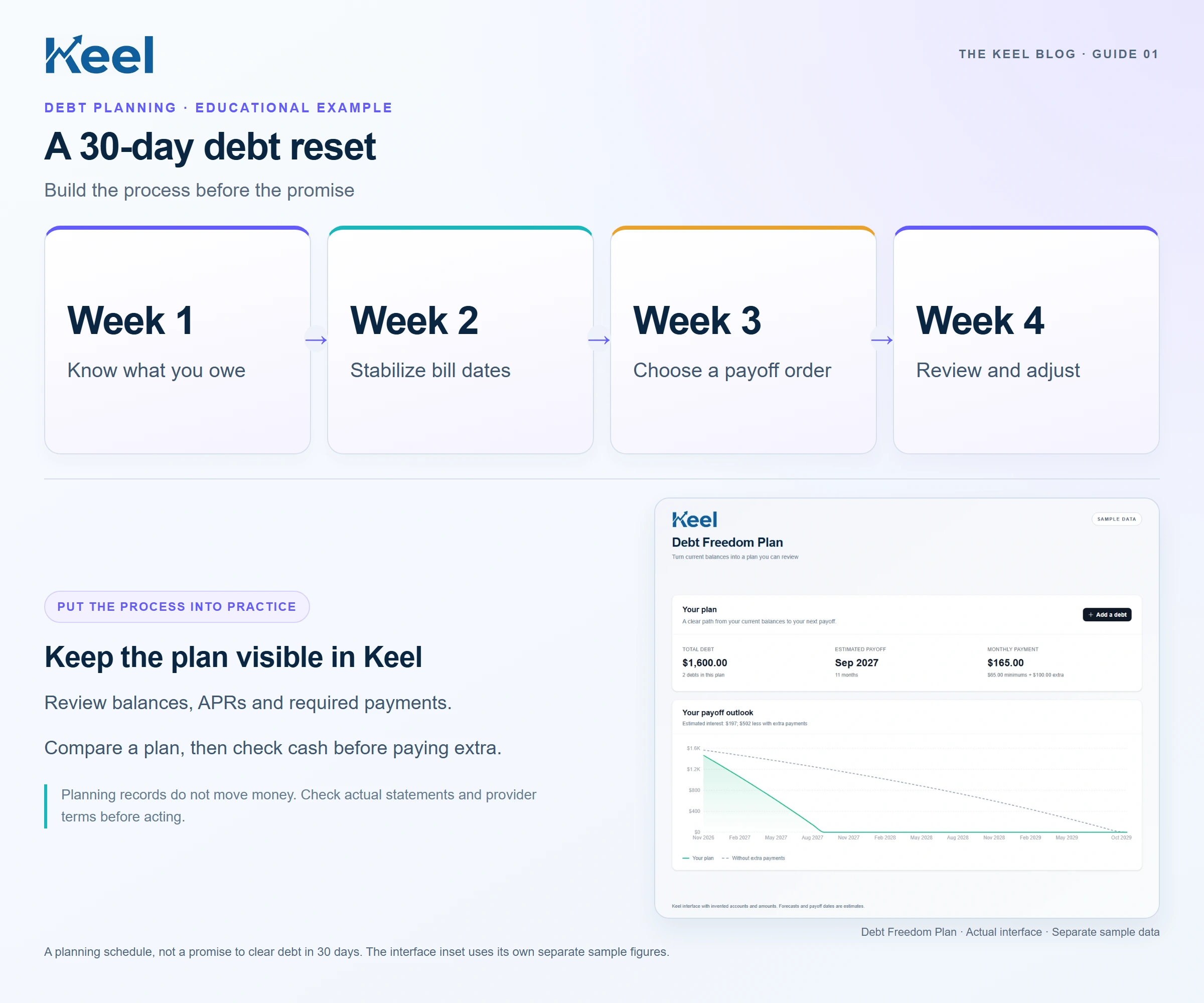
Week 1: make one debt inventory
Gather current statements and list the creditor, masked account ending, balance, APR, required minimum and due date. Separate a remaining debt balance from this month’s payment. Two cards at the same bank are not automatically duplicates, and two copies of one account are not two debts. Mark anything uncertain for follow-up instead of entering a zero rate or guessed balance. The output of this week is a trustworthy list you can update, not a perfect strategy. A collector notice or disputed account may need a different process from an ordinary current card.
Week 2: find the next month’s pressure points
List essential living costs and obligations by date, then compare them with money already available and income you reasonably expect. The FTC recommends reviewing a budget and contacting creditors when payments are becoming difficult. If required payments do not fit, call the provider early rather than assuming a partial payment changes the agreement. Ask about payment arrangements, costs and reporting consequences. Keep the existing due date until the provider confirms a change. Completing a spreadsheet cannot replace that conversation.[1] [3]
Work out an initial amount to test
Suppose take-home income is $3,000, essential living costs and planned everyday spending are $2,350, and required debt payments total $400. That leaves $250 before any savings contribution or missed expense. Setting aside $100 for a planned reserve leaves $150 to test as an extra debt payment. These invented numbers demonstrate a check, not a recommended allocation. If actual bills or irregular costs use the remaining money, the available extra amount changes.
| Monthly item | Amount |
|---|---|
| Take-home income | $3,000 |
| Living costs and everyday spending | −$2,350 |
| Required debt payments | −$400 |
| Planned reserve contribution | −$100 |
| Possible extra payment to test | $150 |
Week 3: choose one repayment order
Keep required payments in view, then compare the smallest-balance and highest-interest-rate approaches for money beyond those requirements. Choose an order you can explain in one sentence. Write down what would make you revisit it: a new fee, a rate change, a missed bill or a change in income. Avoid opening a new borrowing product merely to make the plan look tidier. If the plan needs concessions from lenders, confirm those terms before treating them as available. A consistent, affordable process is more useful than repeatedly restarting an impossible one.
How to use Keel for the reset
Use Transactions to review recent spending, Bills to put obligations in date order, and the cash forecast to inspect low points before payday. In Debt, confirm balances and rates, compare repayment previews and apply a plan only when the inputs make sense. Record actual payment progress separately from the remaining lender balance. Keel does not renegotiate your accounts, send payments or determine whether a collection claim is valid. Use lender records for those questions, and ask a qualified counselor or legal adviser when the situation needs individual help.
Week 4: review what changed
Compare the plan with a full week of real activity. Did every required payment leave the account? Did an overlooked annual charge appear? Has income arrived on a different date? Correct the inputs and choose the next review date. Save the next practical action, such as checking a lender statement or confirming a changed due date, instead of measuring success only by the balance reduction. Your first month succeeds when you know the numbers, understand the timing and have a process you can repeat. There is no guarantee that a fixed four-week schedule fits every household.[2]
Footnotes and sources
U.S. consumer education. Sources checked . General education, not an individual financial or legal recommendation.