
Be Careful With Get-Out-of-Debt-Quick Claims
Separate legitimate ways to accelerate repayment from promises that hide fees, risky borrowing or an unsupported guarantee of debt removal.
By Keel · Safety ·
Free 7-day trial. No card required. Subscribe for $4.99/month to continue; no charge unless you subscribe.
Identify the real mechanism
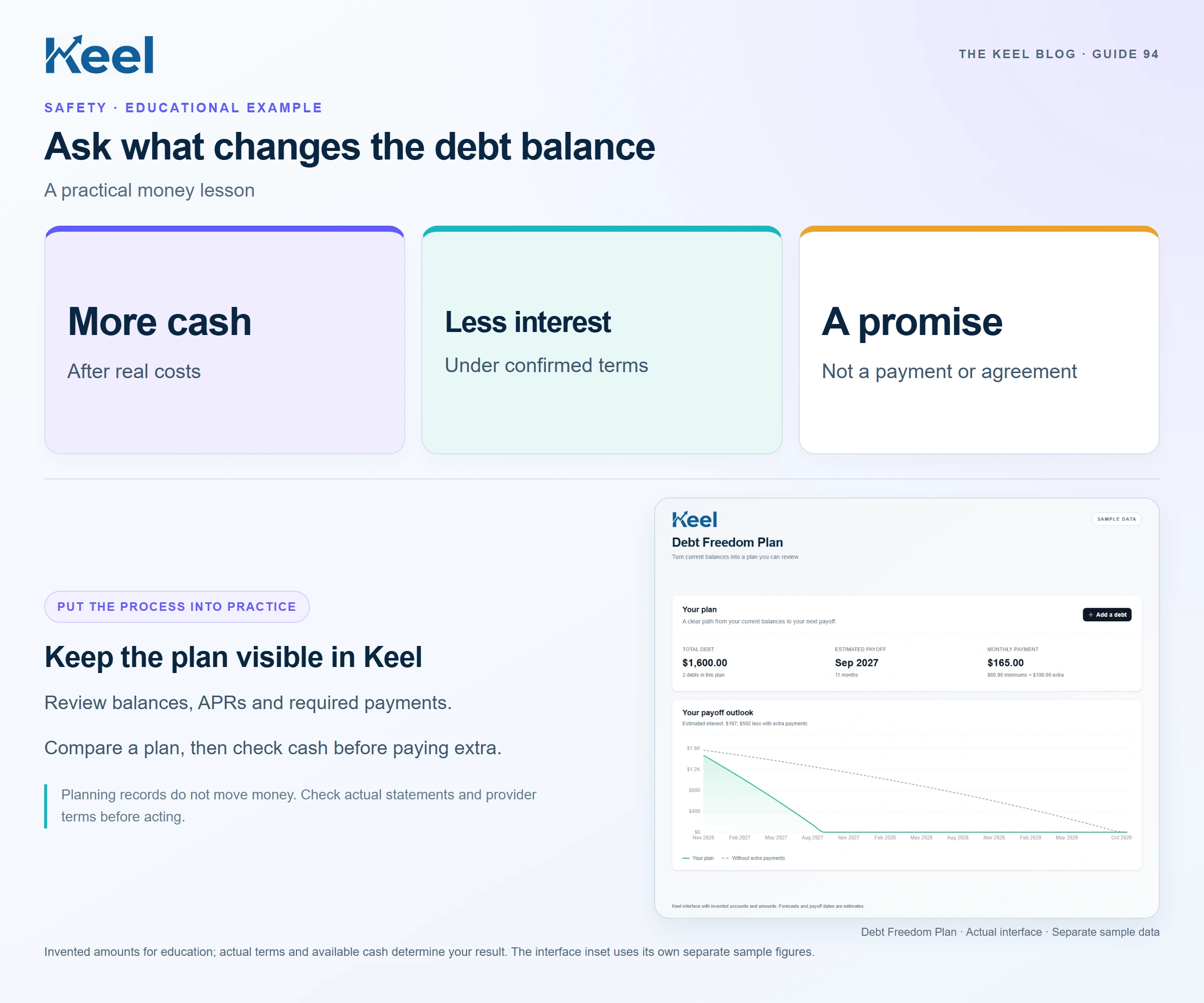
Faster repayment can come from affordable additional principal, lower confirmed costs or more available income after expenses. A new loan may reorganize the obligation without reducing it. Ask which balance changes, why and under what written terms. The FTC warns that debt-relief offers can involve significant risks and no guaranteed participation by creditors.[1]
Inspect claims that remove uncertainty
Be cautious when a provider guarantees a payoff date, debt forgiveness or a credit outcome without a complete review. Ask about fees, creditor acceptance and what happens if the program fails. Do not stop meeting existing requirements simply because an advertisement implies someone else will handle everything. Independently verify the organization before sharing sensitive information.[2]
Compare acceleration with a sustainable budget
An invented extra $75 for twelve months contributes $900 before interest effects. That is real additional payment only if it is funded and sent. Borrowing $900 elsewhere to make those payments changes the liability rather than creating the same result. Keep the source of cash and its new obligations visible.
| Plan | Extra paid |
|---|---|
| 12 × $75 funded contributions | $900 |
| Guaranteed interest or date result | Not established by this arithmetic |
Use Keel to test transparent choices
Maintain accurate debt inputs, compare strategy and payment scenarios, and check cash-flow low points before acting. Keel does not guarantee debt removal, negotiate every creditor agreement or pay on your behalf. Its estimate is useful when the assumptions are visible and realistic. Confirm actual payments and updated balances through the lender.
Choose a verifiable next step
Review one statement, ask an issuer about terms or fund an affordable extra payment. Seek appropriate counseling when requirements cannot be met. Progress should be traceable to a real balance, payment or agreement. A trustworthy plan can explain its limits instead of promising that urgency alone will make a difficult situation disappear.
Footnotes and sources
U.S. consumer education. Sources checked . General education, not an individual financial or legal recommendation.