
Build a Home Repair Reserve From Real Risks
Plan for known maintenance and uncertain repairs, choose a practical first target and avoid treating a generic percentage as a guaranteed repair budget.
By Keel · Savings ·
Free 7-day trial. No card required. Subscribe for $4.99/month to continue; no charge unless you subscribe.
List what the property actually needs
Review major systems, recent inspections and routine maintenance before choosing a target. A home’s age, condition and responsibilities under the ownership or rental arrangement matter. A universal percentage of property value can be a rough conversation starter, but it is not a quote for replacing your particular roof or appliance. Use current estimates when a known job is approaching.
Distinguish scheduled work from emergencies
An annual service or expected replacement is a predictable expense. An unexpected essential repair may draw on a reserve. CFPB savings guidance distinguishes the role of emergency money, while spending guidance encourages accounting for irregular costs. Decide whether your home reserve is separate from a broader emergency fund and avoid counting the same cash fully toward both.[1] [2]
Choose a staged target
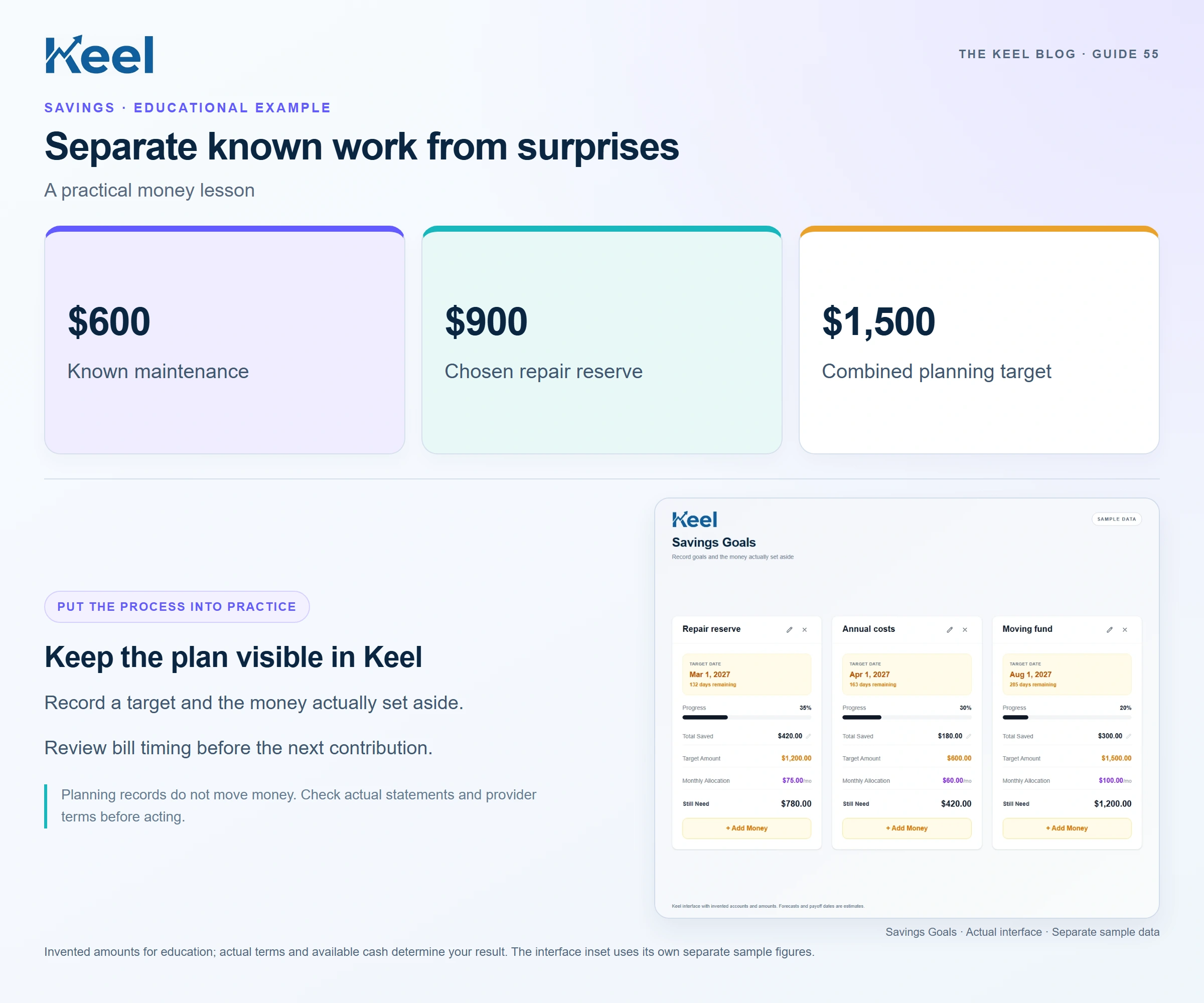
An invented plan might include $600 for known maintenance and $900 for a chosen repair cushion, totaling $1,500. If $300 is already funded, $1,200 remains. Twelve $100 contributions would fund that gap before withdrawals or price changes. This is a planning illustration, not a recommendation that $900 covers the likely repairs at any home.
| Purpose | Amount |
|---|---|
| Known maintenance | $600 |
| Repair cushion | $900 |
| Combined target | $1,500 |
| Already funded | $300 |
| Remaining gap | $1,200 |
Use Keel for amounts and timing
Record the funded goal in Savings and confirmed service dates in Bills. Inspect the cash forecast before accepting work with a deposit or staged payment. Keel does not inspect buildings, price repairs or determine insurance coverage. Keep contractor quotes, policy documents and warranties separately, and verify any reimbursement before counting it as available money.
Rebuild and revise after a repair
Update the reserve after real spending and compare the final invoice with the estimate. Reassess known work rather than automatically restoring an old target that no longer fits. Check the effect on extra debt payments while replenishing cash. The purpose is a clearer response to property costs, not an assumption that every surprise is fully funded.
Footnotes and sources
U.S. consumer education. Sources checked . General education, not an individual financial or legal recommendation.