
Catch Lifestyle Creep in Recurring Commitments
Review how small recurring upgrades change your baseline spending and protect a deliberate share of financial progress from becoming new fixed costs.
By Keel · Everyday money ·
Free 7-day trial. No card required. Subscribe for $4.99/month to continue; no charge unless you subscribe.
Measure the baseline that now repeats
Compare current recurring obligations with an earlier ordinary period. A few subscriptions, a larger plan and a new installment can gradually increase the amount needed every month. CFPB spending guidance includes less-frequent costs, so compare annual renewals as well. Avoid judging one unusual month as a permanent trend.[1]
Compare the new costs with actual income
Use take-home pay, not a gross raise or an expected bonus. Identify which upgrades genuinely improve life and which arrived without a decision. The question is not whether enjoying higher income is wrong. It is whether the ongoing commitments leave room for the goals and reserves you still want to fund.[2]
Check an invented increase
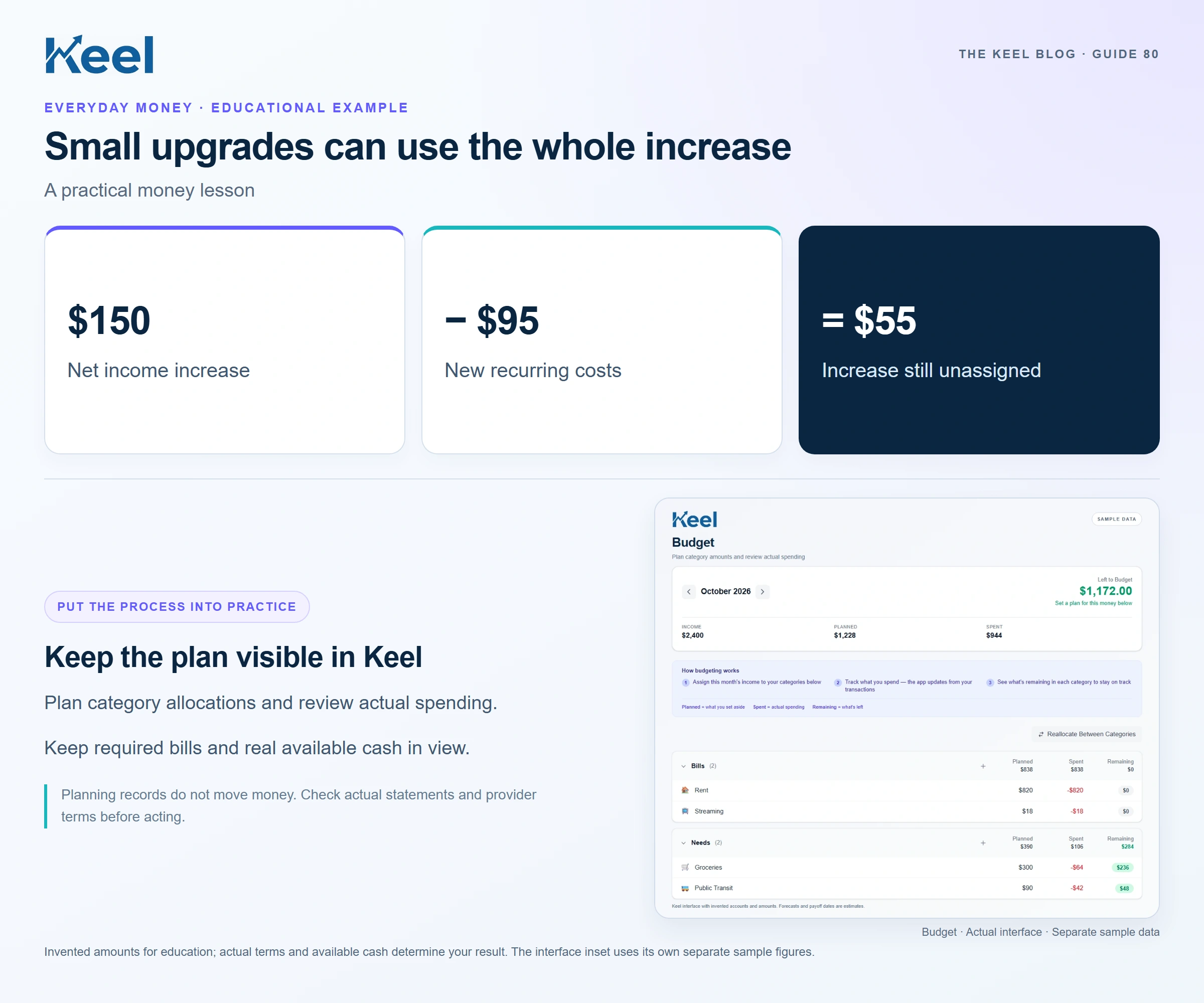
If monthly take-home pay rises $150 but recurring costs rise $95, only $55 of the increase remains before other changes. Over twelve unchanged months, the $95 costs total $1,140. A one-time purchase and a recurring contract affect the future differently, even when the first debit looks similar.
| Item | Amount |
|---|---|
| Net income increase | $150 |
| New recurring costs | −$95 |
| Difference remaining | $55 |
Use Keel to review the pattern
Review Subscriptions, Bills and category spending in Keel. Compare the forecast with realistic expected income and keep debt and savings goals visible. Keel does not automatically label lifestyle creep or decide which upgrade matters to you. Confirm any cancellation with the provider before removing its future cost.
Choose a rule for the next increase
Decide in advance how you will review a new recurring commitment and what part of an income increase gets assigned to existing goals. Keep the rule adjustable when essential costs change. Review after a few normal cycles. Deliberate upgrades are easier to sustain when their full future cost has a place in the plan.
Footnotes and sources
U.S. consumer education. Sources checked . General education, not an individual financial or legal recommendation.