
Understand How Loan Payments Reduce Principal
Read an amortization schedule, separate principal from interest and check why the balance does not fall by the full payment amount.
By Keel · Debt planning ·
Free 7-day trial. No card required. Subscribe for $4.99/month to continue; no charge unless you subscribe.
Know what an amortization schedule describes
An amortization schedule shows how payments divide between interest and principal over a loan’s repayment period. The CFPB explains that with a typical fixed-payment amortizing auto loan, the interest share generally declines as principal is reduced. The schedule depends on agreed terms and assumptions about payment timing; it is not the same as a record of what actually posted.[1]
Look for fees and timing differences
Late charges, daily accrual and changed payment dates can affect how much reaches principal. Ask the servicer how it applies money before assuming the full debit reduces the debt. For some loans, paying extra may also advance a due date; clarify whether you still need the next scheduled payment.[2]
Read a simplified payment split
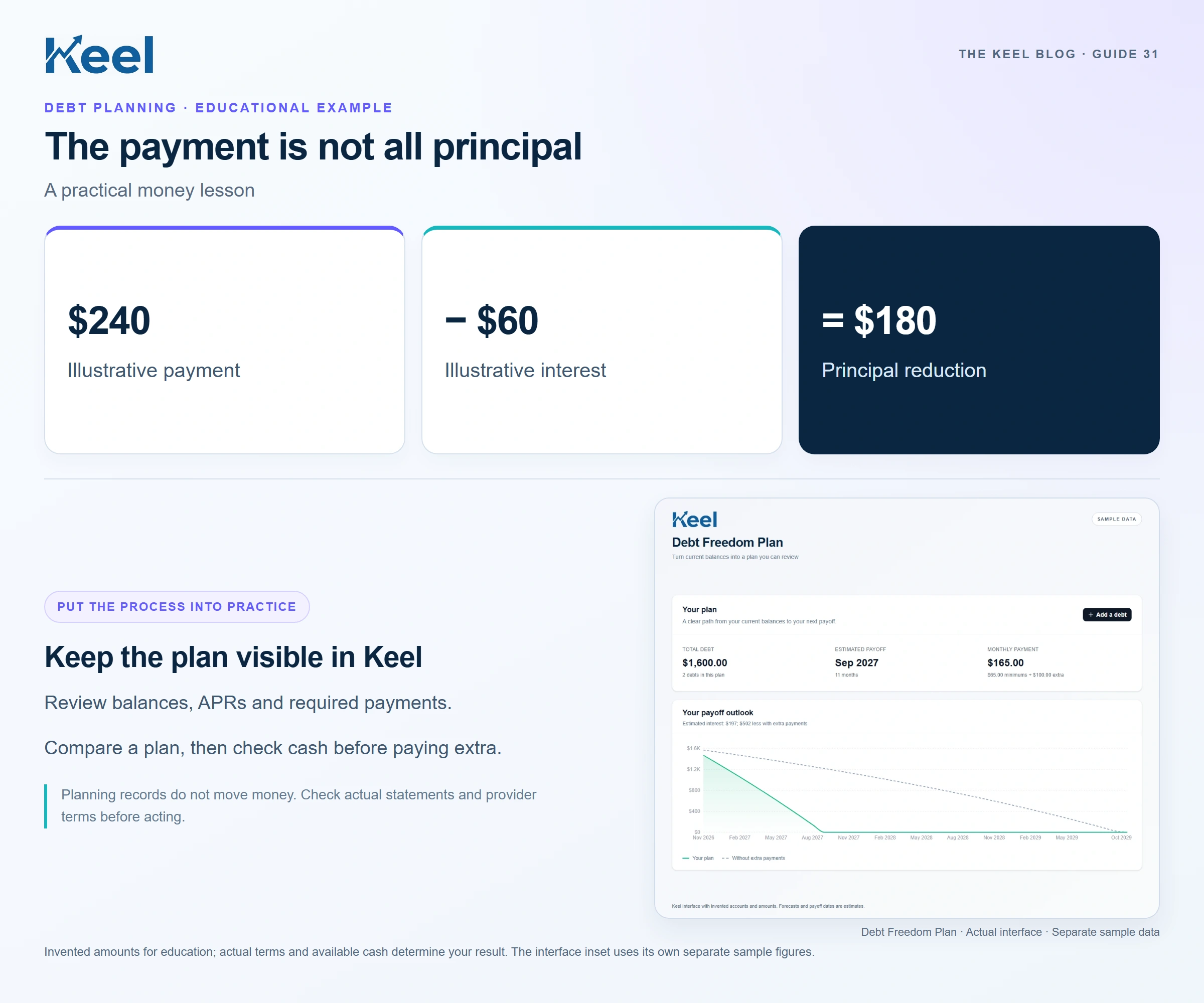
For an invented cycle, a $240 payment covering $60 interest and no fees reduces principal by $180. On a $6,000 opening principal, that leaves $5,820 before later activity. This is an arithmetic illustration, not a quote for a particular APR or term. New borrowing and fees would change the result.
| Item | Amount |
|---|---|
| Opening principal | $6,000 |
| Payment | $240 |
| Interest included | $60 |
| Principal reduction | $180 |
| Remaining principal | $5,820 |
Use Keel for a current planning view
Review Debt in Keel using current lender balances, rates and required payments. Compare an affordable extra amount with the baseline outlook, while keeping the lender’s schedule available for exact servicing questions. Keel estimates a payoff path from its model; it does not provide the lender’s official amortization schedule or certify the next interest charge.
Verify progress with statements
After payment, compare the principal movement and interest charge with your expectation. A difference is a reason to check dates and terms, not to force the app balance to match your mental subtraction. Keep a record of the lender’s explanation. Revisit the plan when a payment amount or rate changes rather than relying on an old printed schedule indefinitely.
Footnotes and sources
U.S. consumer education. Sources checked . General education, not an individual financial or legal recommendation.