
Make Better Needs-and-Wants Decisions
Separate an essential function from an optional upgrade, use consistent categories and make the next purchase decision with current cash commitments visible.
By Keel · Budgeting ·
Free 7-day trial. No card required. Subscribe for $4.99/month to continue; no charge unless you subscribe.
Define the function first
Ask what problem the purchase solves: food, safe transport, communication, work or a discretionary preference. A spending rule such as the CFPB’s needs-and-wants framework can organize a conversation, but circumstances differ. The essential function and the premium version are not necessarily the same decision. Keep health, disability and caregiving needs in the context rather than imposing someone else’s category.[1]
Compare real alternatives
Look at the complete usable cost of an option, not just its advertised price. A cheaper item that cannot perform the required job may not be an alternative. On the other hand, a preferred brand does not automatically make every added feature essential. Decide which part of the cost is a requirement and which part is a choice.
Split an example honestly
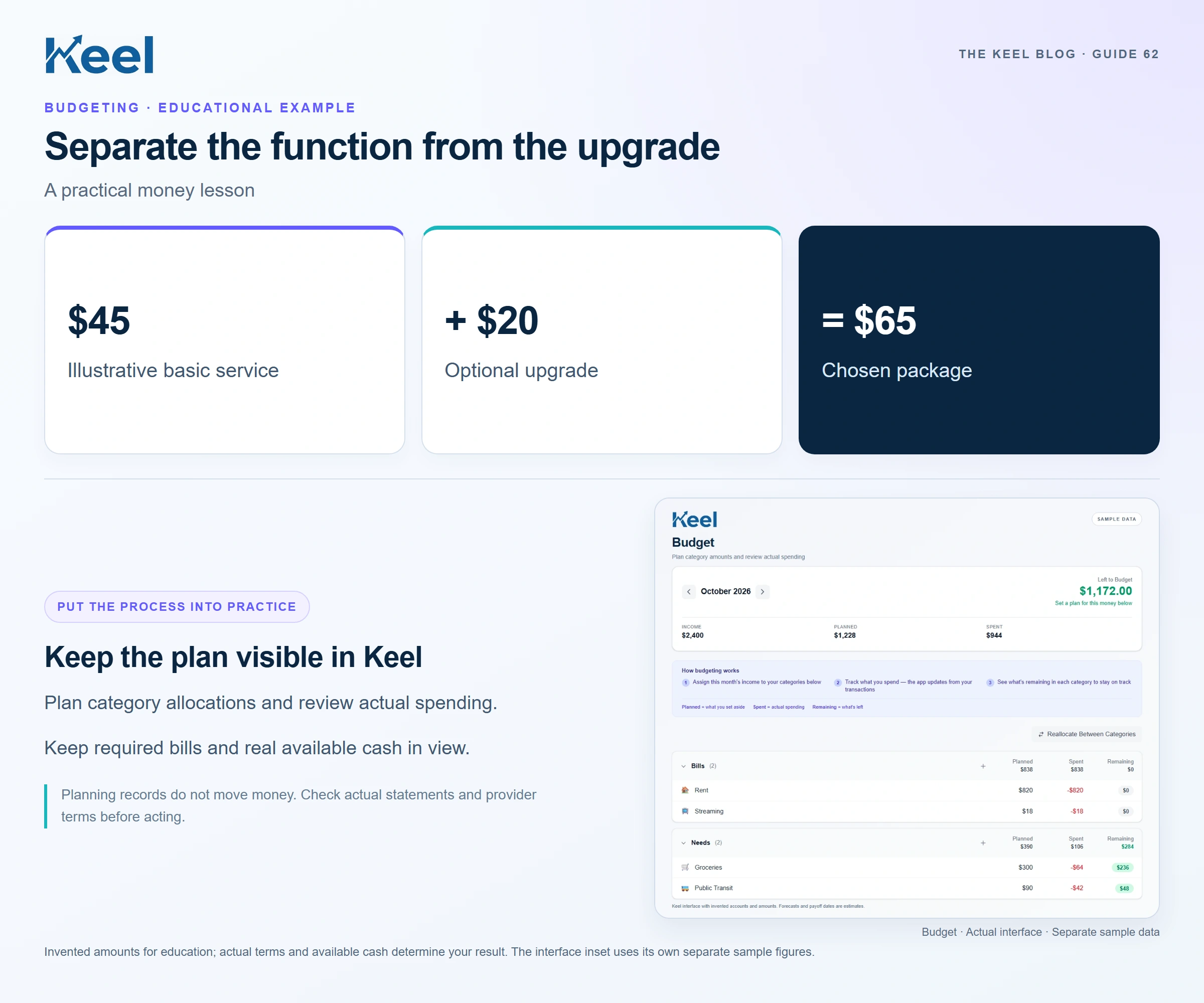
An invented basic communication service is $45, while an optional package adds $20. The selected $65 package contains a $45 baseline and a $20 upgrade for this comparison. That does not establish that $45 is available locally or sufficient for every household. It shows how to evaluate a choice without relabeling the entire premium cost as unavoidable.
| Part | Amount |
|---|---|
| Basic function | $45 |
| Optional upgrade | $20 |
| Selected total | $65 |
Use Keel for consistent tracking
Choose categories and budgets that make the decision visible, then review Transactions against that plan. Check Bills and the forecast before making a recurring commitment. Keel does not automatically classify every transaction as an objective need or want. Correct unclear categories without changing the factual amount or deleting a purchase you regret.[2]
Revisit categories when life changes
A work requirement, family change or canceled service can alter what is essential. Review the current situation rather than defending an old label. An affordable want can be a valid choice; an unfunded essential can still require support or a different plan. The purpose is a clearer tradeoff and an accurate total, not a score for personal discipline.
Footnotes and sources
U.S. consumer education. Sources checked . General education, not an individual financial or legal recommendation.