
Net Worth and Cash Flow Answer Different Questions
Separate the value of what you own and owe from the cash available for upcoming bills, and interpret changes without counting transfers as wealth creation.
By Keel · Everyday money ·
Free 7-day trial. No card required. Subscribe for $4.99/month to continue; no charge unless you subscribe.
Define the balance-sheet question
Net worth subtracts liabilities from assets at a point in time. Tiffany Aliche’s financial-wholeness checklist includes this measure as one part of a broader financial picture. An app view may cover only the accounts and values it knows. A missing loan or untracked asset changes the scope; do not treat a partial total as a complete household balance sheet.[1]
Define the cash-timing question
Cash flow asks when usable money enters and leaves. An asset may be valuable but unavailable for tomorrow’s bill. The CFPB cash-flow framework emphasizes the dates of income and expenses. A rising investment estimate does not automatically fund an upcoming debit, and borrowing can increase cash without improving net worth.[2]
Follow a principal-only payment
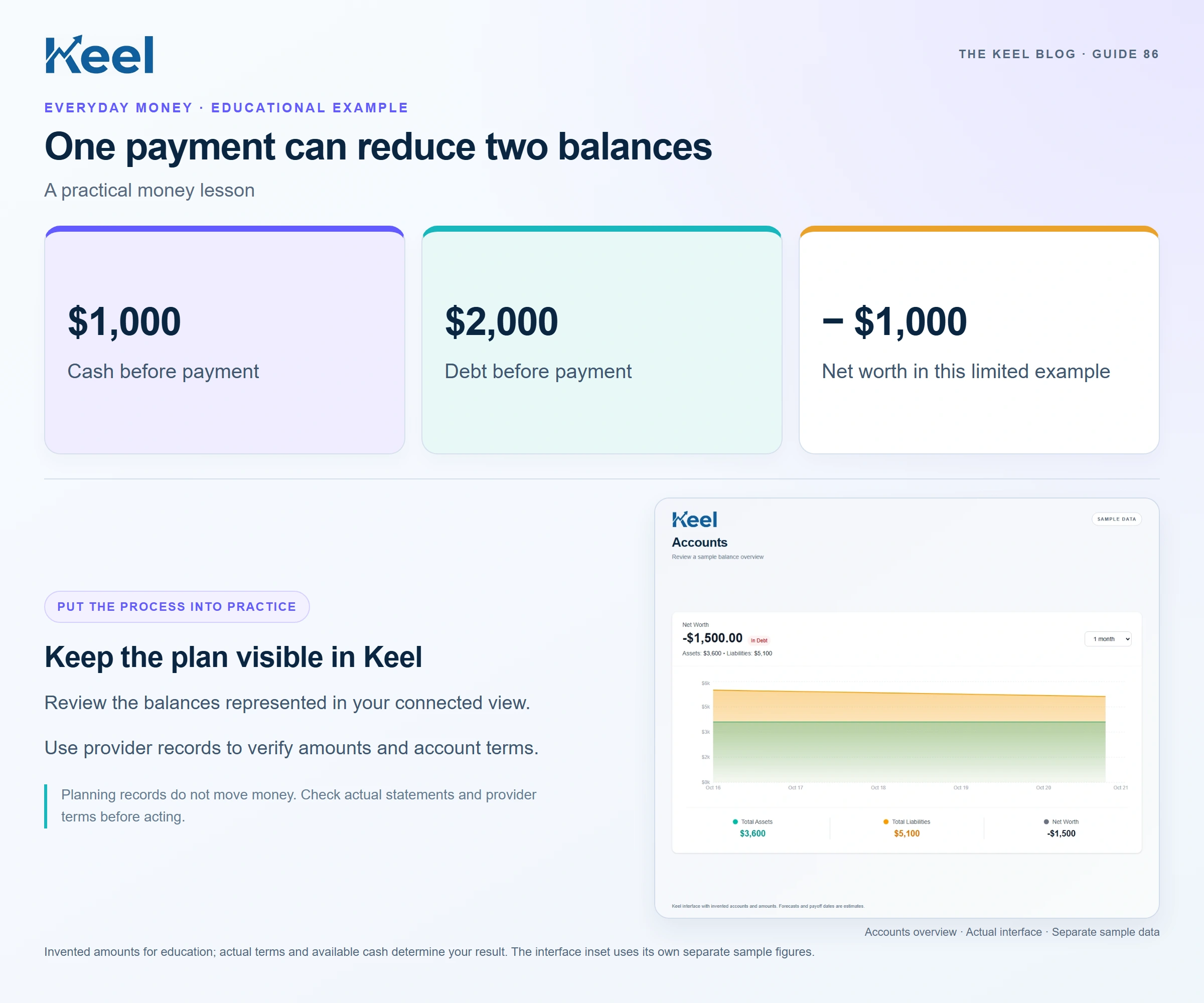
In an invented limited example, $1,000 cash and $2,000 debt give net worth of −$1,000. Paying $100 of principal leaves $900 cash and $1,900 debt: still −$1,000 immediately. Interest and fees are excluded. The payment changes liquidity and debt, while future interest effects are a separate question.
| Position | Cash | Debt | Net worth |
|---|---|---|---|
| Before | $1,000 | $2,000 | −$1,000 |
| After $100 principal payment | $900 | $1,900 | −$1,000 |
Use Keel’s views together
Review Accounts for the balances represented there, Debt for your payoff plan and the forecast for upcoming cash timing. Check whether manual or unconnected obligations are included before interpreting a total. Keel does not automatically appraise property or guarantee that every asset and debt is present. Use current provider records and a separate complete inventory when needed.
Choose progress measures for the job
Use a debt balance to assess remaining repayment, a reserve balance for resilience and a cash forecast for near-term bills. Net worth can add a longer perspective, but it does not replace those checks. Review consistent dates and scopes. A useful financial picture can contain several truthful measures that do not move in exactly the same direction each month.
Footnotes and sources
U.S. consumer education. Sources checked . General education, not an individual financial or legal recommendation.