
Pending, Posted and Available Balance Explained
Understand why a bank balance can differ from a posted transaction total, and check holds and deposit availability before treating cash as free to spend.
By Keel · Everyday money ·
Free 7-day trial. No card required. Subscribe for $4.99/month to continue; no charge unless you subscribe.
Identify the status of each figure
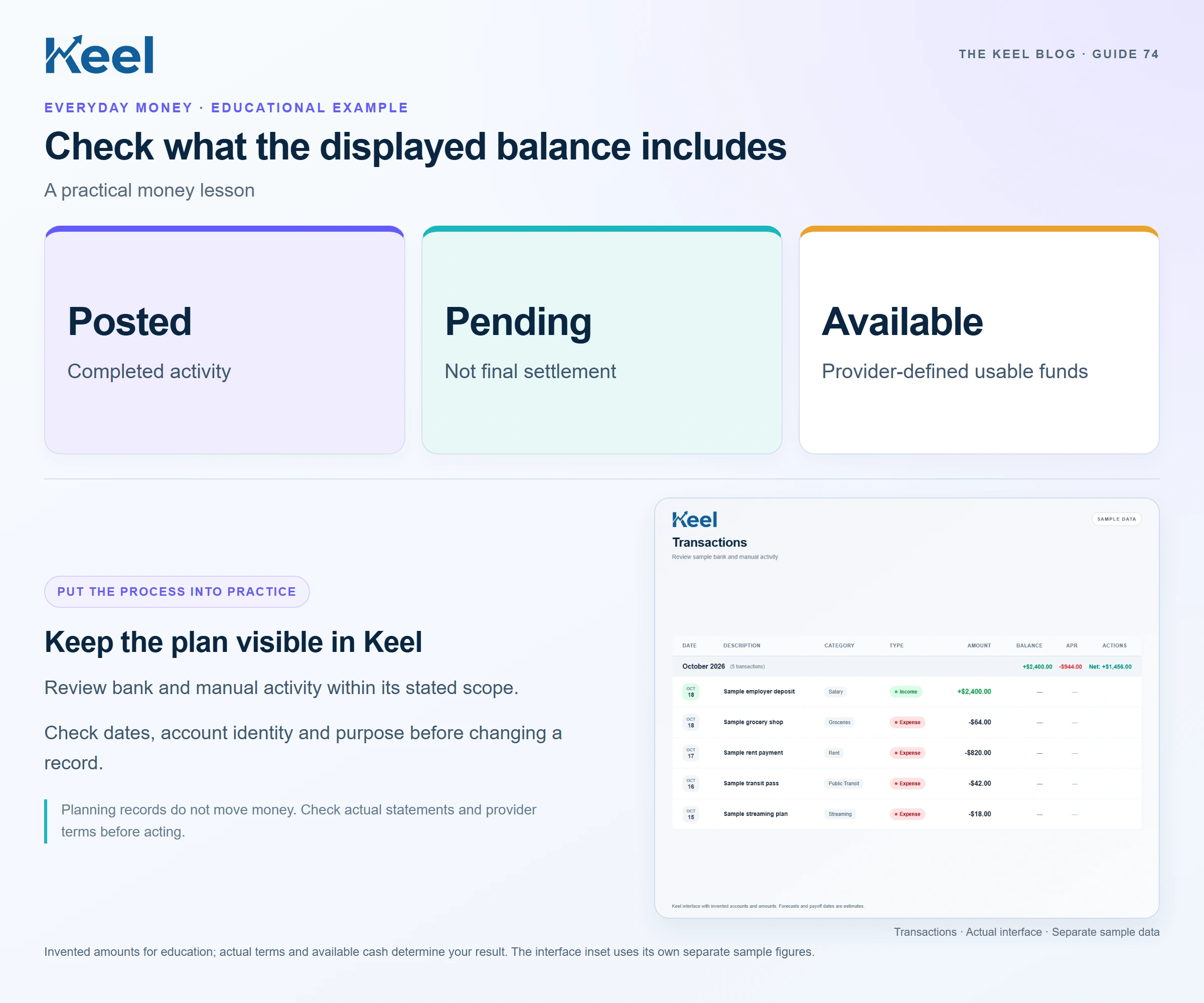
A posted transaction has settled into the provider’s account record. A pending authorization may reserve funds before the final amount or date is established. Available balance is the provider’s usable-funds figure under its rules. It can reflect holds and deposit availability differently from a simple sum of posted rows. Ask the provider which items its displayed balance includes.
Keep spending capacity separate from a transaction list
A fresh deposit or released hold can change usable cash without matching your expectations about the posted list. Automatic payments can create fees when the actual available amount is insufficient. The CFPB recommends monitoring balances and scheduled debits rather than assuming automation handles every cash question.[1]
Avoid counting one hold twice
If an invented $300 available balance already reflects a $40 authorization hold, subtracting that same hold again would show $260 even though it has already been included. This is conditional arithmetic, not a claim about every bank. Confirm the balance definition first, and still account for other obligations the provider has not reserved.
| Figure | Amount |
|---|---|
| Available balance | $300 |
| Same hold already reflected | $40 |
| Do not subtract it again | No second $40 reduction |
Use Keel with provider timing in mind
Review connected balances and the bank’s own record when something looks inconsistent. Inspect the forecast inputs for obligations already reflected in starting cash so they are not duplicated. Keel cannot control bank posting order or guarantee immediate synchronization. A planning estimate should not override the provider’s current availability rules.
Recheck before a large payment
Leave room for outstanding obligations and uncertain timing. Investigate unfamiliar activity promptly through the provider and use its actual statements to confirm settlement. A projected positive balance is not an overdraft guarantee. The CFPB’s overdraft guidance can help you understand the provider options that apply to your account.[2]
Footnotes and sources
U.S. consumer education. Sources checked . General education, not an individual financial or legal recommendation.