
Ramit Sethi’s Conscious Spending Plan Explained
Learn the purpose of Sethi’s four spending buckets, test them against your real obligations and use Keel to review choices without inventing automation.
By Keel · Money methods ·
Free 7-day trial. No card required. Subscribe for $4.99/month to continue; no charge unless you subscribe.
Understand the four-bucket idea
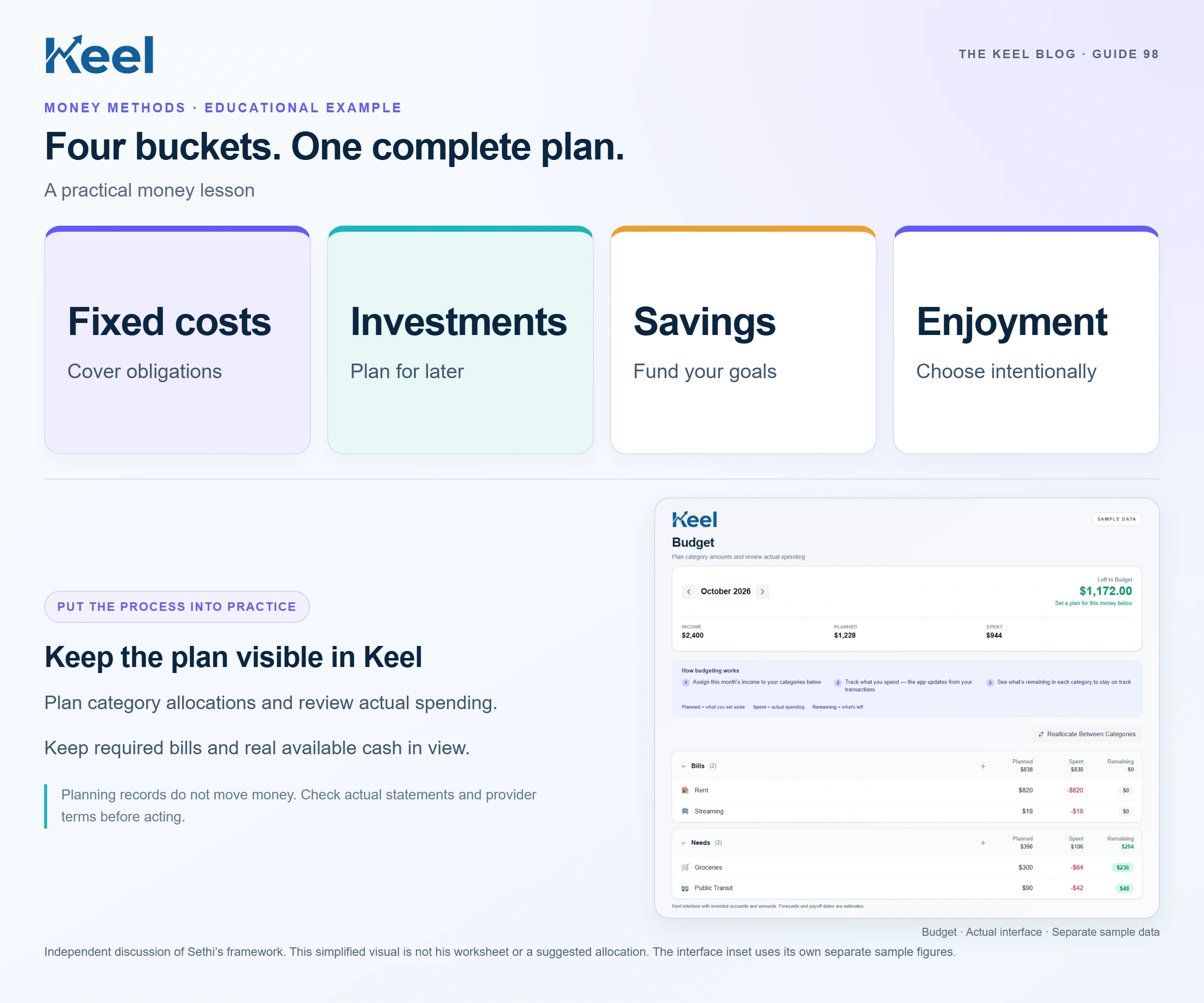
Ramit Sethi’s Conscious Spending Plan separates fixed costs, investments, savings and guilt-free spending. His explanation emphasizes intentional priorities and an affordable place for enjoyment rather than tracking solely for restriction. The categories belong to Sethi’s framework; they are not a claim that Keel has a built-in Conscious Spending mode or that every household can use the same percentages.[1]
Use a realistic baseline before assigning enjoyment
List actual take-home income, necessary costs and required payments. Include annual expenses and constraints that a neat percentage can hide. The CFPB’s spending-rule worksheet explicitly allows adapting a rule to personal circumstances. A high essential-cost share is a constraint to address, not evidence that a household simply chose the wrong attitude toward money.[2]
Check a complete invented allocation
Suppose $3,200 take-home pay is assigned as $1,900 fixed costs, $300 investing, $350 savings and $650 discretionary spending. The allocations total $3,200. This is an original arithmetic example, not Sethi’s recommended split or individualized advice. If retirement saving was already deducted before the take-home figure, define the accounting consistently so it is not counted again.
| Purpose | Amount |
|---|---|
| Fixed costs | $1,900 |
| Investing | $300 |
| Savings | $350 |
| Discretionary | $650 |
| Total | $3,200 |
Use Keel to review the choices
Review category budgets and actual transactions, funded Savings goals and the effect of bills on cash timing. Keep investment decisions and provider transfers outside assumptions about Keel’s role. Keel does not recommend investments, automatically implement Sethi’s percentages or move money into those buckets. A budget allocation is a planning record, not a separate funded account.
Evaluate whether the plan supports your priorities
Compare actual activity with the chosen allocation and ask which spending was worthwhile. Revise one commitment when the numbers or priorities change. Keep repayment and reserve needs visible before enlarging fixed costs. This independent explanation is not an endorsement from Sethi or an affiliation with his business; readers can consult the original framework through the footnotes.
Footnotes and sources
U.S. consumer education. Sources checked . General education, not an individual financial or legal recommendation.