
Handle Refunds and Reimbursements Clearly
Distinguish returned spending, shared-cost reimbursements and earned income, then verify when a credit actually becomes available.
By Keel · Everyday money ·
Free 7-day trial. No card required. Subscribe for $4.99/month to continue; no charge unless you subscribe.
Identify what the incoming amount is for
A merchant refund reverses part or all of a purchase. A reimbursement may repay your share of an expense you advanced for someone else. Earned income is a different event. Give the record a purpose before interpreting a total. Moving every credit into an income category can make ordinary earnings appear larger than they are.
Wait for the actual credit
Keep cancellation or return confirmation and check the account where the credit is expected. A credit to a card is not automatically a cash deposit to checking. Ask the issuer whether a refund changes the amount due this cycle. CFPB card guidance distinguishes statement balances and payment obligations; do not assume a pending return replaces a required payment.[1]
Work through a partial refund
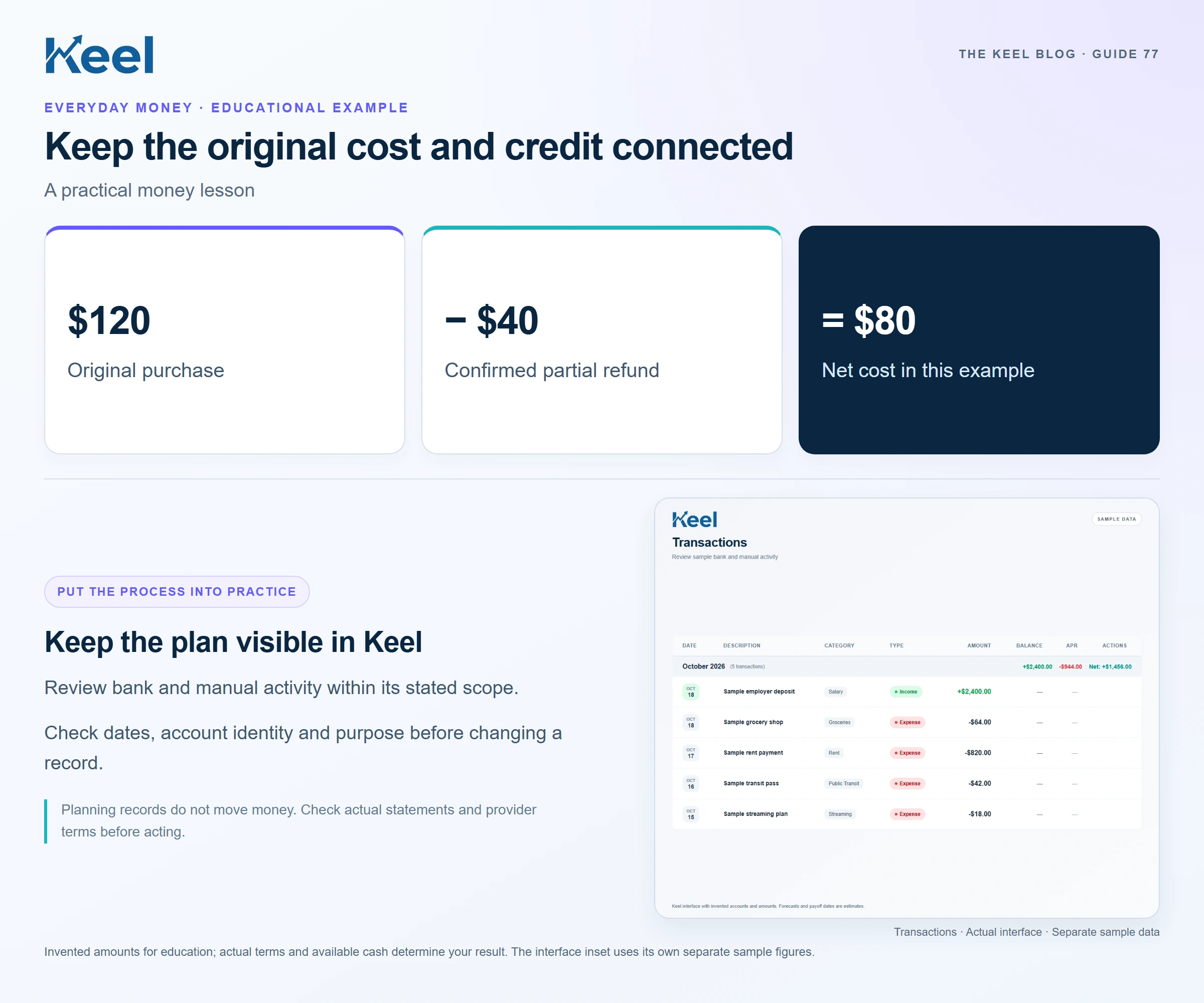
An invented $120 purchase followed by a confirmed $40 refund has an $80 net cost. If the two events fall in different reporting periods, a monthly view may look unusual even though both records are correct. Preserve the dates instead of moving a real transaction merely to smooth the chart.
| Event | Amount |
|---|---|
| Original cost | $120 |
| Refund | −$40 |
| Net cost | $80 |
Use Keel to review the underlying records
Check the incoming transaction, account identity and category in Keel, and review purpose information when an incoming transfer needs clarification. Compare reports with the same date range and scope. Keel does not request a refund, guarantee reimbursement or determine an employer’s expense policy. Keep receipts and approvals outside ordinary budget notes.[2]
Assign the money once
If you temporarily used reserve cash for a reimbursable expense, decide whether the received reimbursement restores that reserve. Do not count it as both reserve replenishment and fresh spending money. Follow up on overdue reimbursements through the relevant provider or person. A clear record protects the cash plan while the credit is still uncertain.
Footnotes and sources
U.S. consumer education. Sources checked . General education, not an individual financial or legal recommendation.