
Use Round-Up Savings as a Supplement
Estimate what spare-change transfers can contribute, check fees and cash timing, and avoid spending more just to create larger round-ups.
By Keel · Savings ·
Free 7-day trial. No card required. Subscribe for $4.99/month to continue; no charge unless you subscribe.
Understand the mechanism
A round-up arrangement generally moves an additional amount based on purchases into another destination. It uses your money; it is not a discount from the merchant. Provider rules differ, including whether transfers are batched or have minimums. Read the terms and confirm the destination. Keel does not offer or execute a round-up transfer service.
Compare contribution potential with the goal
A savings target needs a realistic contribution pace. The CFPB’s savings-plan approach helps translate a goal into amounts and dates. If a goal needs $100 this month, a round-up habit that contributes $20 leaves $80 to find elsewhere. Increasing purchases to create more round-ups adds spending rather than creating free progress.[1]
Subtract the costs
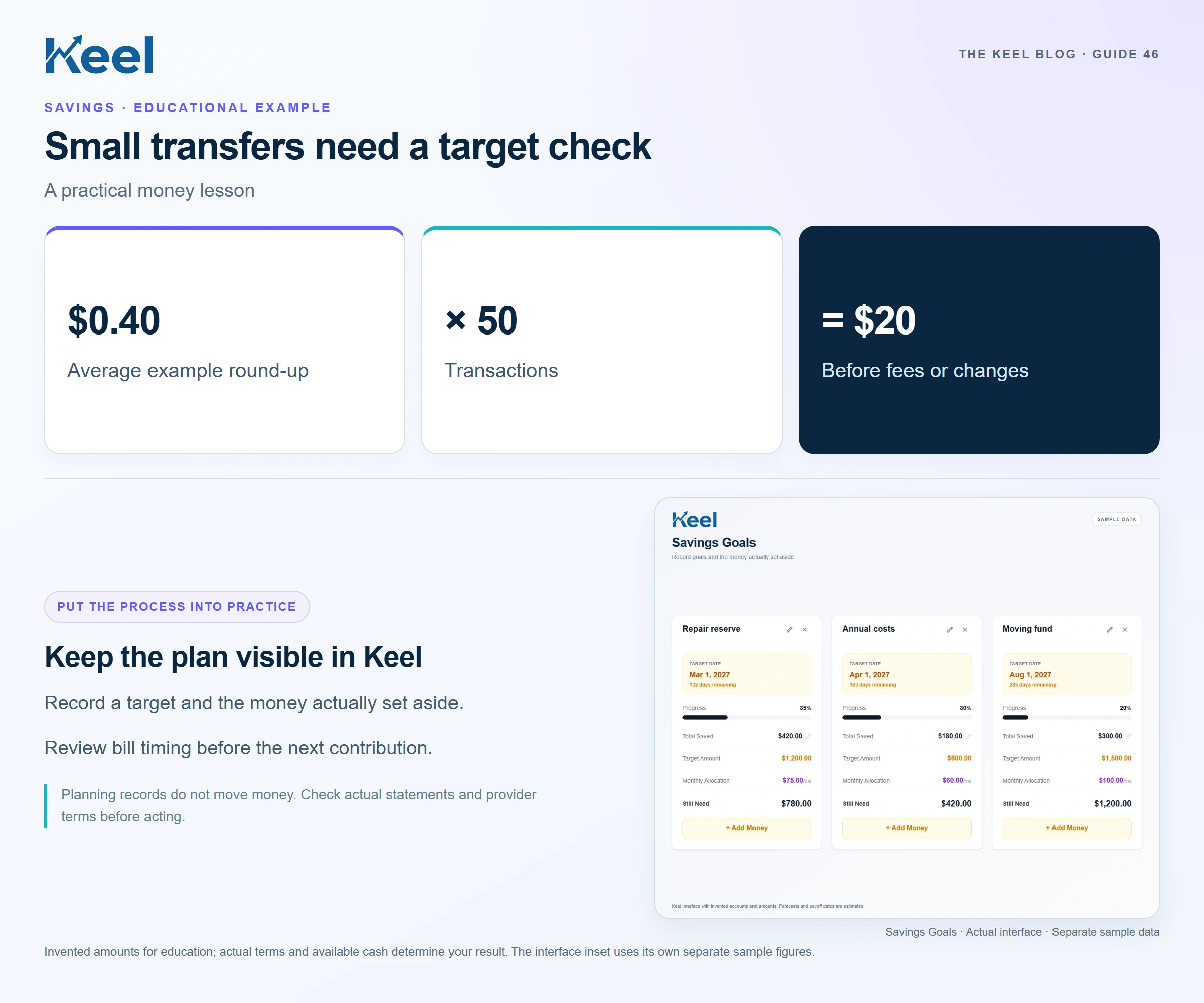
Fifty invented round-ups averaging $0.40 total $20. If a separate $3 fee is charged for the arrangement that month, the net gain relative to not paying that fee is $17, ignoring interest. Actual provider pricing varies. A percentage comparison on small transfers can make a modest fee significant.[2]
| Item | Amount |
|---|---|
| 50 × $0.40 transferred | $20 |
| Illustrative program fee | −$3 |
| After that fee | $17 |
Use Keel for the broader view
Review actual spending in Transactions and track the funded savings goal after completed transfers. Check the cash forecast for any separate debit timing. Avoid counting an internal transfer as newly earned income or the same saved cash toward multiple goals. Keel can record the plan; provider statements establish the transfer and charges.
Review whether the tool still earns its place
Compare actual contributions, fees and account pressure over a few cycles. A small fixed transfer may offer more predictable progress if it is affordable. Keep whichever arrangement fits your situation and can be verified. Spare-change transfers can support a habit, but a deadline goal still needs a complete funding plan.
Footnotes and sources
U.S. consumer education. Sources checked . General education, not an individual financial or legal recommendation.