
Build Your First $100 Savings Habit
Start with a small, affordable savings milestone, choose a real place for the money and track contributions without mistaking a goal entry for cash.
By Keel · Savings ·
Free 7-day trial. No card required. Subscribe for $4.99/month to continue; no charge unless you subscribe.
Choose a useful first milestone
A first savings goal should be small enough to act on and meaningful enough to keep visible. The FDIC encourages beginning with an affordable amount even when a fixed percentage is out of reach. A $100 milestone is an example, not a complete emergency fund or proof that a household is prepared for every disruption.[1]
Find a contribution in the actual pay period
Check food, housing, transport and required payments before setting an amount. Look for a real change, such as an avoided purchase, rather than guessing what ought to be left. If there is no safe surplus, focus first on the bill shortfall. A savings habit should not require missing essentials or creating a new overdraft.[2]
Use an achievable sequence
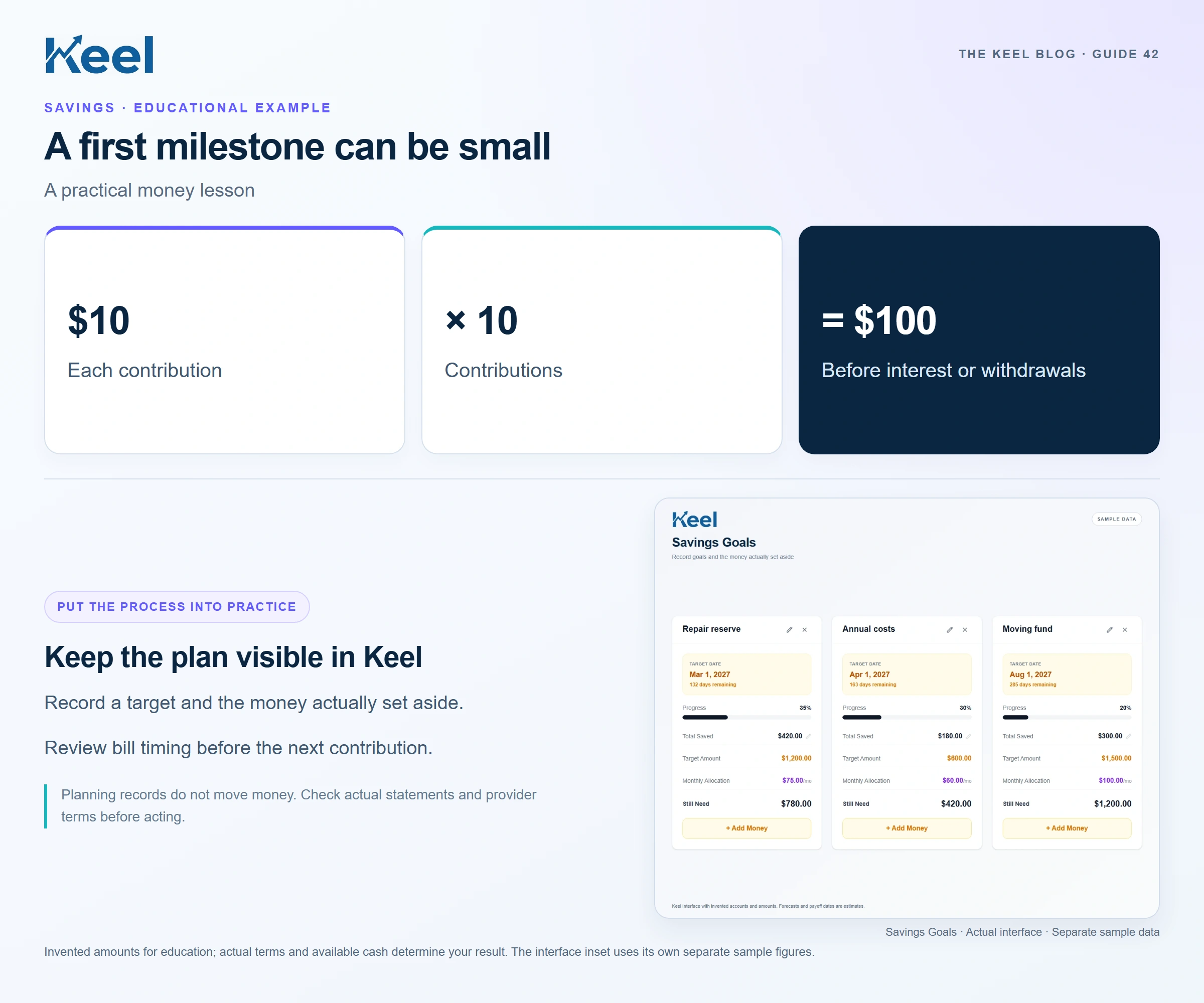
Ten invented contributions of $10 add $100 before interest or withdrawals. If a particular week only supports $3, record $3 and revise the timeline. A skipped or smaller contribution does not erase money already saved. Measure the actual funded balance rather than claiming the original schedule was completed.
| Contribution size | Number | Total |
|---|---|---|
| $10 | 10 | $100 |
| $5 | 20 | $100 |
Track real progress in Keel
Create a Savings goal with your milestone and update the saved amount after money is actually set aside. Check Bills and the forecast before committing the next contribution. Keel does not open a savings account or transfer the contribution. If the same cash is assigned to several goals, review the allocations so their combined records do not exceed the money available.
Give the milestone a rule for use
Decide what would justify spending this reserve and how to rebuild after a withdrawal. Keep predictable costs in their own plan where possible. Once $100 is genuinely funded, choose the next step based on your risks and budget. The useful achievement is a repeatable process supported by real money, not a badge that implies the work is finished.
Footnotes and sources
U.S. consumer education. Sources checked . General education, not an individual financial or legal recommendation.