
Match Your Money to When You Need It
Separate near-term spending, emergency access and longer-term goals before choosing where money belongs or how much risk it can take.
By Keel · Savings ·
Free 7-day trial. No card required. Subscribe for $4.99/month to continue; no charge unless you subscribe.
Write down the earliest likely use
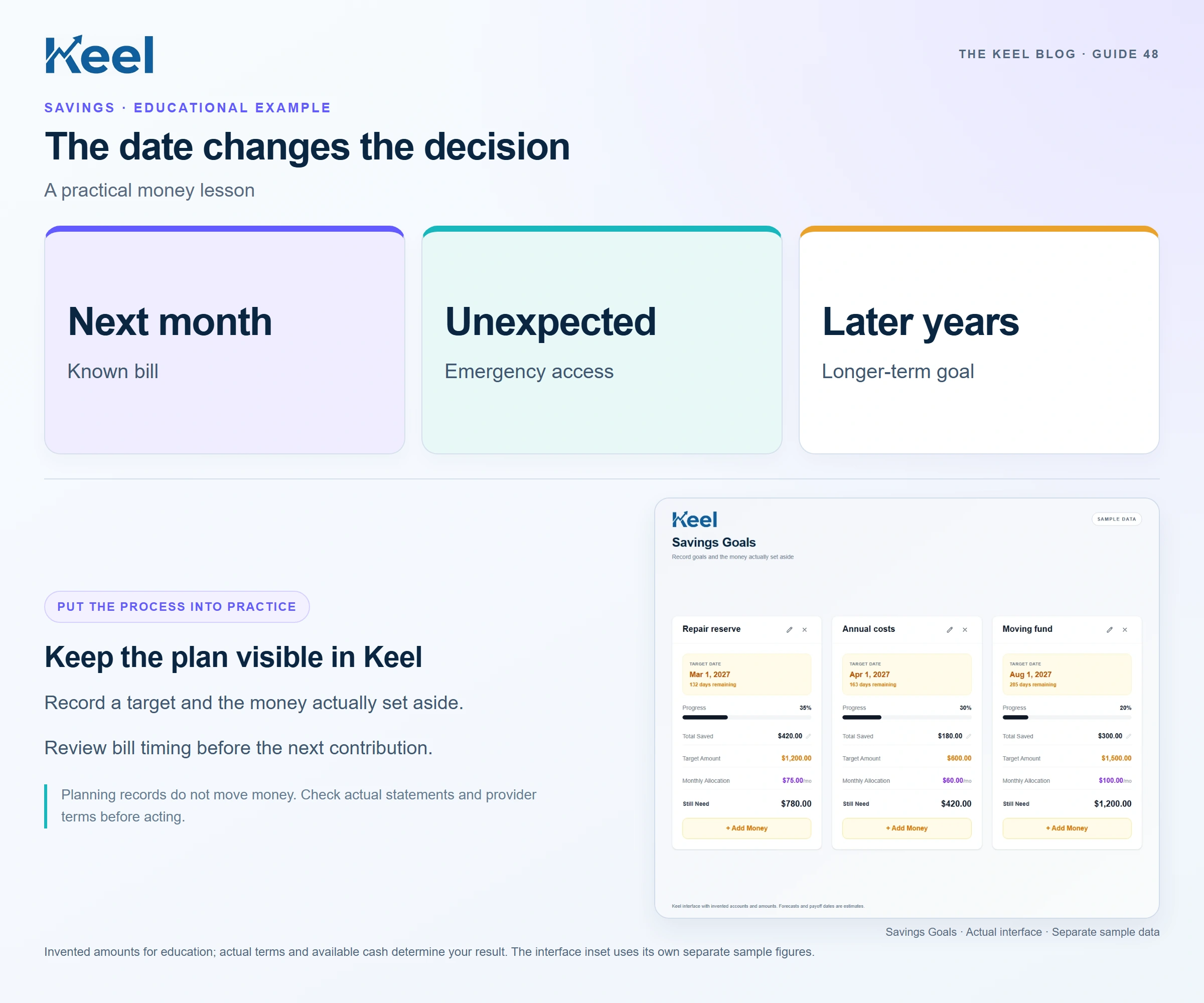
A goal’s time horizon describes when its money may be needed. A known bill in six weeks differs from a flexible purchase several years away. CFPB goal-setting tools distinguish near-term and longer-term aims. Include uncertainty: an emergency reserve can be needed sooner than its owner expects, even if it has sat untouched for a year.[1]
Check access before chasing a return
Deposit products can have withdrawal rules, minimums or penalties. A certificate of deposit may tie money to a stated term; read its maturity and early-withdrawal conditions. A higher quoted yield is not automatically better for money needed at short notice. Market investments and insured deposits also have different risks and protections.[2] [3]
Separate the jobs in a simple example
Suppose an invented $2,500 includes $600 for an upcoming bill, $1,400 for emergencies and $500 for a flexible goal. These total $2,500, not three separate balances beyond that amount. Choosing a storage arrangement does not change what is already committed. Keep the emergency portion accessible under terms suited to its job.
| Purpose | Amount |
|---|---|
| Upcoming bill | $600 |
| Emergency reserve | $1,400 |
| Flexible goal | $500 |
| Total | $2,500 |
Use Keel to keep purposes visible
Use Bills for confirmed obligations and Savings for funded goals, then inspect the forecast around near-term dates. Keel does not recommend a specific investment, open deposits or determine an account’s insurance coverage. Verify actual terms and seek appropriate individual advice when choosing longer-term investments or dealing with tax-sensitive accounts.
Revisit the horizon when life changes
A move, job change or revised deadline can turn previously flexible money into near-term cash. Review before locking it into a new term. Keep money for imminent obligations separate in the plan from funds you could leave untouched. The practical aim is a suitable match between purpose, access and risk, not the highest rate on a comparison screen.
Footnotes and sources
U.S. consumer education. Sources checked . General education, not an individual financial or legal recommendation.