
Use sinking funds for expenses you know are coming
A bill can be infrequent and still be predictable. Give it a place in the plan before the due month arrives.
By Keel · Savings ·
Free 7-day trial. No card required. Subscribe for $4.99/month to continue; no charge unless you subscribe.
Find the expenses a normal month hides
Review a full year of records when available. Look for renewals, seasonal utilities, school costs, gifts, maintenance and other costs that do not appear in every month. The CFPB’s spending guidance specifically encourages checking less frequent expenses, and its savings worksheet breaks targets into manageable contributions. Make a distinction between a contractual amount you know and a rough allowance for something like repairs. The first has a fixed invoice and date; the second needs a sensible estimate and periodic review. Both deserve attention before they become a cash surprise.[2]
Choose a target, a deadline and a real place for the money
Write down the expected cost and when you need the cash. Subtract amounts genuinely reserved for that purpose, then count the contribution opportunities remaining before the deadline. Do not count a paycheck scheduled for after the bill is due. Decide whether the reserve lives in one account with clear records or another arrangement you can maintain. Whatever you choose, a bank balance and several goal balances are not separate piles of cash unless you have actually funded and allocated them that way.
Calculate the contribution from the remaining gap
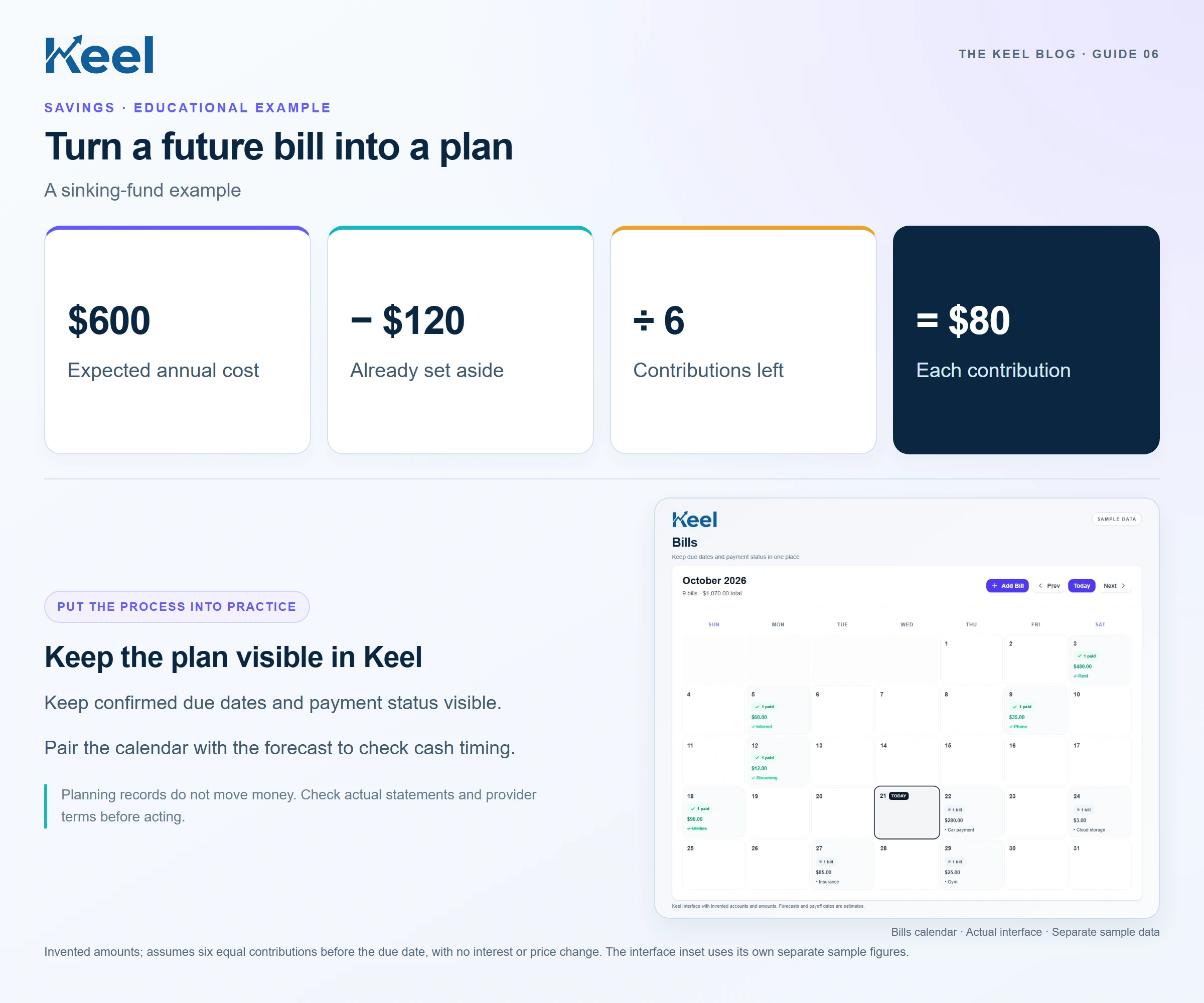
An invented annual bill is $600, $120 is already reserved and six equal contributions remain before the due date. The unfunded gap is $480, so the target contribution is $80 each time. If only four opportunities remain, the same gap requires $120 each time. That is why dividing every annual bill by twelve can be misleading when you start late in the cycle. These calculations exclude interest, fees and changes to the actual price.[1]
| Step | Amount |
|---|---|
| Expected bill | $600 |
| Already reserved | $120 |
| Remaining gap | $480 |
| Six contributions remaining | $80 each |
| Four contributions remaining instead | $120 each |
Make room before committing the contribution
Compare the target with upcoming essentials and required payments. If the contribution cannot fit, change something real: reduce the planned purchase, extend a flexible goal deadline, find additional resources or investigate a provider-approved arrangement for a contractual bill. Merely entering the desired contribution into an app does not make it affordable. Keep flexible wishes distinct from obligations that have penalties. If you have several sinking funds, add their contributions together; individually small targets can still exceed the cash you have available.
Use Savings and Bills in Keel
Use a savings goal to record the target and the amount actually set aside. Put the bill itself on the appropriate date in Bills and inspect the cash forecast near that date. Confirm that the reserve’s cash is not also being treated as available for extra debt payments. Keel can help you track the plan and its dates, but its goal records do not open accounts or transfer funds. Move money through your provider, then update records so the goal reflects a real funded amount rather than an intention.
Close one cycle and start the next deliberately
When the bill is paid, compare the final amount with the estimate, update the remaining reserve and decide what next year needs. A lower final cost may leave money to reassign; a higher cost may call for a different contribution. Review whether the item still belongs in the plan rather than automatically renewing every target. Keep proof of contractual changes with the provider. The useful rule is to make known costs visible early, not to build so many named buckets that maintaining them becomes another source of confusion.
Footnotes and sources
U.S. consumer education. Sources checked . General education, not an individual financial or legal recommendation.