
Turn a Money Wish Into a SMART Goal
Choose a specific financial target, test the contribution against your budget and define a review process that measures funded progress.
By Keel · Routines ·
Free 7-day trial. No card required. Subscribe for $4.99/month to continue; no charge unless you subscribe.
Replace a wish with a defined outcome
The CFPB’s SMART framework asks whether a goal is specific, measurable, achievable, relevant and time bound. Instead of saying save more, name the purpose, amount and date. A goal should connect with something you value. Choosing one or two priorities can make the next action clearer than creating a long list of equally urgent targets.[1]
Identify what is already funded
Subtract money genuinely reserved for that purpose. Do not count an expected gift, unconfirmed refund or the same cash assigned to another goal. Then count contribution opportunities before the deadline. CFPB savings worksheets connect a remaining target with regular contributions; the dates matter as much as the arithmetic.[2]
Test an invented target
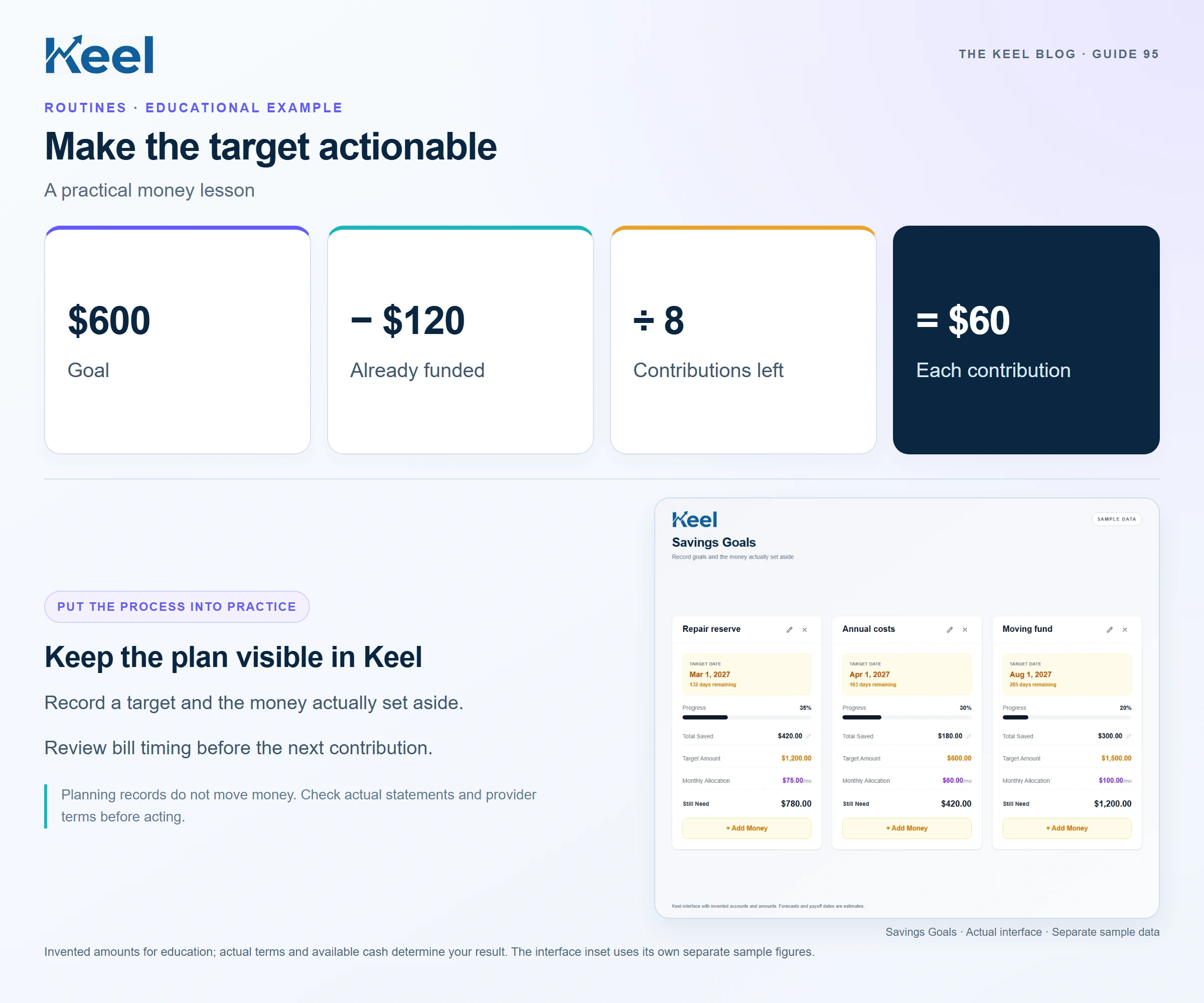
A $600 target with $120 already funded leaves $480. Eight contributions require $60 each. If the budget supports only $40, eight contributions add $320 and leave $160 still unfunded. Change the target, date or a real budget choice rather than describing the original goal as achievable without a funding source.
| Item | Amount |
|---|---|
| Remaining gap | $480 |
| 8 × $60 | $480 |
| 8 × affordable $40 instead | $320 |
| Gap still left | $160 |
Track it in Keel
Use Savings for a target, funded balance and supported goal details. Review Bills and the forecast before allocating the next contribution. Keel records the goal; it does not move money, guarantee the deadline or create additional income. Update the saved amount from real funding and check that the same cash is not assigned twice.
Define the review and the fallback
Choose when to compare actual progress with the plan and what change would trigger a revision. A needed withdrawal or missed contribution is new information, not a reason to falsify the balance. Keep the purpose visible and decide the next affordable action. A good goal improves a decision even when the initial timeline needs to change.
Footnotes and sources
U.S. consumer education. Sources checked . General education, not an individual financial or legal recommendation.