
Audit subscriptions before the next renewal
The useful savings number comes after a cancellation or downgrade takes effect, not when you first notice a charge.
By Keel · Bills ·
Free 7-day trial. No card required. Subscribe for $4.99/month to continue; no charge unless you subscribe.
Build a list that includes annual renewals
Review several months of bank and card statements, and a longer period for annual services when records are available. Include app-store subscriptions, merchant memberships and charges processed through payment services. The CFPB recommends accounting for less frequent expenses when assessing spending. A monthly-only search can miss a large renewal that happens once a year. Write down the merchant, payment source, amount, frequency, renewal date and the service you actually receive.[2]
Verify the charge before calling it a duplicate
Two similar merchant names may represent separate services or purchases, while a purchase and its funding transaction can describe the same underlying activity. Check dates, account identity and the merchant’s own billing history. Do not delete or cancel a legitimate service solely because the amounts match. If a charge is unfamiliar, investigate through a verified channel and check whether another authorized household member recognizes it. Separate a billing error from a service you simply no longer want.
Calculate the decision in a comparable period
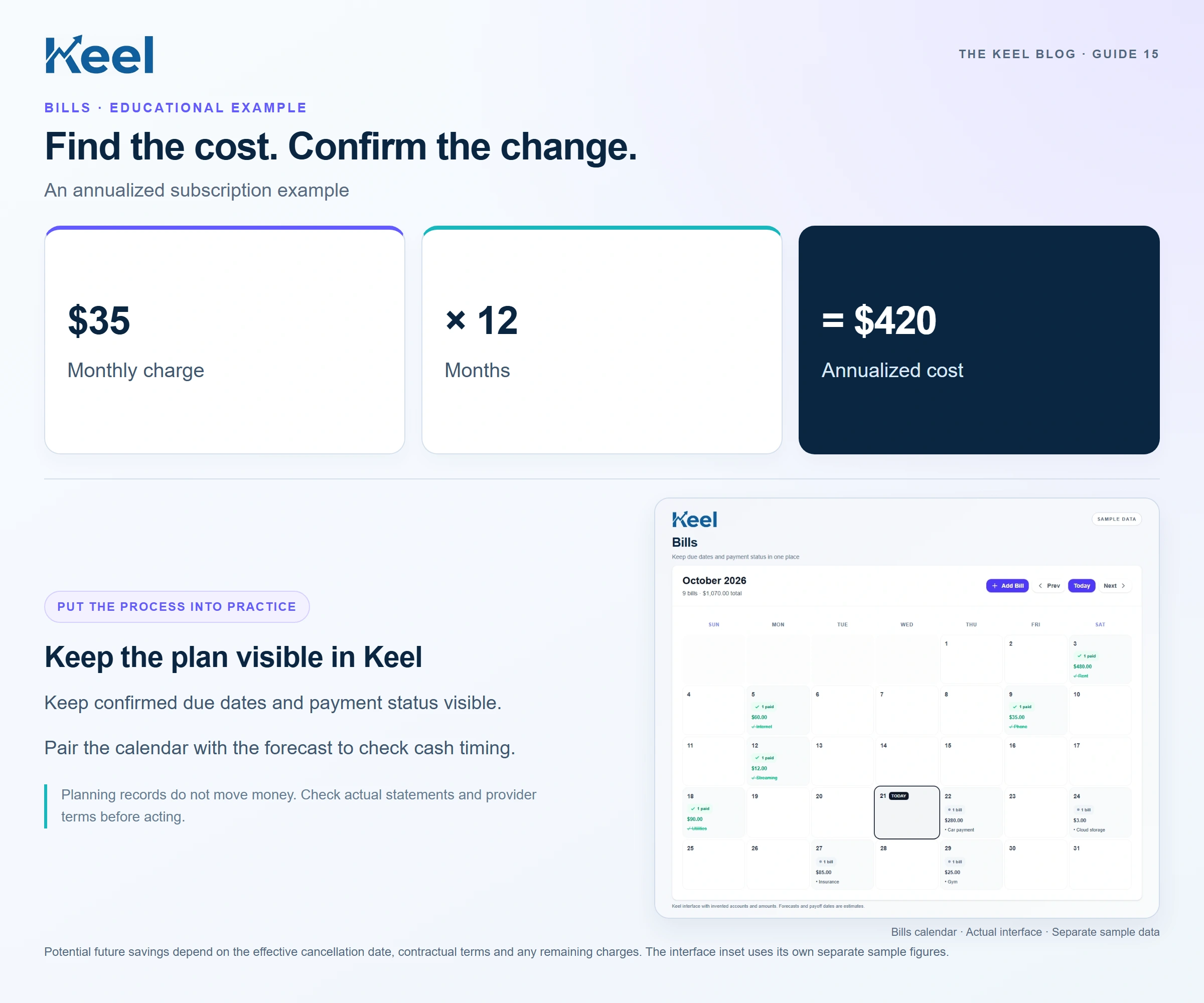
An invented $35 monthly service costs $420 over twelve unchanged monthly charges. That is its annualized cost, not a guaranteed refund or immediate savings. A contract, notice period, already-paid annual term or replacement service can change the result. Compare what you will actually avoid paying after the effective date. Consider a suitable downgrade as well as cancellation, and avoid counting a smaller headline price if the new plan adds fees or removes something you must replace.
| Calculation | Amount |
|---|---|
| Monthly charge | $35 |
| Twelve unchanged charges | $420 |
| Immediate savings before confirmation | Not established |
Cancel through the provider and keep proof
The FTC advises reviewing terms, following the cancellation process and keeping records. Removing an app or hiding a charge in a budget does not necessarily cancel the subscription. Save the confirmation, effective date, reference number and any remaining amount owed. For unwanted charges after cancellation, contact the provider and, where appropriate, your payment issuer using official dispute procedures. Do not assume every renewal has the same refund right or cancellation terms.[1]
Use Keel to find and follow up on recurring costs
Review Keel’s detected subscriptions and correct suggestions that do not represent an ongoing service. Check upcoming renewals alongside Bills so annual charges are visible before they arrive. Keel’s planning controls do not contact the merchant or stop billing. After canceling externally, update the plan to match the confirmed effective date and inspect future statements. A service can disappear from your planned outflows while a contractual charge is still due if the records are changed too early.
Give verified savings a job
After confirming that charges have stopped, decide whether the freed money belongs in a reserve, an essential category or an extra debt payment. Check the cash forecast before committing the full annualized number as though it were available today. Revisit the subscription list periodically and before large annual renewals. The goal is a smaller set of useful services and accurate future obligations, rather than a one-time list of cancellation intentions.
Footnotes and sources
U.S. consumer education. Sources checked . General education, not an individual financial or legal recommendation.