
Plan a Third-Paycheck Month Carefully
Understand biweekly pay, check the real payroll calendar and assign an additional paycheck without overlooking the costs it must still cover.
By Keel · Budgeting ·
Free 7-day trial. No card required. Subscribe for $4.99/month to continue; no charge unless you subscribe.
Identify your actual pay frequency
Twice-monthly pay commonly produces twenty-four deposits each year, while a biweekly schedule commonly produces twenty-six. Some payroll calendars differ, so use your employer’s dates. Gross salary divided by twelve does not tell you the cash arriving in each calendar month. Check the pay stub and net amount rather than assuming every deposit will be identical.[1]
Decide how the regular budget is built
If ordinary monthly commitments are based on two biweekly paychecks, months with a third can provide planning flexibility. If your budget already allocates annual income evenly, that third check may already have a job. Avoid switching methods midway and counting it twice. A cash-flow budget connects the actual deposit dates with the expenses they must cover.[2]
Work through the annual view
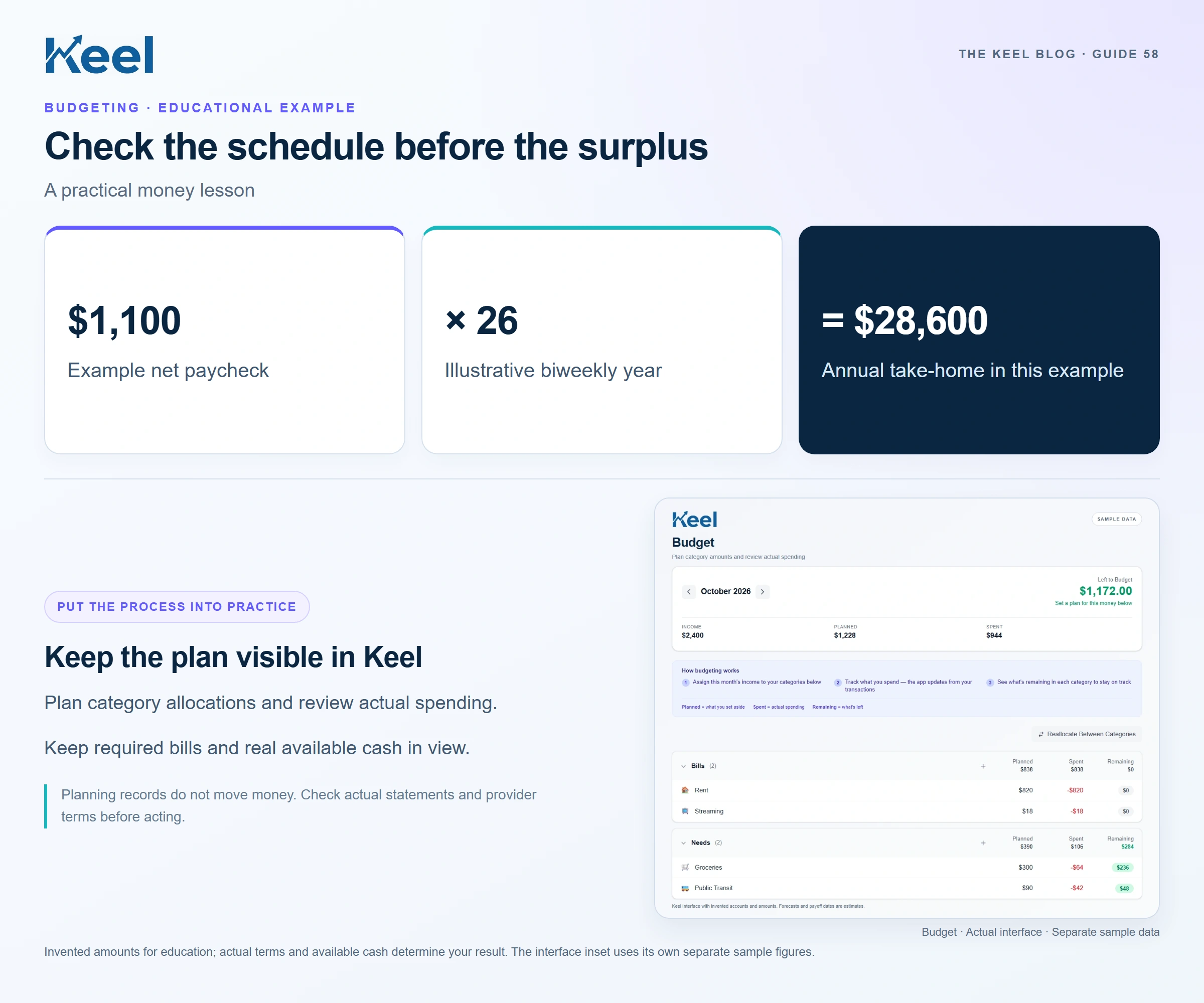
Twenty-six invented $1,100 net deposits total $28,600. Budgeting only two such deposits in each of twelve months accounts for $26,400, leaving $2,200 across the additional deposits. This does not mean the household has $2,200 of surplus: it still depends on living costs, irregular bills and the chosen budgeting method.
| Calculation | Amount |
|---|---|
| 26 × $1,100 | $28,600 |
| 24 × $1,100 | $26,400 |
| Difference | $2,200 |
Assign the deposit in Keel
Review upcoming Bills and the forecast before choosing a reserve contribution or extra debt payment. Use Savings for funded goals and Debt for a revised payment scenario. Keel does not determine your employer’s payroll calendar or classify a paycheck as automatically disposable. Keep current cash and future expected income separate in the forecast inputs.
Avoid a permanent commitment from a temporary bump
An additional paycheck can fund annual costs or reduce a balance without creating a new recurring bill. Check the next ordinary two-paycheck month before increasing monthly spending. Record what was actually funded and verify any lender payment. The valuable feature of the third deposit is flexibility, provided its obligations have not already been assigned elsewhere.
Footnotes and sources
U.S. consumer education. Sources checked . General education, not an individual financial or legal recommendation.