
Compare the Full Cost of Your Transport
Add payments, fuel, insurance, maintenance and alternatives before deciding which transport arrangement your budget can sustain.
By Keel · Budgeting ·
Free 7-day trial. No card required. Subscribe for $4.99/month to continue; no charge unless you subscribe.
Define the journeys that must be covered
List work, school, care and other necessary travel, including accessibility and schedule constraints. Compare options that can genuinely perform those jobs. A cheaper route that misses a work shift is not an equivalent alternative. Keep optional travel visible too, so necessary transport does not become a label for every journey.
Count ongoing and irregular costs
For a vehicle, include the loan or lease, insurance, fuel, parking, registration, maintenance and a realistic repair plan. CFPB auto guidance emphasizes total costs and terms, while spending guidance highlights infrequent expenses. If comparing public transport or ride services, include the actual trips, passes and backup needs rather than one unusually cheap fare.[1] [2]
Add a complete illustrative month
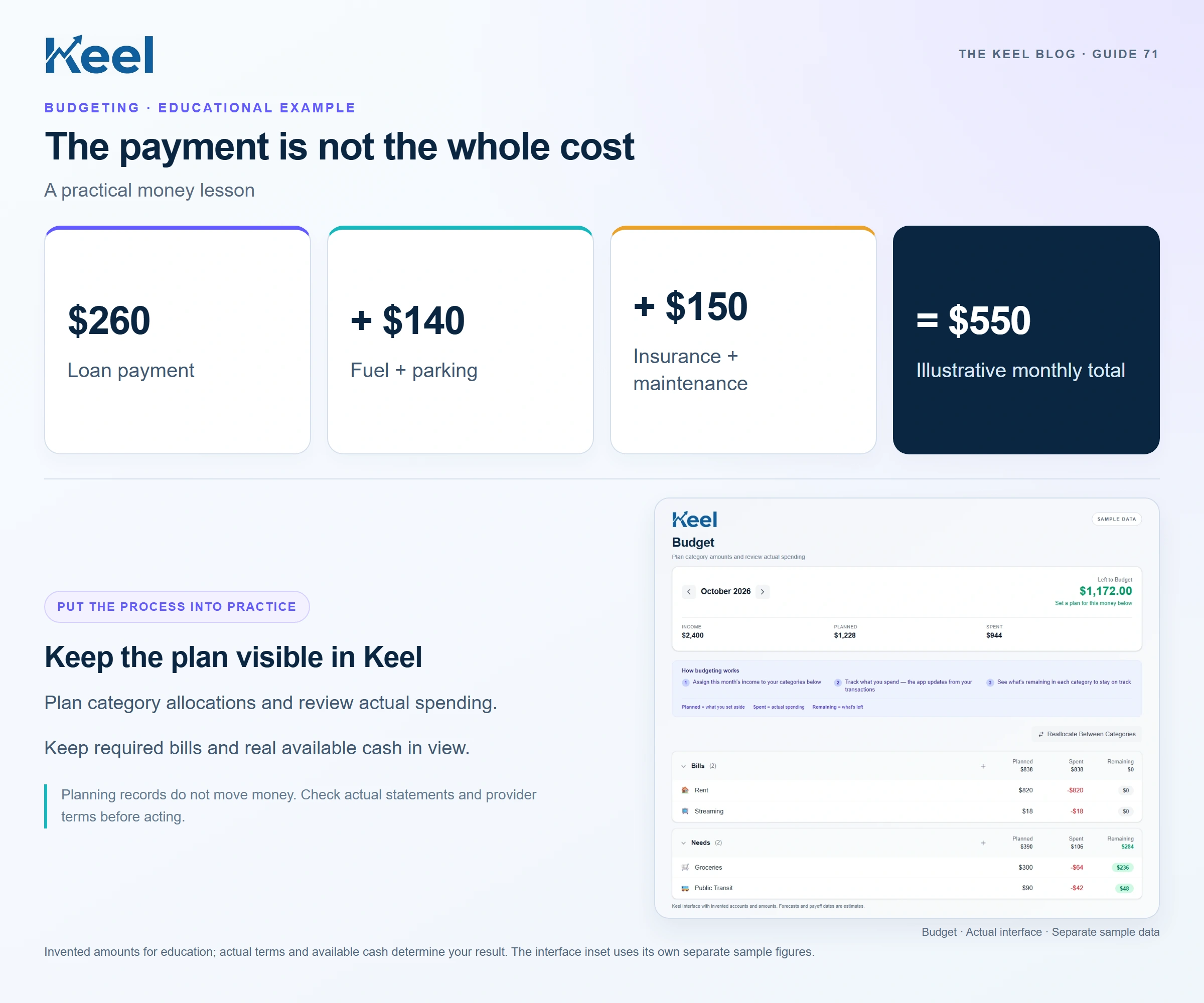
An invented $260 vehicle payment, $140 fuel and parking, and $150 insurance and maintenance allocation total $550. That is not a market estimate or a recommendation. Compare the same period and duties for alternatives, and identify which costs would truly disappear if you changed transport.
| Component | Amount |
|---|---|
| Payment | $260 |
| Fuel and parking | $140 |
| Insurance and maintenance allocation | $150 |
| Total | $550 |
Use Keel to see the connected costs
Review the relevant categories in Budgets and actual Transactions. Use Bills for confirmed payments and Savings for funded irregular costs. Inspect the forecast before a new recurring commitment. Keel does not quote insurance, value vehicles, plan routes or certify that an alternative meets your needs. Gather those details from the relevant providers.
Recheck when a major term changes
A new job location, insurance renewal or loan payoff changes the comparison. Keep sunk costs separate from future costs you can still influence. Verify cancellation or payoff conditions before counting a cost as eliminated. The goal is an affordable transport system over time, rather than the smallest number on one monthly bill.
Footnotes and sources
U.S. consumer education. Sources checked . General education, not an individual financial or legal recommendation.