
Build a Spending Plan Around What Matters
Name your priorities, protect essential obligations and choose affordable spending you value instead of treating every optional purchase as a failure.
By Keel · Budgeting ·
Free 7-day trial. No card required. Subscribe for $4.99/month to continue; no charge unless you subscribe.
Name the experiences or outcomes you value
Ramit Sethi’s Conscious Spending approach connects financial priorities with intentional room for enjoyment. The useful question is which spending contributes to the life you want, after obligations and future needs are considered. Identify two or three priorities in your own words. Avoid copying another household’s definition of a worthwhile purchase.[1]
Keep constraints visible
Values guide tradeoffs inside a real budget. They do not create cash or change a contract. List essential costs and required payments, then decide what remains for chosen wants and goals. A clear spending rule can be adapted to circumstances rather than treated as a moral ranking of people with different housing, health or caregiving costs.[2]
Redirect a low-value cost
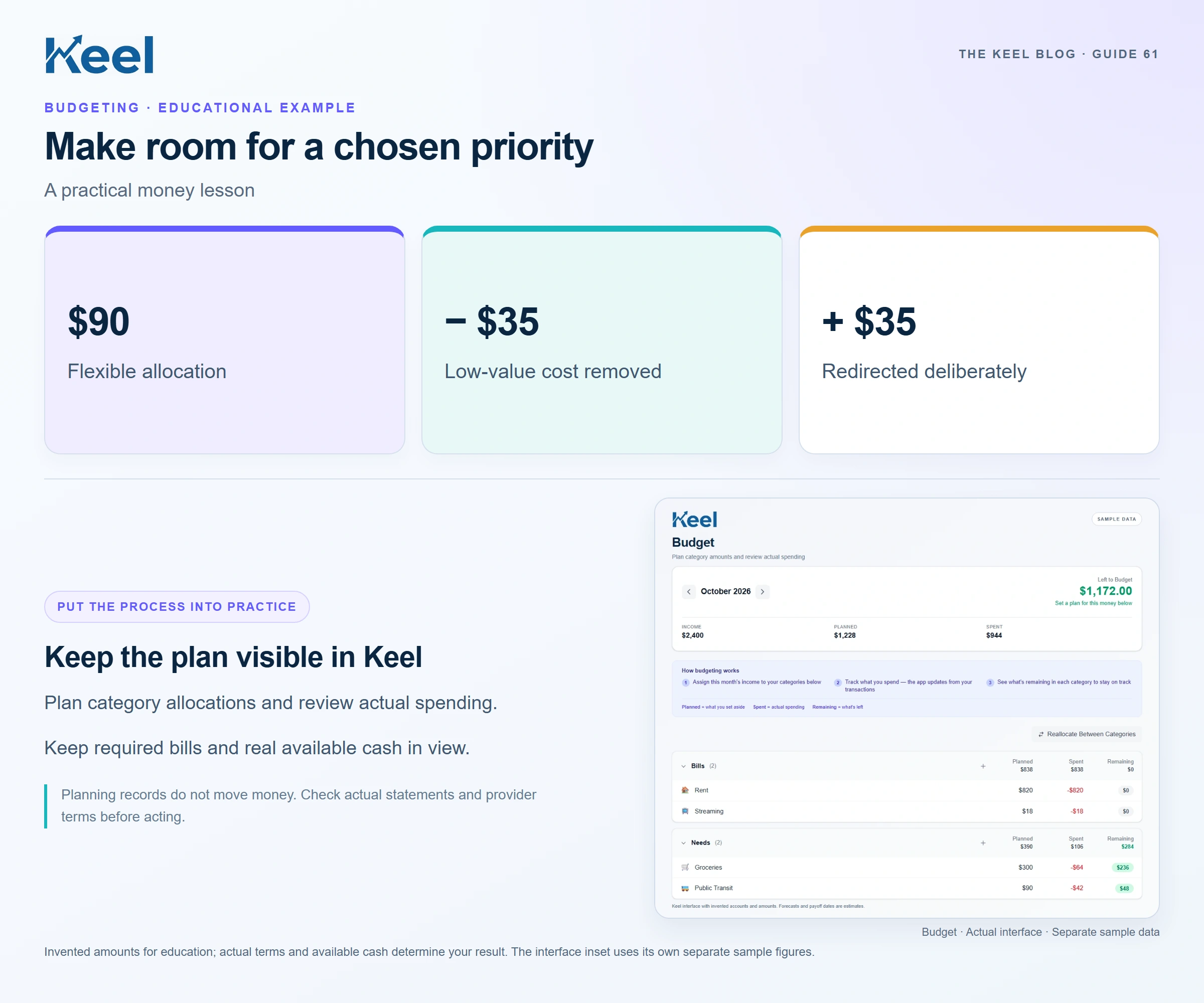
Suppose an invented $90 flexible allocation includes a $35 cost you no longer value. Removing it can free $35 for a priority within the same total. It does not make the allocation $125. Confirm any merchant cancellation before counting recurring savings. If another essential cost rises, the redirect may need to wait.
| Use | Before | After |
|---|---|---|
| Low-value cost | $35 | $0 |
| Chosen priority | $55 | $90 |
| Total | $90 | $90 |
Use Keel to compare intention with activity
Review Transactions and category budgets to see where money actually went. Use Savings for a funded priority with a future date, and Bills for its confirmed obligations. Keel does not determine your values or automatically apply Sethi’s framework. It provides records and planning views you can use to assess the choices.
Review without rewriting the past
Ask whether the purchase delivered what you expected and whether the allocation remains affordable. Keep accurate transactions even when the answer is disappointing. A useful review produces one change for the next cycle. Intentional enjoyment and financial progress can coexist when the same dollar is not promised to both a bill and a want.
Footnotes and sources
U.S. consumer education. Sources checked . General education, not an individual financial or legal recommendation.