
Should You Pay Debt Weekly or Monthly?
Compare payment timing without confusing smaller installments with extra repayment, and check lender rules before changing your payment routine.
By Keel · Debt planning ·
Free 7-day trial. No card required. Subscribe for $4.99/month to continue; no charge unless you subscribe.
Separate timing from the amount paid
Paying more frequently can suit a paycheck schedule, but it does not automatically mean you pay more overall. Compare annual totals and check whether the lender credits partial payments immediately or holds them. The CFPB advises checking how loan payments are applied; a planning preference cannot override the servicing rules or the amount due.[1]
Check the interest method
For balances that accrue interest daily, earlier principal reduction may affect interest. The size of the effect depends on terms, posting and the balance. Not every loan uses the same method, and fees or a prepayment penalty may change the decision. Ask the servicer rather than assuming a weekly schedule always produces a quoted savings amount.[2] [3]
Compare the right totals
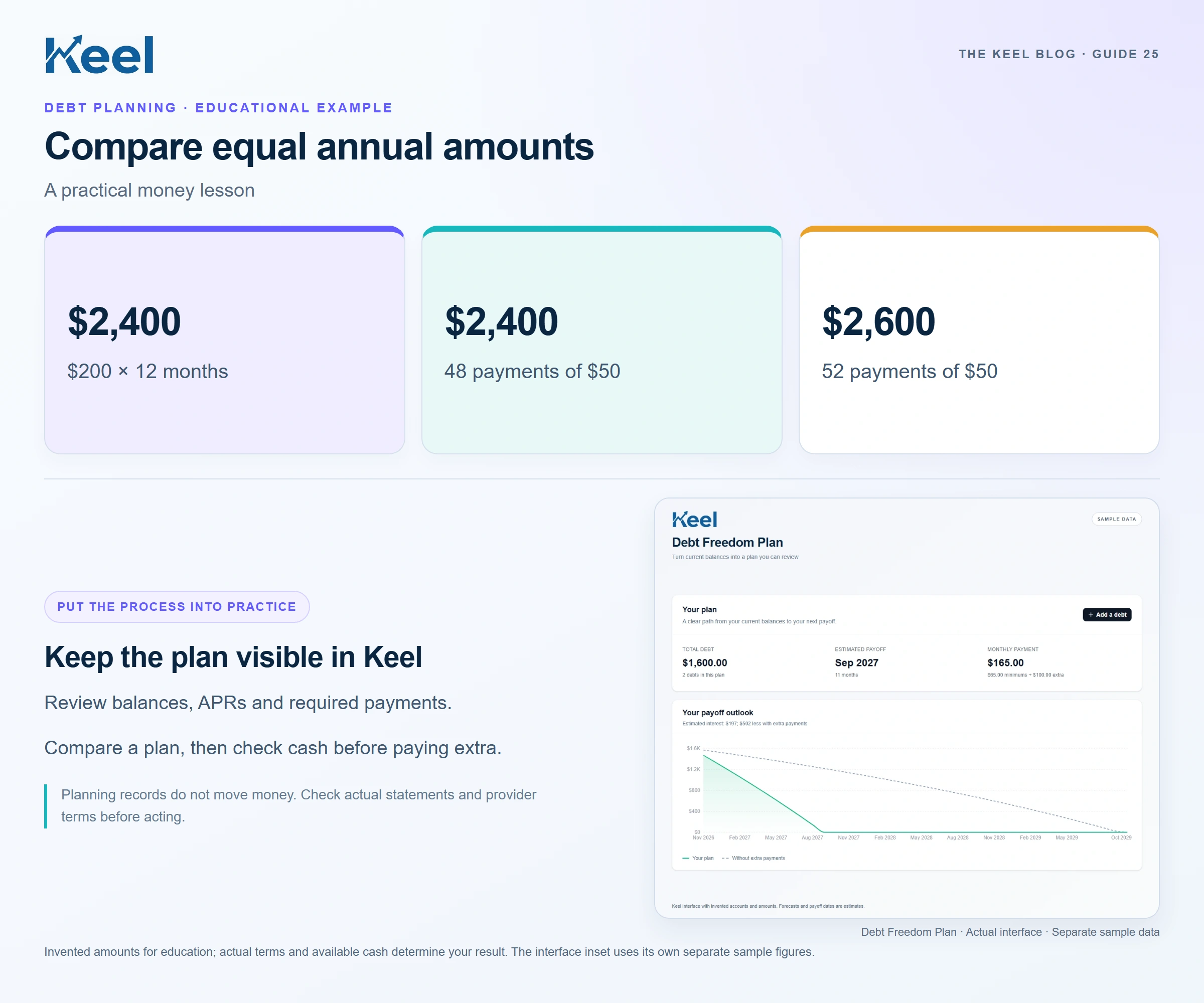
Twelve $200 payments total $2,400. Forty-eight $50 payments also total $2,400. Paying $50 every week for fifty-two weeks totals $2,600, which is $200 more. An improvement from the last schedule may reflect more money paid, different timing, or both. These figures compare contributions only, without an interest simulation.
| Schedule | Annual total |
|---|---|
| 12 × $200 | $2,400 |
| 48 × $50 | $2,400 |
| 52 × $50 | $2,600 |
Use Keel for the surrounding cash plan
Review debt balances and required payments in Debt, then inspect Bills and the cash forecast around actual lender due dates. If you need to track unusual payment dates, use accurate individual bill records rather than assuming a monthly calendar entry creates a weekly schedule. Keel does not establish a new payment arrangement with your lender.
Test the first cycle carefully
Confirm the lender received enough by the contractual deadline. Avoid a late fee because four small payments were mistaken for a satisfied monthly requirement. Check whether a manual payment changes the next automatic debit. Keep a record of what you authorized and adjust the routine only after its cash and servicing effects are clear.
Footnotes and sources
U.S. consumer education. Sources checked . General education, not an individual financial or legal recommendation.