
Use a Bonus or Windfall Without Creating a Cash Gap
Give a one-time deposit a deliberate job across overdue needs, reserves and debt, then verify what is actually available before making a large payment.
By Keel · Debt planning ·
Free 7-day trial. No card required. Subscribe for $4.99/month to continue; no charge unless you subscribe.
Start with spendable money, not the announcement
A bonus, gift, refund or sale can create an opportunity, but the gross amount may not equal available cash. Confirm the deposit and any costs or obligations associated with it. The CFPB identifies one-time income as an opportunity to build reserves. Do not commit the same expected deposit to several goals before it is available.[1]
Check urgent needs before accelerating repayment
Review essentials due before the next normal paycheck and any arrears with serious consequences. A large card payment can look productive while leaving housing or transport unfunded. When choices are tight, consider consequences rather than using the repayment order alone. Keep ongoing required payments separate from the optional use of this one-time amount.[2]
Allocate an invented $900 deposit
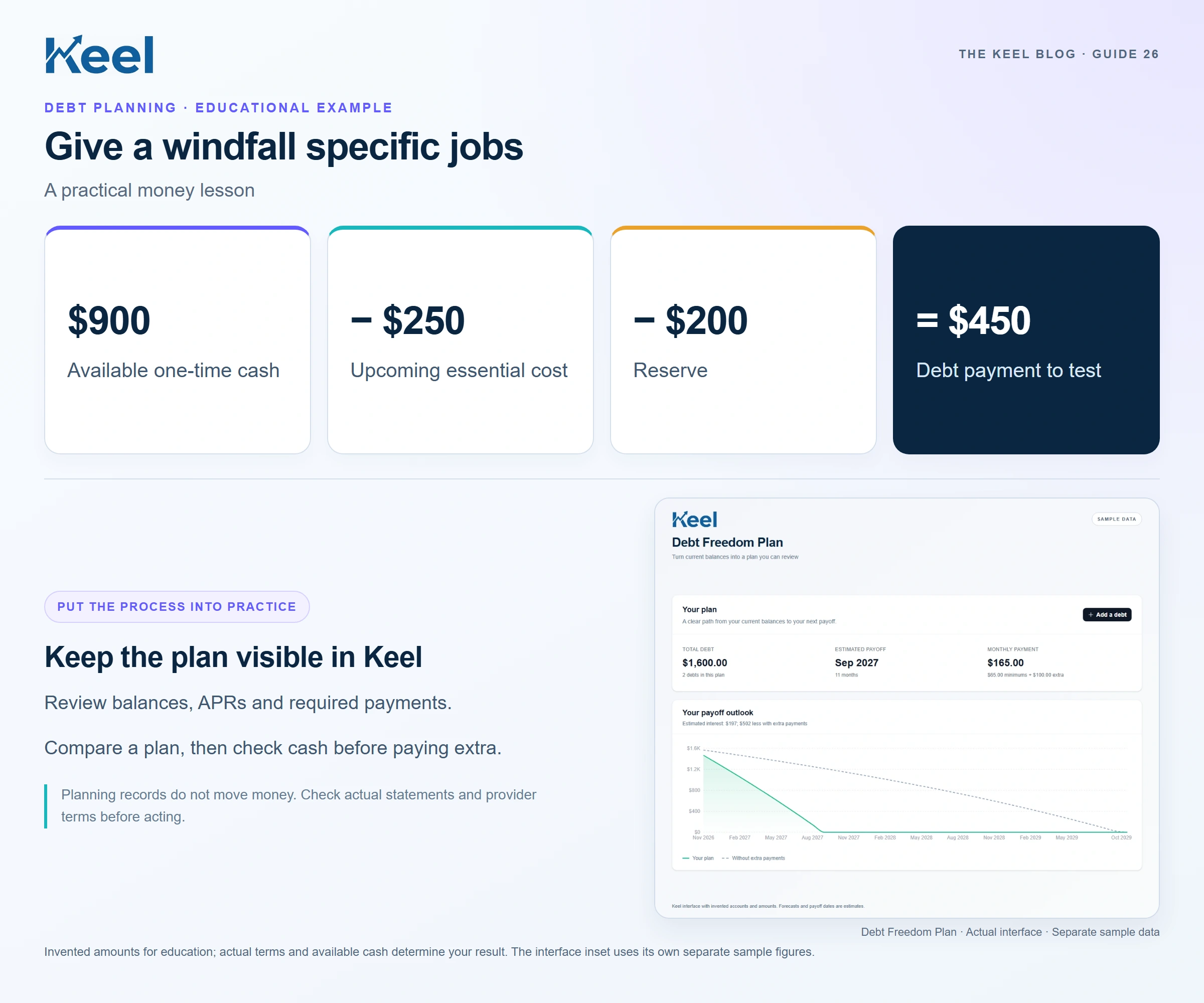
Suppose $900 is available after relevant deductions. Covering a $250 essential cost and reserving $200 leaves $450 for a debt payment to test. The allocation uses the deposit once. It does not establish that $450 is available every month or that $450 will all reduce principal; lender interest and charges still matter.
| Job | Amount |
|---|---|
| Essential cost | $250 |
| Reserve | $200 |
| Possible debt payment | $450 |
| Total | $900 |
Compare the scenario in Keel
Review your debt inputs, test a one-time amount where the debt planning controls support a lump-sum scenario, and compare the outlook with the current plan. Use the cash forecast to check the aftermath. If the deposit is already in the starting balance, avoid also listing it as future income. Keel’s scenario does not add money to an account.
Verify and record what happened
Send an affordable payment through the lender and check the next balance. Update funded savings records only after cash is actually set aside. Keep a deliberate portion for a chosen purchase if that fits the plan, rather than spending repeatedly against the memory of receiving extra money. Return the next month’s budget to ordinary income.
Footnotes and sources
U.S. consumer education. Sources checked . General education, not an individual financial or legal recommendation.