
Give every available dollar a job with a zero-based budget
Zero left to assign should mean a complete plan, not an empty bank account.
By Keel · Budgeting ·
Free 7-day trial. No card required. Subscribe for $4.99/month to continue; no charge unless you subscribe.
Separate your plan from your bank balance
A zero-based budget assigns all the money in the plan to specific purposes. Those purposes include bills, everyday spending, saving and a buffer. A bank account can still hold substantial cash after every dollar has a job. Consumer.gov and the CFPB describe the underlying habit: list income and expenses, make a realistic plan, and compare it with what happens. Zero-based budgeting adds an explicit check for money that has not yet been assigned.[1] [2]
Choose the period and the funds it can use
You can plan a month, a pay cycle or the period until the next reliable deposit. Be clear about which money is already available and which income is only expected. Do not allocate the same reserve as both this week’s grocery money and next month’s insurance money. If using a monthly income forecast, also maintain a cash-flow check so the plan does not spend money before it arrives. An allocation is a decision, not a deposit.
Build a complete example
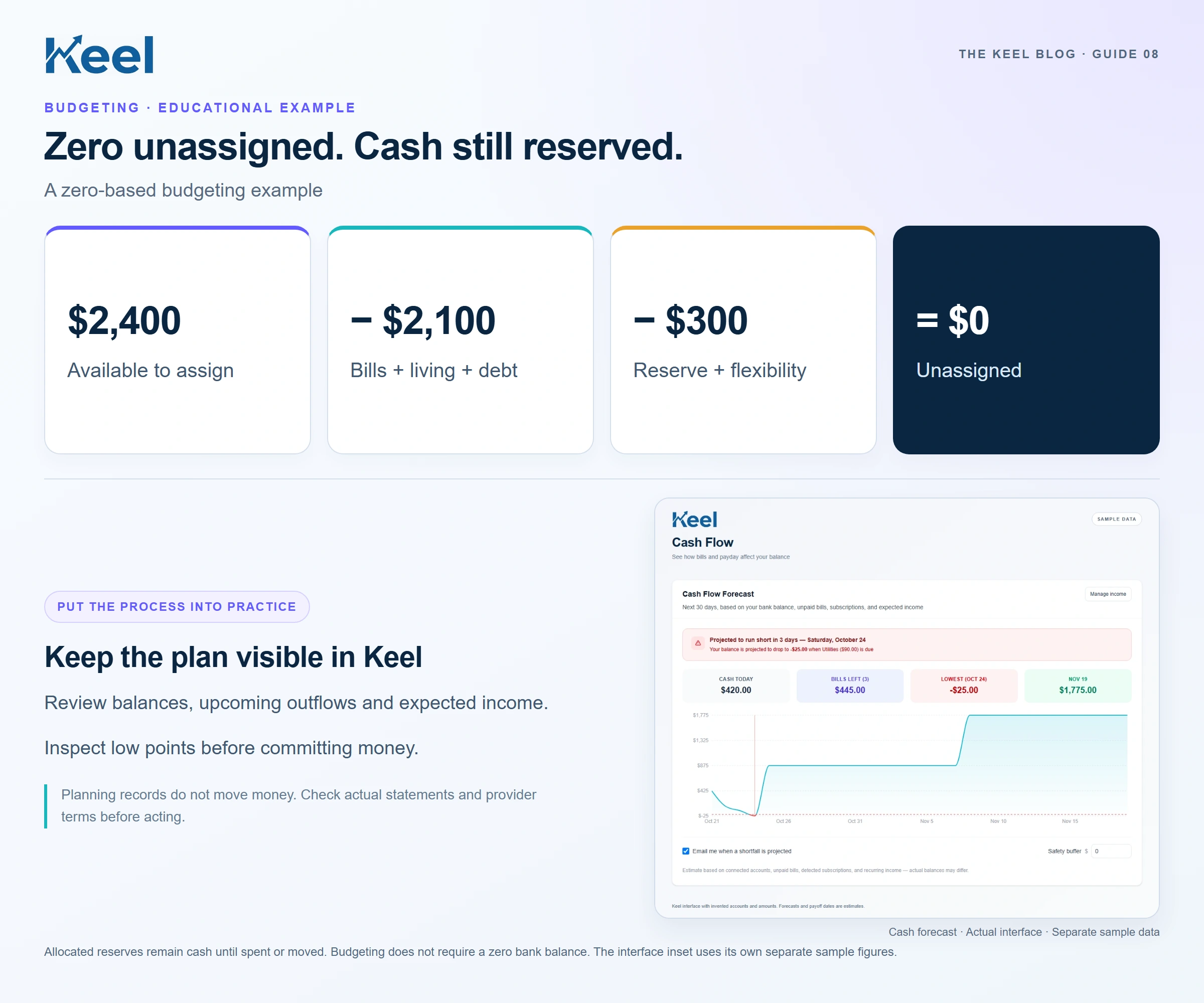
Suppose $2,400 is available for the period. Assign $1,300 to bills, $500 to food and transport, $300 to required debt payments, $200 to a reserve and $100 to flexibility. These jobs total $2,400, leaving zero unassigned. The reserve remains available for its stated purpose rather than being spent to satisfy the formula. This invented example excludes any interest earned and assumes the listed money is available before the expenses fall due.
| Job | Allocation |
|---|---|
| Bills | $1,300 |
| Food and transport | $500 |
| Required debt payments | $300 |
| Reserve | $200 |
| Flexibility | $100 |
| Total assigned | $2,400 |
| Unassigned | $0 |
Make tradeoffs explicit when something changes
If groceries need another $40, choose where that $40 comes from. A flexible category might have room; a contractual payment might not. Update the plan before treating overspending as invisible. If there is no safe place to reduce another allocation, recognize the shortfall and investigate a real change such as additional income or a provider-approved arrangement. Constantly reallocating essential bills to cover other essentials is evidence of a structural gap, not a spreadsheet problem.
Use Keel to maintain the allocations
Create category budgets in Keel, review the transactions assigned to them and adjust the plan deliberately. Use Savings to record genuinely funded goals separately from spending allowances. Keel’s budgets and goal records help organize decisions; they do not automatically divide money into bank envelopes or transfer cash. Reconcile the overall plan with actual account balances, especially when some money is reserved for a purpose outside the current month.
Keep a weekly check and a month-end reset
Each week, check new transactions, remaining allocations and the next set of bill dates. Pair the Bills calendar with the cash forecast before directing more money to debt. At the end of the period, distinguish a timing difference from a true spending change. Carry forward real reserves deliberately and use new information to create the next plan. The aim is a repeatable decision process, not a prediction that never needs revision.
Footnotes and sources
U.S. consumer education. Sources checked . General education, not an individual financial or legal recommendation.